

The session ends, the muscles feel heavy, and a seductive promise appears: neutralize free radicals to speed recovery. The problem is that some of these molecules also carry the signal that teaches the body to respond better to the next training session.
This is the central tension in the new International Society of Sports Nutrition (ISSN) position stand. Antioxidants may help when stress exceeds recovery capacity. In another setting—especially at chronically high doses—they may reduce signals involved in adaptation.
The useful question, then, is not “do antioxidants work?” It is more specific: which compound, for which purpose, in which phase, at what dose, and in response to what real need?
The document offers a sound contextual guide and a consistent case for food as the foundation. Its supplement table, however, is the authors’ narrative classification: useful for framing questions, but insufficient for copying doses or setting a universal prescription.

The paper is real, official, and must be read in light of its design
The reference is confirmed: this is an official ISSN position stand, published in February 2026 with open full text, a DOI, and a PubMed record. The document covers redox biology, food sources, 25 compounds or supplement classes, and special populations.
But it is not a systematic review. The method describes an invited article, prepared by experts, reviewed by researchers and approved by the society's committee. It does not present a reproducible search strategy, formal inclusion criteria, duplicate selection, structured assessment of the risk of bias or certainty by GRADE.
That does not invalidate the position stand. It determines how much weight it should receive. The paper offers breadth, expertise, and integration of an extensive literature base; it provides less assurance that every relevant study was selected and weighted with the same rigor.
Free radicals are not only damage: they are also signals
During exercise, reactive oxygen and nitrogen species increase. In excess and for a prolonged period of time, they can contribute to molecular damage, inflammation, fatigue, worsening immune function and slower recovery. This is the known part of the story.
The part often left out is that low to moderate levels participate in signaling. They help activate endogenous antioxidant defenses, mitochondrial biogenesis, muscle repair and remodeling. The body learns to tolerate stress better because it has been exposed to a disturbance that it has managed to resolve.
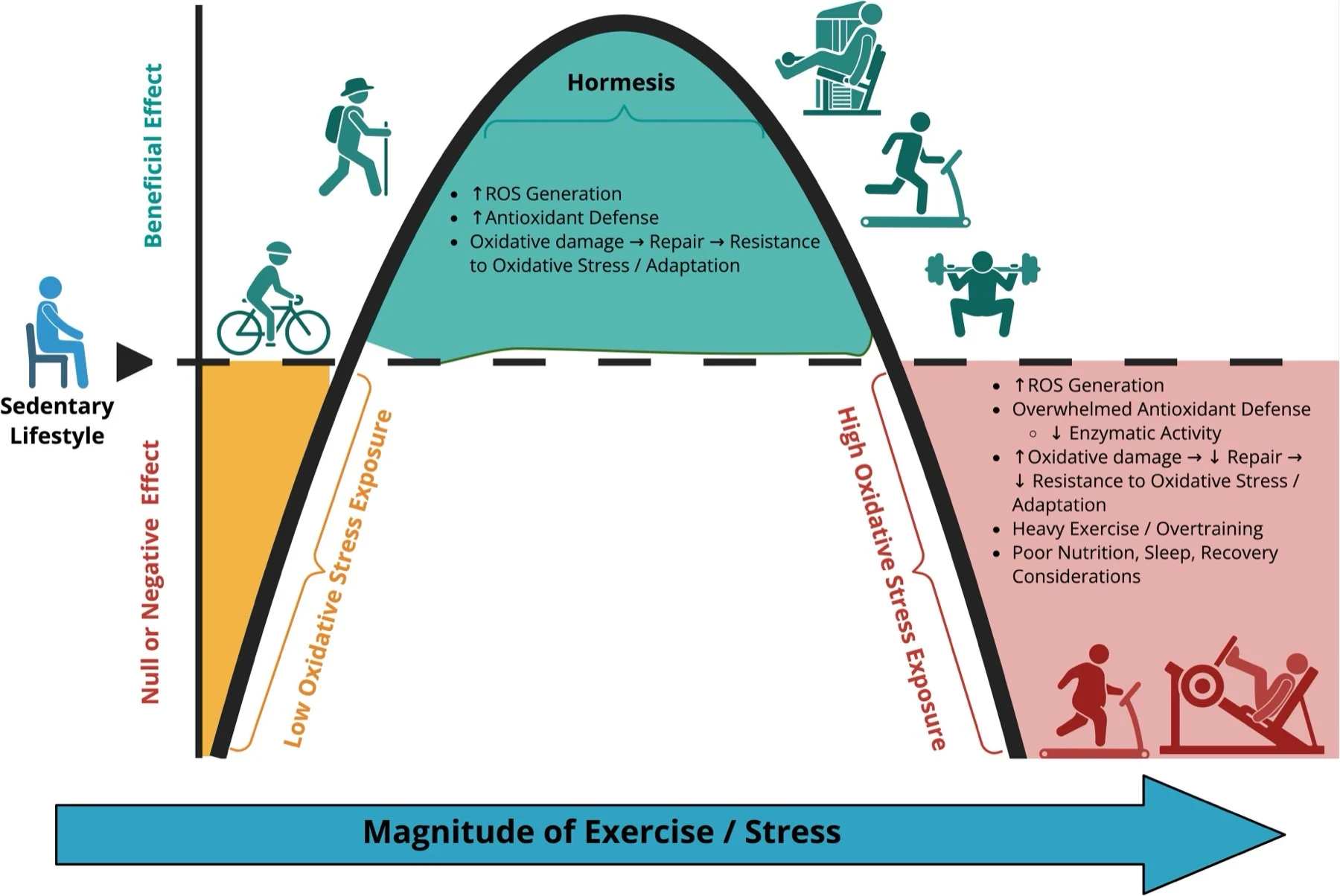
This curve explains why “more antioxidant” does not automatically mean “better recovery”. If the intervention reduces excessive stress, it may be helpful. If a signal that the athlete had the capacity to resolve is indiscriminately erased, it can interfere with the process that the training sought to build.
The target is not to eliminate oxidative stress. It is to keep the disturbance within a range that the athlete can resolve and transform into adaptation.
How the ideas connect
Consensus is stronger on strategy than ranking
The ten ISSN conclusions converge on four defensible principles: regular training strengthens endogenous antioxidant defenses; food should be the priority source; supplements make more sense when intake is insufficient, the diet is inadequate, or stress is unusually high; and the response depends on training, diet, age, sex, environment, dose, form, and timing.
Classifying these compounds requires more nuance. Table 2 separates performance evidence from antioxidant evidence, yet the final conclusion groups creatine, omega-3, tart cherry, and astaxanthin as standout options. That synthesis can obscure how different the evidence and role of each one actually are.
Creatine
Creatine has strong support as an ergogenic aid. The position stand itself describes antioxidant activity as an additional benefit supported by few human studies and mixed findings.
Do not justify it by a secondary mechanismTart cherry
A 2026 meta-analysis found improvement of some functional and CRP markers, but not pain, CK, IL-6, TNF-α, or range of motion. Heterogeneity was high and certainty ranged from very low to moderate.
Useful signal, not universal effectOmega-3
A 2026 review found favorable signals after muscle damage alongside important methodological limitations. The authors could not establish an effective dose—an important contrast with the broad range reported in the position stand.
Context and baseline status matterAstaxanthin
Meta-analyses published after acceptance of the consensus suggest an effect on some markers of damage or oxidation, but do not demonstrate consistent improvement in VO₂max, time trial, maximum load or power.
Promising for recovery; uncertain for performanceVitamins C and E illustrate the same need for precision. High-dose trials found attenuation of cellular markers linked to mitochondrial biogenesis. A meta-analysis of trials, however, found no significant impairment in VO₂max, endurance, lean mass, or strength. The molecular signal warrants caution; it does not justify claiming that all vitamin supplementation undermines training outcomes.
Scientific scrutiny changes what we can recommend
The “low”, “moderate” and “high” categories were assigned by the author team. Without a systematic search, risk of bias per study and GRADE, they do not equate to formal certainty of the body of evidence.
Reducing malondialdehyde, creatine kinase, or a cytokine does not guarantee perceived recovery, ability to train better, chronic adaptation, or competitive performance.
Some of the antioxidant evidence comes from clinical or untrained populations. The mechanism may be relevant, but application to a healthy athlete is not automatic.
A trial cited in the omega-3 section is identified in the bibliography itself as retracted. This reinforces why a narrative count of studies cannot replace quality assessment and sensitivity analysis.
Several authors disclose supplement-related funding; the declarations also include consulting, a patent application, industry ties, and a coauthor employed by AstaReal. The article itself received no funding. A conflict does not invalidate a finding, but it calls for closer scrutiny, especially when the product under discussion matches the disclosed relationship.
Table 2 itself acknowledges that some dose ranges are broad and reflect the full set of studies, not the best-supported dose. One example is especially instructive: the table lists 50–100 mg/day of zinc for 2–16 weeks, whereas the tolerable upper intake level for healthy adults is 40 mg/day. The NIH warns that 50 mg or more for weeks can interfere with copper absorption, reduce immune function, and lower HDL cholesterol.
A research range is not a prescribing range. Chemical form, dietary intake, nutritional status, duration, medications, adverse events, and supervision all change risk.
From concept to decision
A better decision process than a simple “take it or skip it” question
Explanatory visual created for this analysis
Start with need
Is there a deficiency, insufficient intake, dietary restriction or a real period of stress beyond the capacity to recover? If not, the supplement already starts with a weak justification.
Define the role of the intervention
Is the objective to accelerate recovery between competitions, correct a gap, sustain health or promote chronic adaptation? The same compound does not deserve the same decision in all these scenarios.
Demand evidence for the right outcome
Oxidative marker, pain, strength return, availability to train and performance are different results. Seek support for what really needs to change.
Periodize and monitor
Use the smallest defensible intervention during the period in which the benefit matters, and track tolerance, diet, recovery, and performance. Reassess when the schedule or goal changes.
- Development blockWithout a deficiency or clinical indication, avoid making chronic high doses of vitamins C and E routine around sessions intended to drive adaptation.
- Congested calendarWhen restoring function within hours or days is the priority, a polyphenol-rich dietary strategy—and, in selected cases, tart cherry—may offer better alignment among mechanism, evidence, and purpose.
- Incomplete dietCorrect energy availability, carbohydrate and protein intake, fruit and vegetable intake, sleep, and micronutrient status before treating an antioxidant blend as compensation for an inadequate foundation.
- Creatine and omega-3Decide by main benefits, nutritional status, usual intake and individual context. The word “antioxidant” should not be the central argument.
For athletes subject to doping control, there is another independent layer: product quality and traceability. A compound may be permitted while the supplement still carries a contamination risk. The decision must include batch certification and the athlete’s strict liability.
Antioxidants: too much protection also comes at a cost
- Free radicals are not only damage: they are also signals
- Consensus is stronger on strategy than ranking
- A better decision process than a simple “take it or skip it” question
Recovery is about removing what gets in the way — not everything that signals
The greatest strength of the ISSN position stand is that it moves antioxidants beyond binary thinking. They are neither universal protectors nor inevitable enemies of adaptation. Their effects depend on what is consumed, by whom, at what dose, for how long, and in response to which demand.
A critical reading adds a necessary restraint: the consensus framework is more reliable than its exact ranking and dose ranges. Reviews published after the paper was accepted already make some conclusions less certain, especially for astaxanthin, omega-3, and tart cherry.
In high performance, a mature decision does not chase the lowest possible inflammatory marker. It pursues enough recovery to meet the next training demand without overprotecting the athlete from the signal that needed to be learned.
Verified references
Usage Note: educational content. The assessment of diet, deficiency, dose, interactions, clinical risk and product quality needs to be individualized. For athletes subject to anti-doping, also check the current list and batch traceability.