

The paper's most provocative number isn't 90 or 120. It's 10. The review proposes that about 10 grams of carbohydrate per hour could support blood glucose levels and preserve prolonged exercise performance.
Read without attention to method, this conclusion can make decades of recommendations appear to have collapsed. Once study design enters the discussion, the interpretation changes: the paper offers a relevant physiological hypothesis, identifies questions the literature has handled poorly, and challenges the idea that more carbohydrate always produces more performance. But it does not show that 10 g/h is sufficient for every athlete, sport, intensity, or duration.
The point is not to defend a high dose out of tradition. It is to avoid replacing one automatic rule with another.
The paper reinforces the importance of blood glucose and liver glycogen in prolonged fatigue. The claim that exercise-induced hypoglycemia is the primary mechanism remains plausible, not proven. The 10 g/h dose comes mainly from a small, specific fasted trial; it was not compared directly with 30, 60, or 90 g/h. It therefore does not replace current guidelines.
The paper changes the question before changing the dose
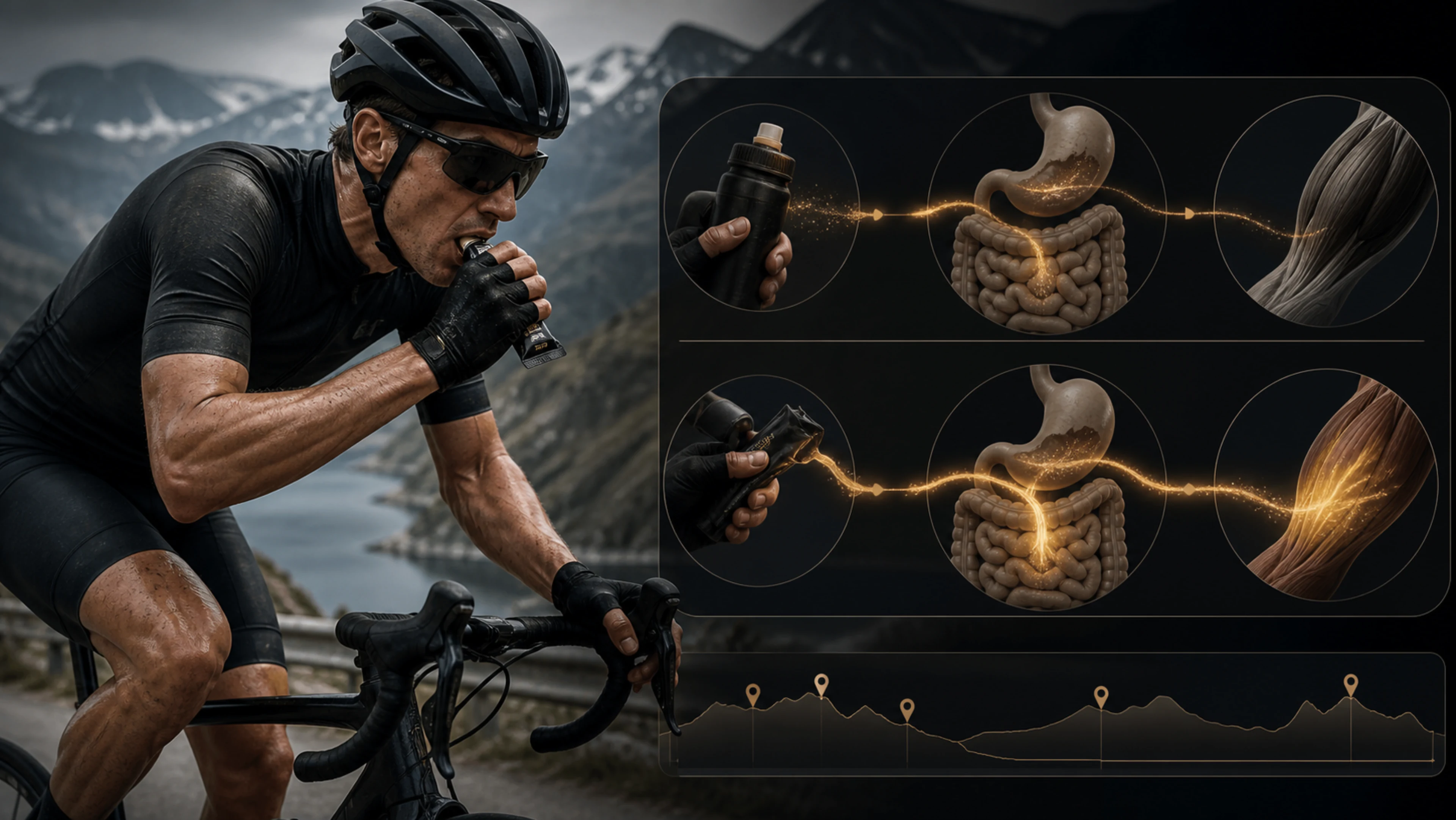
Noakes and collaborators reviewed more than a century of literature and organized 16 lines of evidence to confront the classical model. Instead of attributing the benefit of carbohydrate primarily to providing substrate to the muscle and preserving glycogen, they place at the center a “small pool of glucose”: blood glucose and liver glycogen.
The logic is this: when hepatic glucose production no longer keeps pace with use during prolonged exercise, blood glucose falls. The nervous system would reduce muscle recruitment and pace before dangerous neuroglycopenia develops. Carbohydrate intake would help because it prevents this decline, not because the muscle is necessarily out of fuel.
Carbohydrate intake can improve endurance
Meta-analyses find average benefit, especially in longer efforts. The effect is usually greater in tests to exhaustion than in time trials.
Liver and blood glucose matter
Maintaining glucose availability for the nervous system and for prolonged exercise is a real part of the phenomenon, not a secondary detail.
Glycemia explains the main effect
The association among falling blood glucose, fatigue, and the response to carbohydrate does not isolate causality or exclude muscle glycogen, perception, heat, and other mechanisms.
10 g/h works for everyone
It has not been tested. An effective dose in a specific protocol does not establish equivalence with higher doses nor define the lowest dose for other situations.
The contribution of the paper is to force science to take a better look at blood glucose. The mistake would be to transform this lens into single explanation.
‘Blood glucose fell’ is not automatically synonymous with clinical hypoglycemia
For the retrospective analysis, the authors classified any reduction greater than 0.1 mmol/L in relation to baseline as a “drop in blood glucose indicating the development of exercise-induced hypoglycemia”. They recognize that the medical definition usually uses values below 3.9 mmol/L and report that, in the majority of classified studies, the drop was greater than 0.3 mmol/L.
This choice greatly expands the number of cases. Blood glucose that moves from 5.2 to 5.0 mmol/L remains within the normal range, yet it enters the same analytical category as a decline to clinically low values. The trend may be physiologically relevant; the point is that a trend, a clinical threshold, and a symptom are not the same variable.
There is still a causal problem. Fasting, duration, intensity, liver glycogen and carbohydrate intake simultaneously affect blood glucose and performance. Finding more benefit from carbohydrates when blood glucose drops in the placebo group is compatible with the authors' hypothesis, but does not prove that this drop is the dominant cause.
The numbers in the central table do not add up — and that needs to be said
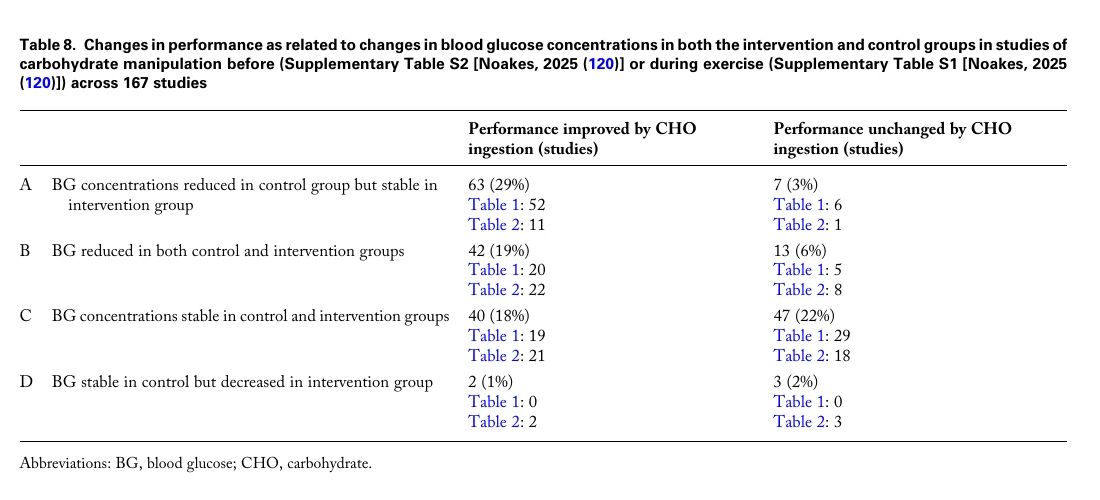
Table 8 is central to the argument. It cross-tabulates falling or stable blood glucose in the control and intervention groups with improved or unchanged performance. The problem is that the report contains two verifiable inconsistencies.
What the table itself shows
Audit of published numbersThese discrepancies do not alone refute the biological hypothesis. They reduce confidence in quantitative synthesis and call for correction or explanation — including whether “studies,” “conditions,” and “comparisons” were used as different units.
The supplementary material is public, which is a strength of transparency. At the same time, the review is narrative: it does not present a reproducible search strategy, duplicate selection, formal assessment of risk of bias, or meta-analysis with effect sizes. Counting heterogeneous studies is not equivalent to estimating the combined effect or controlling quality, sample size and dependence between comparisons.
Where do the 10 g/h come from?
The most cited data comes from a 2025 randomized crossover trial with ten trained male triathletes. Each participant followed a diet rich or very low in carbohydrates for six weeks. In the final test, he cycled at 70% of VO₂max until exhaustion after 15 hours of fasting, receiving placebo or approximately 10 g/h of maltodextrin.
A strong result within a narrow scenario
Prins and colleagues, 2025.
The small dose eliminated values below 3.9 mmol/L and increased the time to exhaustion by around 22%, regardless of diet. The study did not include women, fed status, actual time trials, team sports, or comparisons with 30–90 g/h.
This design was excellent for causing hypoglycemia and testing whether a small dose could prevent it. Precisely for this reason, its external validity is limited. A test to exhaustion also tends to produce larger percentage effects than a time trial; 22% more sustained time does not mean 22% more speed in competition.
The result demonstrates sufficiency relative to placebo in that protocol. It does not show that 10 g/h is equivalent to 30, 60, or 90 g/h, because those doses were not included. ‘It worked’ and ‘it is the best or lowest universal dose’ are different claims.
How the ideas connect
What the broader syntheses show
A systematic review with meta-analysis and meta-regression published in 2024 brought together 136 studies and found significant improvement in performance with acute carbohydrate intake. The effect was greater in tests until exhaustion, in longer efforts and in less trained participants. Dose did not appear to be a significant moderator of the average effect.
This does not prove that all doses are equivalent. Meta-regression without association may reflect heterogeneity, few studies in each range, different protocols and poor ability to separate dose from context. It weakens the idea of a simple curve in which “more is always better”, but does not define 10 g/h as the optimum point.
An umbrella review published in 2026 included 15 reviews, 262 randomized trials, and 521 comparisons. It found a favorable signal especially for efforts lasting one to four hours and for carbohydrate combinations, but rated 73% of the reviews as low or critically low quality. A benefit is likely; precision about when and how much remains lower than confident headlines suggest.
In practice, the dose responds to the work
The Brazilian Sports Nutrition Association clinical guideline, published in 2025 using GRADE methodology, recommends individualization by duration, intensity, goal, gastrointestinal tolerance, and logistics. It maintains 30–60 g/h for efforts longer than 75 minutes and up to 90 g/h from mixed sources beyond 2.5 hours.
| Scenario | More defensible reading | What 10 g/h does not resolve |
|---|---|---|
| Up to 60–75 min | The need during exercise is variable and depends on the initial state, intensity and objective. | They do not create an obligation when the session does not require fueling. |
| More than 75 minutes | The Brazilian guideline uses 30–60 g/h as a reference range, adjusted to the context. | They were not directly compared to this range in the key trial. |
| More than 2.5 hours | Up to 90 g/h of mixed sources can be considered, with progression and gastrointestinal training. | They are not shown to sustain increased competitive demand or subsequent recovery. |
| Team sports | Intermittent efforts, decision-making, breaks, and the competition schedule require their own interpretation. | They cannot be generalized from a continuous cycling test to exhaustion. |
| Athlete with symptoms | Document food intake, blood glucose when indicated, duration, intensity, and symptoms; investigate recurrence. | They do not replace clinical evaluation nor do they treat every cause of decreased performance. |
Ranges from the 2025 ABNE Clinical Practice Guideline. Application should be tested in training and adapted to the athlete, sport, and environment.
The lowest appropriate dose is not the lowest dose that maintains blood glucose levels in a test. It is the lowest dose that supports the intended work, tolerance, recovery and health within the real context.
Is 10 g/h enough? The right question is: for what effort?
- The paper changes the question before changing the dose
- Where do the 10 g/h come from?
- In practice, the dose responds to the work
What I would take into training and competition
- Define the demand before the dose.Duration, intensity, modality, prior nutrition, temperature, goal and recovery change the need.
- Separate maintaining blood glucose from supplying the entire system.Preventing hypoglycemia may be sufficient in one scenario; sustaining power, cognition, and recovery may require another strategy.
- Use the guidelines as a starting point.They structure the decision; they do not eliminate individualization or make the upper limit mandatory.
- Train the gut and the logistics.A dose only exists in practice when the athlete tolerates, transports and consumes it at the expected rate.
- Don't turn low intake into chronic low availability.Reducing carbohydrate during a session must not normalize low energy availability, inadequate recovery, or signs of REDs.
- Record the response.Pace, power, perception of effort, symptoms, blood glucose when clinically indicated and recovery help to review the strategy.
Conflicts of interest do not invalidate the paper — they raise the standard of scrutiny
The authors disclose relevant ties: low-carbohydrate books, royalties, equity holdings, and consulting for companies related to low-carbohydrate diets and metabolic health, as well as patents and commercial activities involving ketones. The article received open-access publication support and acknowledges funding that contributed to some of the research reviewed.
These ties do not make the data false. They make it even more important to distinguish results, interpretation, and recommendation, especially when the review reanalyzes historical studies through a strong thesis and includes the authors' own research as decisive evidence.
The Brazilian Sports Nutrition Association reached a similar interpretation: it recognized the hypothesis as thought-provoking and the criticism of universally high recommendations as legitimate, but warned that a narrative review does not confirm the causal primacy of hypoglycemia or justify applying carbohydrate restriction in practice without context.
The hypothesis deserves testing. The dose deserves context
The paper does an important service to the field: it reminds us that the liver, blood glucose and nervous system cannot disappear behind muscle glycogen and oxidation rates. It also challenges the tendency to convert gastrointestinal capacity or exogenous oxidation into an automatic promise of performance.
The next step is not to declare victory for 10 g/h. It is to design studies that directly compare doses, in men and women, fed and fasted, in time trials and competitions, measuring blood glucose, liver and muscle glycogen, oxidation, central response, symptoms and recovery.
Until then, the most advanced conclusion remains contextual: there is no merit in consuming more carbohydrate than the work demands. There is also no merit in consuming less than the work requires.
Verified references
The main reference was confirmed in its final version; the full text, supplements, funding, declarations of interest, and editorial status were reviewed. No correction or retraction was identified as of August 16, 2026. The interpretation was checked against the 10 g/h trial, systematic syntheses, a clinical guideline, and the ABNE position statement.