There is an elegant mistake in high performance: assuming that raising the challenge will always raise performance.
In practice, a task can be too demanding for the capacity available at that moment. Attention stops serving the action in full and begins monitoring error, threat, judgment, and consequence. The opposite also carries a cost. When skill grows while the challenge stands still, the person no longer needs to mobilize everything they know. Execution may remain competent, but the mind starts looking elsewhere.
Between those extremes lies flow: a state of deep absorption in which action unfolds with intense focus, a sense of control, and less reflective self-consciousness. Psychologist Mihaly Csikszentmihalyi turned this experience into one of the most influential models in performance psychology.
The graph’s message is not “find the perfect point.” It is: continuously recalibrate what the situation requires and what the person can mobilize now.

How to read the graph without turning flow into a cliché
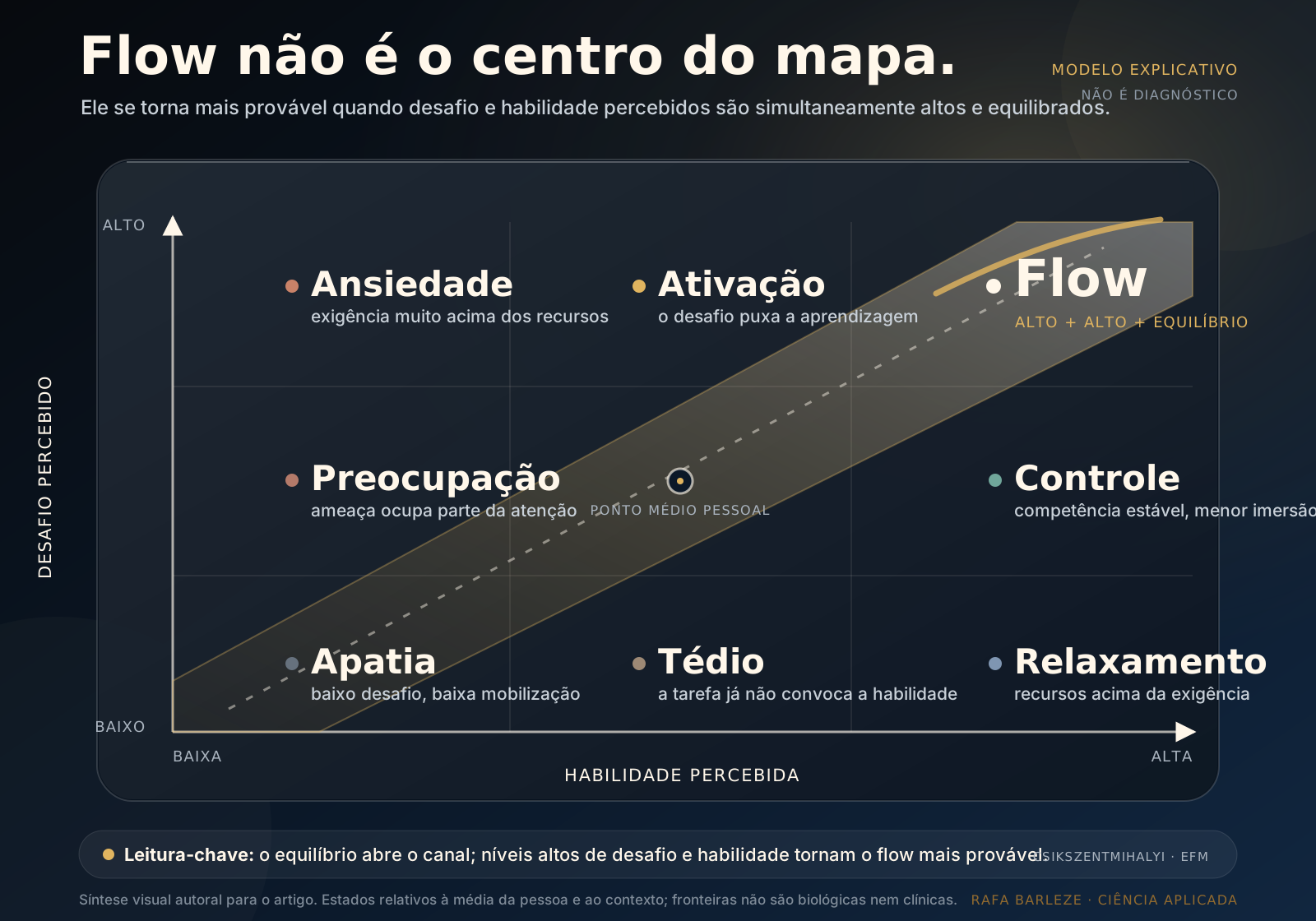
The vertical axis represents perceived challenge. The horizontal axis represents perceived skill. “Perceived” is the decisive word. The same final, meeting, surgery, or training session can occupy different coordinates for two people—or for the same person on different days.
The popular drawing often places flow in the “middle” between anxiety and boredom. That is partly correct, but incomplete. In the original model, the experience emerges along a channel where challenge and skill approach each other. Later developments showed that the most favorable profile appears when both are high and relatively balanced. Low challenge with low skill does not produce flow; it tends toward apathy.
Flow is not the geometric center of the map. It occupies the upper region of the diagonal: a habitable tension.
The demand exceeds the resources the person believes they possess.
It may open a learning window when support and room for error are available.
Competence and stability are present, although absorption may be lower.
Available capacity exceeds the demand, and the investment of attention declines.
Neither the demand nor perceived capacity calls forth meaningful involvement.
These names are heuristic coordinates, not labels for people. An athlete is not “an anxious person” because a task appears in the upper-left region. A professional is not “apathetic” because a project has lost meaning. The map describes a changing relationship between person, task, and context.
Balance is necessary, but it does not work alone
The literature often separates the conditions that favor flow from the characteristics felt during the experience.
Those conditions include challenge–skill balance, clear goals, and unambiguous feedback. During flow, people may experience intense concentration, a merging of action and awareness, a sense of control, reduced self-consciousness, altered subjective time, and an autotelic quality—the activity becomes rewarding in its own performance.
A broad scoping review published in 2022 confirmed the centrality of these ideas while also exposing a heterogeneous field. Definitions, scales, and study designs vary, and more experimental and longitudinal work is still needed to clarify causes and consequences.
Balancing difficulty and capacity does not guarantee flow. A task can be well calibrated and still fail because the goal is ambiguous, feedback arrives too late, the body is exhausted, the person fears punishment for error, or attention is interrupted every two minutes.
The graph provides the geometry. Context determines whether it can be inhabited.
How the ideas connect
Flow tracks performance. That does not prove it causes performance
A systematic review and meta-analysis pooled 22 studies involving sport and gaming tasks and found a moderate association between flow and performance: r = 0.31, 95% CI 0.24–0.38. The estimate was similar in the sport subgroup.
This supports relevance, not a causal promise. Most studies were correlational. Flow may improve execution; good execution may produce flow; the two may reinforce each other; or a third condition—preparation, confidence, clarity—may improve both. The authors also reported substantial heterogeneity across studies.
Another review examined 29 interventions in sport and exercise, including mindfulness, hypnosis, and imagery. Some dimensions improved, but no approach conclusively demonstrated that flow had been induced.
We can organize favorable conditions; we cannot press a psychological button.
When the self steps aside
Perhaps the most philosophical aspect of flow is the reduced need to watch oneself acting.
In ordinary life, one part of attention performs the task while another asks what that performance says about us. Am I doing well? Can they see my hesitation? What happens if I fail? During flow, this second layer becomes quieter. The person does not disappear; what disappears temporarily is the obligation to narrate their own presence.
Neurocognitive reviews propose that the organization of attention and reduced self-referential processing may help explain the sense of control without excessive conscious effort. In a laboratory study using simple games, optimal difficulty produced stronger flow feelings and greater mobilization of frontoparietal attention regions than easy or hard conditions.
But the neuroscience of flow remains preliminary. Neuroimaging results do not justify definitive stories about a neurotransmitter “cocktail” or a single brain signature. We currently understand the phenomenology of flow better than its biological formula.
From concept to decision
For the athlete: training moves the diagonal upward
Flow is not a fixed address. As skill grows, a task that demanded everything yesterday may drift toward control, relaxation, or boredom. To return to the channel, the challenge must evolve.
That does not simply mean training harder. It means adjusting the demand that matters: reducing decision time without destroying information quality; increasing variability, opposition, or uncertainty once the basic pattern is stable; tightening the accuracy criterion; combining capacities previously trained in isolation; and increasing representativeness without turning every session into a final.
When challenge advances faster than skill, the intervention changes: reduce degrees of freedom, demonstrate, create high-quality repetitions, make feedback usable, and progressively restore complexity.
Competition adds another layer: consequence. Consequence is not synonymous with productive challenge. It can raise perceived demands without expanding the ability to respond.
Flow should not be mistaken for the only route to excellent performance. Qualitative studies with athletes describe a second state called clutch: more deliberate, intense, and effortful, associated with fixed goals and moments of pressure. In flow, performers tend to “let it happen”; in clutch, they decide to “make it happen.” Both can support exceptional performance.
A decisive penalty does not need to feel effortless to be executed well.
For the leader: design conditions, do not demand states
At work, challenge is not the volume of pressure. Skill is not merely a résumé. Both depend on resources, autonomy, clarity, support, energy, and the interpretation of risk.
A meta-analysis of work-related flow found meaningful associations with job resources, proactive behaviors, well-being, and performance. A review of organizational interventions argues that design must consider context, individual, and group, while distinguishing between entering, boosting, and maintaining flow.
For leaders, the translation is concrete: provide one legible priority rather than five competing emergencies; match responsibility to resources; make progress visible before final evaluation; create autonomy within clear boundaries; protect blocks of attention; and treat learning errors differently from negligence.
A daily diary study of professionals found less flow on days with more fragmented task switching, alongside lower self-reported performance. The design does not prove that every switch is harmful, but it challenges a common confusion: more visible activity does not mean more meaningful challenge. It often means divided attention.
What in this system makes an important task feel too small, too large, or impossible to track?
The central shift
Between boredom and threat: where high performance finds flow
- How to read the graph without turning flow into a cliché
- Balance is necessary, but it does not work alone
- For the leader: design conditions, do not demand states
A recalibration protocol for athletes and teams
- Locate the experience, not the personality.Describe perceived challenge and skill as low, moderate, or high. Identify whether the mismatch comes from speed, complexity, uncertainty, exposure, volume, fatigue, or consequence.
- Choose one side to adjust first.If challenge greatly exceeds skill, reduce the task or expand resources. If skill exceeds challenge, add precision, autonomy, variability, or responsibility—not simply more work.
- Define the next observable target.“Play better” and “lead better” do not guide attention. Describe what must be perceived or executed now and how the person will know they have progressed.
- Shorten the feedback cycle.Feedback during execution should be specific and compatible with the task’s speed. Too much instruction turns information into interference.
- Reassess after the block.The channel moves. Ask whether the challenge still requires adaptation, whether skill has increased, what interrupted attention, and whether the next dose should rise, fall, or change form.
If challenge and skill are both low, investigate meaning and energy before increasing pressure. Apparent apathy may reflect poor clarity, fatigue, disengagement, or a task with little perceived value.
The goal is not to maximize difficulty. It is to preserve a relationship in which difficulty keeps teaching.
High performance does not live in permanent flow
Flow is transient. It should be.
Recovery requires lower demand. Learning eventually requires stepping outside action to reflect on it. Leadership requires considering consequences that narrow absorption may leave outside the field of view. A life organized solely around remaining immersed would be efficient in one sense and impoverished in many others.
The philosophical value of the graph is not that it teaches us how to escape ourselves forever. It shows that growth and presence arise from a relationship: the world asks something; the person responds; the response changes the person; the challenge must be redesigned.
High performance is not living in the flow channel. It is developing the ability to find it, leave it, recover, learn, and return to a higher diagonal.
The mature athlete does not chase a special feeling. The mature leader does not demand enthusiasm as proof of commitment. Both build conditions in which attention can find a task worthy of it.
Frequently asked questions
Can flow be forced?
There is no conclusive evidence that any technique reliably induces flow. Its conditions—compatible challenge, skill, clear goals, feedback, and protected attention—can be supported without guaranteeing the state.
Does more pressure increase the chance of flow?
Not necessarily. Pressure can raise perceived challenge without expanding resources. In high-consequence contexts, excellent performance may also occur in a more deliberate and effortful clutch state.
Is the flow channel the same for everyone?
No. The axes are relative to perceived capacity, experience, physical and emotional state, and context. The same task can produce boredom, flow, or anxiety in different people.
How can we tell whether flow occurred?
Flow is usually assessed through self-report instruments and descriptions of the experience: absorption, concentration, sense of control, reduced self-consciousness, and altered subjective time. There is no single biomarker that confirms flow.
Verified references
- Beyond Boredom and Anxiety