

You finish your workout, look at the clock and start the countdown. Thirty minutes to find a shaker, prepare the whey and “take advantage” of the anabolic window.
Otherwise, the training would have been worth less.
Few sports nutrition ideas have been transformed into such a simple rule — and so far from real physiological complexity. Muscle doesn't stop responding to protein because you took 45 minutes to eat. At the same time, concluding that timing is unimportant would simply be exchanging one exaggeration for another.
The body of evidence offers a more balanced message: the opportunity exists, but it is broader, more flexible, and context-dependent than the famous 30-minute rule.
The most useful question, therefore, is not “how much time is left?” It's another: within the complete nutritional strategy, when does protein timing really deserve priority?

How did the idea for such a narrow window come about?
The anabolic window hypothesis did not come out of nowhere.
Resistance exercise increases the remodeling of muscle proteins. When amino acids are made available during recovery, the training stimulus and protein intake act in a complementary way on muscle protein synthesis.
One study often associated with the origin of this narrative followed just 13 elderly men through 12 weeks of training. Participants were given a drink containing 10 grams of protein immediately after exercise or two hours later. The group that consumed the drink immediately showed superior muscular adaptations. It was an interesting finding, but produced in a small, specific sample and with an intervention that does not necessarily represent the dietary pattern of young or trained athletes. Esmarck et al., 2001.
Practical communication, however, eliminated these nuances. “Consuming protein right after exercise can be advantageous in this context” was converted into “you have 30 minutes to save your workout”. The physiological mechanism remained plausible. The problem was in the dimension of conclusion.
Muscle doesn't work with a gym timer
After strength training, muscle tissue remains more sensitive to the availability of amino acids for many hours.
In an experiment with young men, the muscle protein synthesis response to protein intake remained increased 24 hours after exercise — particularly when sets were performed to failure. This does not mean that all hours are metabolically identical. It shows, however, that the opportunity does not suddenly disappear after 30 or 60 minutes. Burd et al., 2011.
There is a more responsive initial phase of recovery. It looks like an opportunity, not a slamming door.
If the athlete has already consumed a meal with an adequate amount of protein before training, digestion and absorption continue to provide amino acids during and after the session. In this scenario, delaying the next meal a little will hardly compromise adaptation.
If, on the other hand, the training took place on an empty stomach or after several hours without a protein meal, anticipating post-workout intake becomes more important. Urgency doesn't just depend on the time the training ended. It also depends on what happened before it.
What long-term studies show
Acute metabolic studies help understand mechanisms. To know if protein timing really changes hypertrophy and strength, we need to also look at multi-week interventions.
A meta-analysis published in 2013 initially noted a possible advantage of consuming protein close to training. When the researchers controlled for the total amount of protein ingested, however, the specific effect of timing was no longer significant. Total protein intake was the factor most associated with hypertrophy. Schoenfeld, Aragon and Krieger, 2013.
In 2020, a systematic review with 65 studies and 2,907 participants also did not identify a consistent benefit from a specific supplementation schedule for lean body mass, grip strength or leg press. Protein supplementation was helpful for lean body mass, but the results did not appear to depend on a short post-workout window. Wirth, Hillesheim and Brennan, 2020.
A 2025 review restricted the analysis to studies that directly compared protein consumption before and after exercise. Only five studies met the criteria. There was no relevant difference for lean mass. A possible signal favorable to pre-workout consumption appeared for leg press strength, but the evidence base was still small and insufficient for a firm recommendation. Casuso and Goossens, 2025.
Consuming protein close to training is wise. Considering the first 30 minutes a mandatory condition for hypertrophy is not.
How the ideas connect
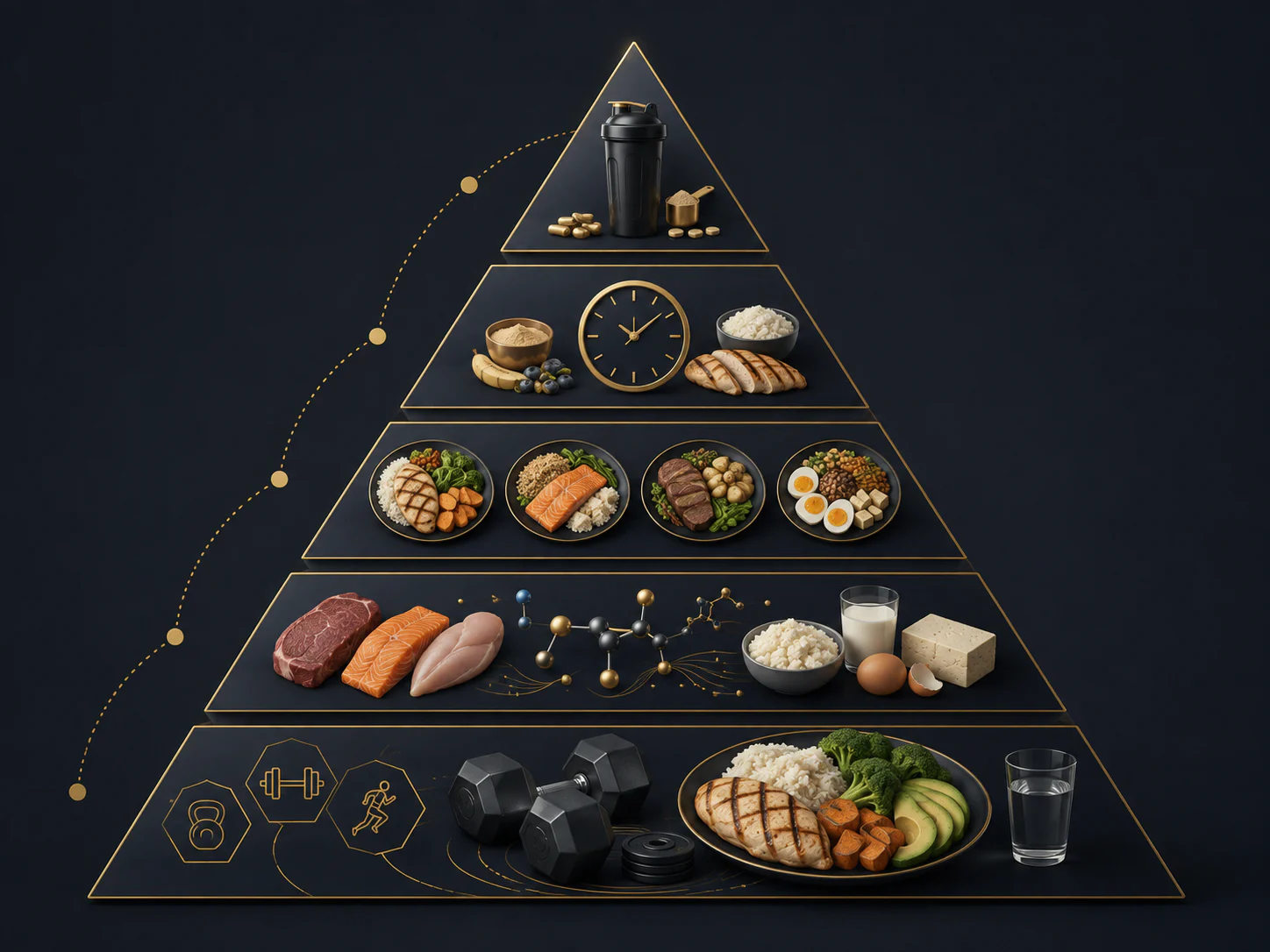
Before watching the clock, organize total intake
When the objective is to gain or preserve muscle mass, the first criterion should not be the minute of ingestion. It should be the total amount of protein available throughout the day.
A meta-analysis of 49 studies and 1,863 participants showed that protein supplementation added small gains in strength, fat-free mass, and muscle size to resistance training. In the average analysis, intakes above approximately 1.6 g/kg/day did not produce additional gains in fat-free mass. This represents a population reference point, not a universal biological limit. Morton et al., 2018.
The International Society of Sports Nutrition position uses a general range of 1.4 to 2.0 g/kg/day for most physically active people. Individual needs may change depending on modality, age, energy availability, training volume, objective and clinical context. Jäger et al., 2017.
There is no timing refinement capable of compensating for an insufficient daily intake. It is possible to drink the shake at the perfect minute and still offer the body less protein during the other 23 hours of the day.
Distribution: useful, but without creating a new hard rule
After the total amount, it is worth observing how the protein is distributed.
A common pattern is to consume little protein at breakfast, a moderate amount at lunch and concentrate almost all of it at dinner. From a protein synthesis point of view, it may be more efficient to provide sufficient protein stimuli at different times of the day.
As a practical reference, position stands suggest approximately 20 to 40 grams of high-quality protein per meal, or about 0.25 to 0.40 g/kg, with intervals of approximately three to four hours. This should be understood as a heuristic, not mandatory programming. Kerksick et al., 2017.
The evidence on distribution itself requires caution. A systematic review found an association between a more uniform distribution and greater muscle mass in part of the studies, but considered the data insufficient to draw firm conclusions about strength or protein turnover. Jespersen and Agergaard, 2021.
In other words: organizing good doses throughout the day is a rational strategy. Transforming each interval into a new mandatory window would be repeating the same conceptual error.
And the study showing a greater response with 100 grams?
A study published in 2023 added an important nuance to the discussion. After exercise, ingesting 100 grams of protein produced a greater and more prolonged anabolic response over the 12 hours observed, when compared to 25 grams.
The finding challenges the popular idea that any protein above 20 or 30 grams would simply be “wasted.” Trommelen et al., 2023.
But the study was acute. He did not demonstrate that 100-gram meals are the best strategy for long-term hypertrophy, nor did he compare this bolus with the same amount distributed over several meals. The result expands our understanding of metabolic flexibility. It does not authorize replacing one dogma with another.
From concept to decision
When timing deserves more — or less — attention
Prioritize post-workout nutrition
When training takes place on an empty stomach, after a long period without protein, it is difficult to reach the daily goal or the following routine will limit food intake.
Don't turn it into an emergency
When there was a good protein meal before the session, there will be a full meal soon after and the rest of the day is already well structured.
Waiting for dinner after a late afternoon workout may be perfectly reasonable. Waiting many hours after training fasted, despite having food available, is probably not the most efficient choice.
The context turns the same delay into two different decisions.
Anabolic window: the 30-minute clock that science left behind
- Muscle doesn't work with a gym timer
- Before watching the clock, organize total intake
- When timing deserves more — or less — attention
Protein before bed: strategy or obligation?
Protein intake before sleep can increase protein synthesis overnight. A systematic review found favorable acute results with approximately 20 to 40 grams of casein, especially in young men.
Chronic results, however, need to be interpreted with caution: Some studies compared groups with different total protein or energy intakes, making it difficult to know how much of the benefit came from the schedule and how much came from simply additional consumption. Reis et al., 2021.
In practice, protein before bed can be useful for those who train at night, have difficulty reaching their daily goal or tolerate a meal well at that time. It is an organization tool, not a mandatory step in the anabolic process.
A practical protocol without nutritional anxiety
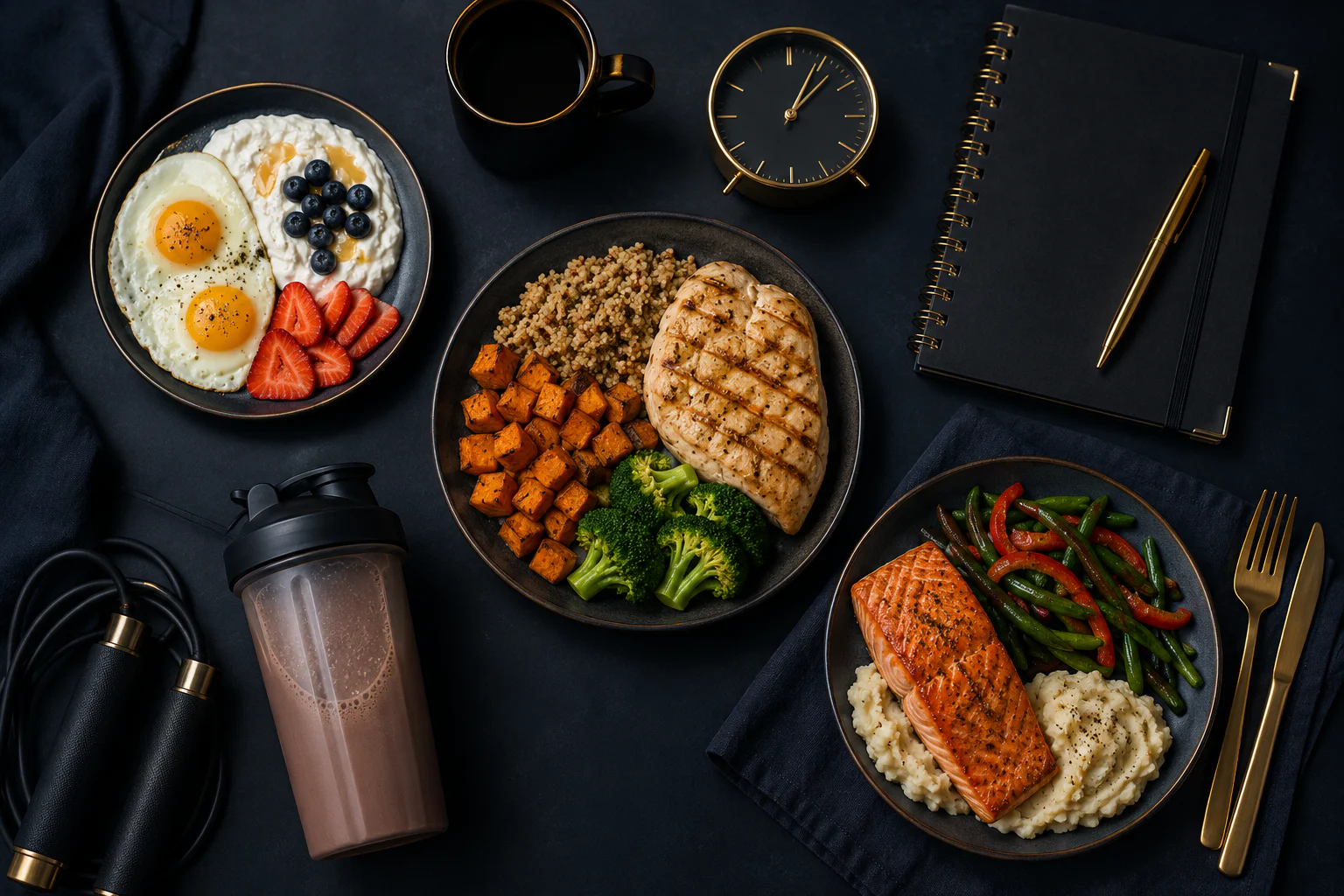
- Ensure well-structured training and sufficient energy.Nutrition enhances a stimulus that needs to exist.
- Achieve a daily protein intake compatible with the goal.The daily total comes before the schedule refinement.
- Distribute adequate doses during main meals.Use distribution as an organizational tool, not as a new dogma.
- Adjust post-workout according to the previous meal.The longer the protein-free interval before the session, the greater the reason to anticipate the next meal.
- Use supplements when they improve convenience or tolerance.Whey makes the routine easier; does not have a unique metabolic clock.
If there was a good protein meal before the session, fit the next dose into the normal flow of the day.
If training occurred fasted or after many hours without eating, prioritize a meal or shake during the initial phase of recovery. A practical reference of up to approximately two hours can help with organization — not because there is a sudden metabolic drop after that.
Food and supplements can fulfill the same function. Whey delivers high-quality protein quickly and conveniently, but it doesn't have a secret anabolic ability.
People with kidney disease, metabolic conditions, or other clinical needs need individualization before adopting high protein goals.
The window exists. The timer was wrong.
Science did not eliminate the anabolic window. It broadened the concept.
Exercise creates a prolonged period in which the muscle responds better to the availability of amino acids. Consuming protein after training remains a coherent decision — especially when the previous diet was insufficient.
What the data doesn't support is the idea that training loses value when the shaker takes a few minutes.
In high performance, timing can refine a strategy. But refinement only produces value after the fundamentals are resolved.
The best post-workout is not the one that beats the clock. It's one that fits into a well-constructed nutritional day.
Verified references
Usage noteEducational content. The ranges presented are general references and do not replace individual nutritional assessment.