
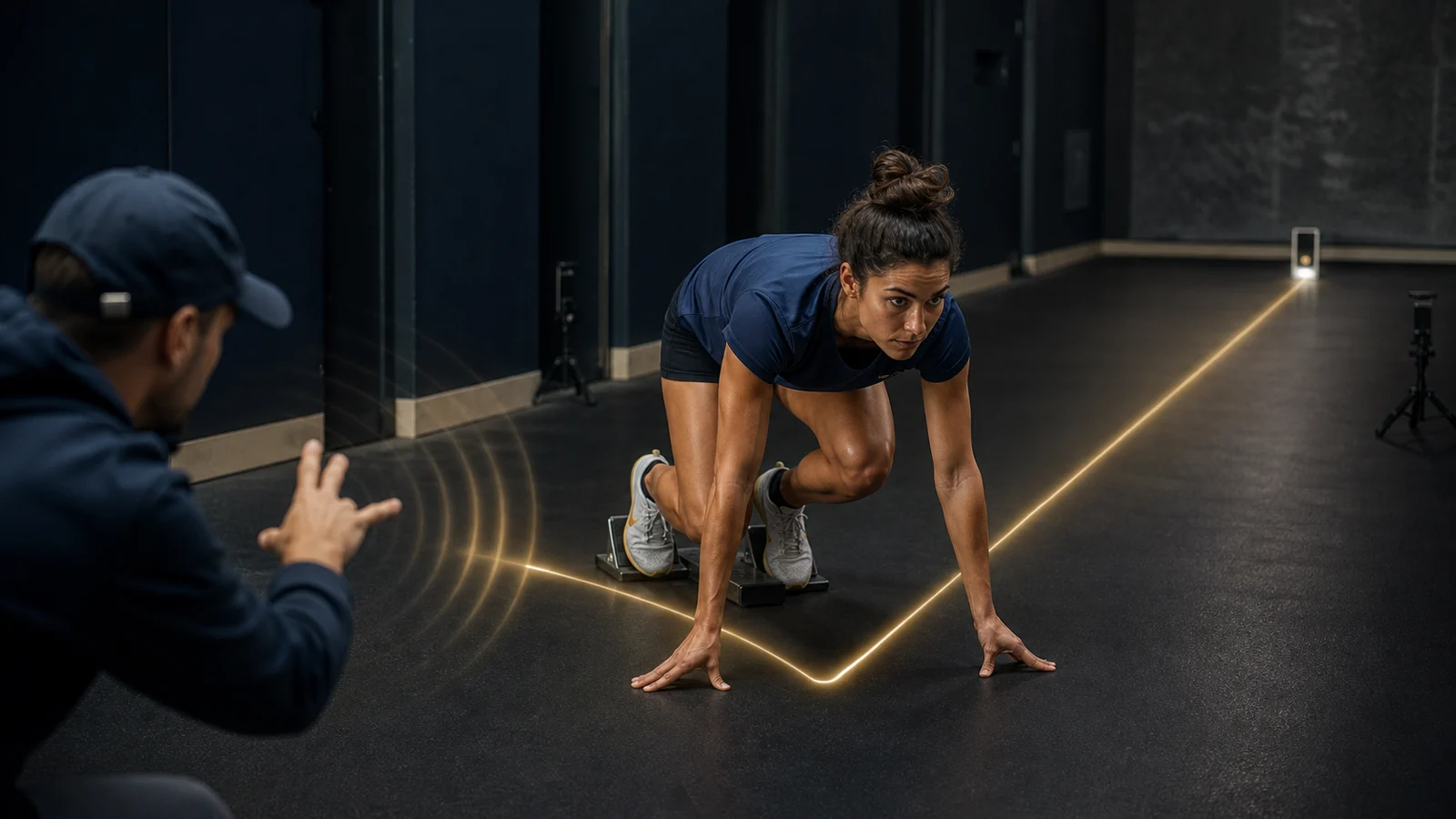
I finished the book with two notes that may seem incompatible, but are not.
The first: language can change how we organize attention, interpret a situation, and move into action. A short cue, a well-formed question, or a precise mental image can change the quality of a repetition.
The second: a compelling subjective experience does not prove that the explanation used to produce it is correct. Feeling more confident after an exercise does not show that the mind has been “reprogrammed,” that an eye movement reveals a thought, or that a technique can treat a health condition.
That tension interested me most. NLP is more useful when it functions as a repertoire for observation, communication, and experimentation. It becomes fragile when it turns metaphors into mechanisms, stories into evidence, and isolated results into universal promises.
In high performance, I would keep the curiosity. I would leave the ready-made certainty on the shelf.

The map is not the territory—and the feeling is not the outcome
One of NLP’s best-known ideas is that the map is not the territory. We do not react to the raw world; we react to the representation we construct of it.
That is relevant to performance because the same training session can be read as a threat, a test, an opportunity, or a routine. Interpretation changes attention, decision-making, and behavior. But the sentence needs a consequence: the territory still exists.
The clock keeps running. The load remains heavy. A decision can still arrive late. Communication can feel inspiring to the coach and remain confusing to the athlete.
A systematic review of NLP and health outcomes found only ten experimental studies, all with high or uncertain risk of bias, and concluded that there was little evidence of benefit. That does not prove that no technique can ever produce an effect. It means that the body of evidence did not support the promises made in NLP’s name.
A direct test of another popular claim is equally instructive. Three experiments found no support for the idea that specific eye movements can identify a lie. The high-performance lesson is larger than that controversy: an elegant model must survive contact with data capable of contradicting it.
First lesson: model excellence without copying people
NLP repeatedly asks us to observe competent people and break down what they do. That is a useful working question.
When an athlete makes a good decision under pressure, what do they perceive first? Where do they direct attention? Which alternatives do they discard? What information triggers action? How do they organize the interval between stimulus and response?
Modeling at this level is very different from copying gestures, phrases, or routines. An expert has accumulated capacities, references, and adaptations that do not appear on the surface. What works for that person may depend on years of practice, physical characteristics, tactical role, environment, and margin for error.
An excellence model should therefore be treated as a transferable hypothesis, not a recipe. It gives us something to test:
- which behavior is actually observable;
- the context in which it appears;
- the problem it solves;
- the prerequisites it demands;
- the indicator that will show whether the adaptation helped.
In high performance, learning from the best does not mean trying to become a copy of them. It means reducing a complex competence to principles that can be taught, trained, and individualized.
How the ideas connect
Second lesson: words are instructions for attention
A sentence delivered before an action can occupy a meaningful share of an athlete’s working memory. If it is long, abstract, or threatening, it competes with the task itself. If it is specific and suited to the moment, it can organize perception and execution.
Research on attentional focus gives scientific shape to that intuition. On average, instructions directed toward the effect of a movement on the environment—known as an external focus—tend to support motor performance and learning better than instructions centered on body parts. “Push the ground behind you” may work better for a sprint than a chain of commands about the hip, knee, and ankle.
This is not an absolute rule. A technical correction may require internal attention during preparation; an experienced athlete may respond differently from a novice; a useful cue at low speed may interfere under pressure. The right words depend on the task, the learning stage, and the observed response.
The same applies to inner speech. A meta-analysis found a moderate positive effect of self-talk interventions on sports performance, with results varying by task type and stronger effects in protocols that actually trained the strategy. That is a long way from saying that repeating positive phrases transforms any execution.
The more useful question is not “Does this phrase motivate?” It is: Where does it direct attention, and what changes in the next action?
Third lesson: mental rehearsal helps when the rehearsal resembles the task
The reading devotes considerable space to visualization, internal imagery, and shifts in perspective. There is a practical core here: imagery can be used to anticipate perceptions, decisions, and movements.
But effective mental rehearsal is not a victory movie. It must contain the actual task.
For an athlete, that includes the environment, tempo, relevant information, motor response, and possible deviations. For a leader, it includes the other person’s reaction, the difficult question, and the need to reorganize the message. For a health professional, it includes the decision sequence and safety criteria—never a fantasy of complete control over the outcome.
A systematic review with meta-analyses of psychological interventions in athletes found favorable signals for imagery and multimodal psychological skills training. The effects, however, were no longer significant in sensitivity analyses that removed nonrandomized studies or subjective performance outcomes. That does not make imagery useless; it shows that confidence in the technique should remain proportional to the quality of the evidence.
My practical interpretation is simple: imagery complements physical practice, feedback and preparation. It does not replace them. The 21-day program at the end of the book provides an exercise schedule; its length does not establish a universal deadline for lasting change.
Fourth lesson: internal state matters, but it does not rule everything
NLP treats confidence, motivation, and mindset as states that can be accessed and reorganized. There is value in recognizing that an athlete takes more than muscles and technique into competition. They also take expectations, fatigue, perceived threat, inner speech, and memories of previous experiences.
The mistake begins when a desired state becomes a guarantee of results. The book itself distinguishes confidence from competence: feeling capable does not remove the need to learn and practice the task. This qualification belongs alongside the promises of transformation made elsewhere in the book.
Confidence can increase readiness to act, but it does not correct a poor strategy. Motivation helps sustain the process, but it does not heal injured tissue faster than biology allows. A positive image may reduce hesitation, but it cannot create a capacity that has not yet been trained.
The closing pages offer another useful observation: peak performance is an experience we can reach, not a condition we must inhabit permanently. My application to sport is to stop demanding a perfect emotional state in every session. In high-performance sport, psychological work should increase the likelihood that available abilities emerge when needed.
This may involve a pre-performance routine, breathing, imagery, cue words, gradual exposure or qualified psychological support. The choice depends on the problem.
Persistent fears, phobias, trauma, and other clinical conditions should not be treated through promises of rapid cures or generic self-help exercises. Language can support care; it does not replace appropriate assessment and treatment.
From concept to decision
Fifth lesson: rapport is shared understanding, not a mirroring trick
The reading also links effective communication to the ability to build rapport. I would preserve the intention and change the criterion.
Within a team, rapport should not mean discreetly imitating posture, breathing, or vocabulary to gain influence. It should mean building enough shared understanding for coach and athlete to be talking about the same problem.
That requires listening to how the person describes the task, confirming what they understood, recognizing their criteria, and adapting the message without abandoning honesty. Sometimes the best evidence of connection is an athlete disagreeing precisely. They feel safe enough to reveal that the instruction did not make sense.
High-performance communication does not seek elegant compliance. It seeks coordination.
Language can guide. It cannot replace evidence.
- The map is not the territory—and the feeling is not the outcome
- First lesson: model excellence without copying people
- Fifth lesson: rapport is shared understanding, not a mirroring trick
My practical translation: ORDER before belief
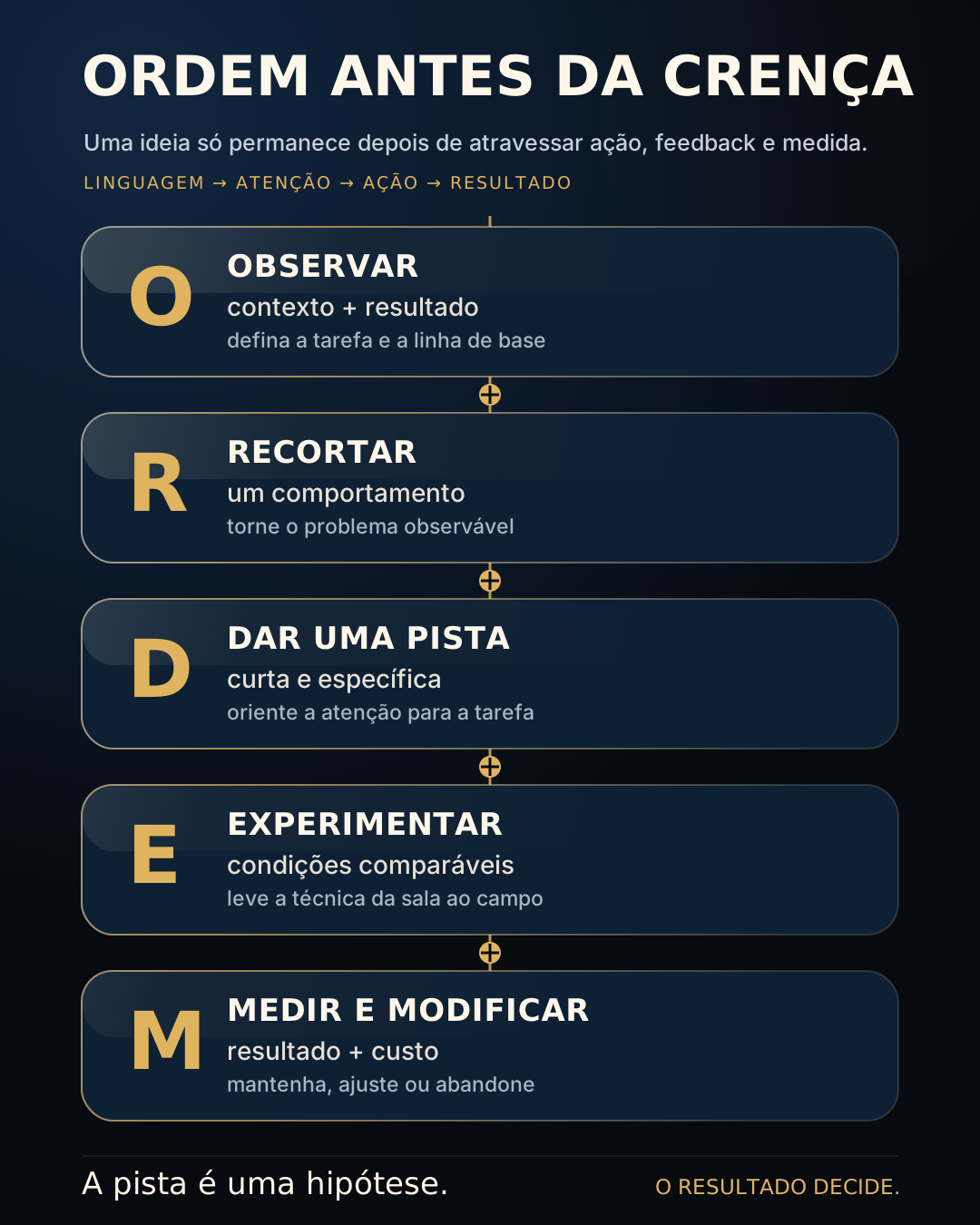
To use a technique without automatically adopting the theory around it, I follow a five-part process.
O — Observe the context and outcome
Define the task, the moment, and the baseline. Does the problem always appear, or only under fatigue? Is it a technical error, a late decision, excess arousal, or a misunderstood instruction? Without observation, every intervention sounds plausible.
R — Reduce the problem to one behavior
Choose a unit that can be seen or measured. “Be more confident” is too broad. “Start the action without the second check that delays the response” gives us something to work with.
D — Deliver one short cue
Use a single word, image, or instruction suited to the task. Its job is to direct attention, not explain the entire theory. If the athlete has to remember a paragraph, the cue has failed before execution begins.
E — Experiment under comparable conditions
Repeat the task with and without the cue while preserving as much context as possible. Test it under low pressure, then increase speed, uncertainty, or consequence. A technique that works only in a quiet room must demonstrate value in the field.
R — Record, revise, or remove
Compare outcome, consistency, attentional cost, and the athlete’s perception. Objective feedback can itself influence performance: a meta-analysis in resistance training found acute benefits and signals of better adaptation when feedback was provided across a training cycle. If the cue does not help, adjust or abandon it.
This final movement protects everything that comes before it. Without measurement, a technique can survive simply because we like its explanation.
The central shift
What I kept—and what I left behind
What I kept from the reading
- Observe patterns of excellence
- As hypotheses for breaking down, teaching, and individualizing competence
- Treat language as a lever for attention
- Through short, specific cues tested in the task
- Rehearse situations mentally
- As a complement to physical practice and feedback
- Break large goals into next actions
- To make action and progress observable
- Change strategy when it does not work
- As data-guided flexibility, not novelty for its own sake
- Build rapport
- As shared understanding and two-way communication
What I left behind
- Eye movements as a reliable reading of the mind or deception
- Experimental tests do not support the claim
- Reducing people to fixed sensory types
- The simplification can impoverish assessment and communication
- “Programming the brain” as a neuroscientific explanation
- It is a language metaphor, not a demonstrated model of the brain
- Rapid-change promises for clinical problems
- They require specific evidence, safety, and professional care
- The idea that anyone can reproduce any form of excellence
- It ignores training history, biology, environment, role, and opportunity
High performance needs language—and reality
I did not finish the reading converted to NLP. I finished it more attentive to the power and limits of words.
A good cue can organize an action. A question can open an alternative the athlete did not see. A mental image can prepare perception and decision. A model of excellence can expose the trainable parts of something that once looked like pure talent.
But none of these tools gets a free pass.
High performance is not about convincing someone that reality can be rewritten with the right words. It is about choosing words that organize attention, creating an action, exposing the outcome to measurement, and remaining humble enough to change your mind.
Language starts the experiment. Reality decides what stays.
Frequently asked questions
Is NLP scientifically supported?
Support is limited for NLP as an integrated system and for many of its specific claims. Some practices found in NLP materials—such as imagery, cue words, goal setting, and model observation—are studied in psychology and sports science. Evidence for those practices does not automatically validate NLP’s explanations or the system as a whole.
Can visualization improve performance?
It can contribute in some contexts, especially when it is task-specific, trained, and combined with physical practice and feedback. The literature still contains heterogeneity and methodological limitations, so imagery is neither a universal intervention nor a replacement for training.
How can I use an NLP technique without accepting the entire theory?
Turn the technique into a hypothesis: observe the baseline, reduce the problem to one behavior, apply a clear cue, test it under comparable conditions, and measure the result. The ORDER process organizes that translation.
Should NLP be used to treat phobias, trauma, or health conditions?
Not as a stand-alone alternative to evidence-based care. Clinical conditions require professional assessment and interventions whose safety and efficacy have been appropriately studied.