

By week 26, almost all the criteria defined at the beginning of rehabilitation were met. One was not: knee extensor strength still showed a deficit of 14% to 16% in the isokinetic dynamometer.
The original goal was to stay within 10% symmetry. Even so, the medical and performance team decided to advance the athlete to complete training. Four weeks later, he started competing again.
This is the most interesting part of the case. Not because it authorizes ignoring tests, but because it shows what a test can — and cannot — tell us when sport-specific actions, load tolerance, and confidence develop at different rates.
The case was described by James Grierson in Sportsmith, in an individual professional report, with its own surgery, resources, calendar and demands. It offers a model for reasoning, not a protocol to copy nor a universal medical clearance.
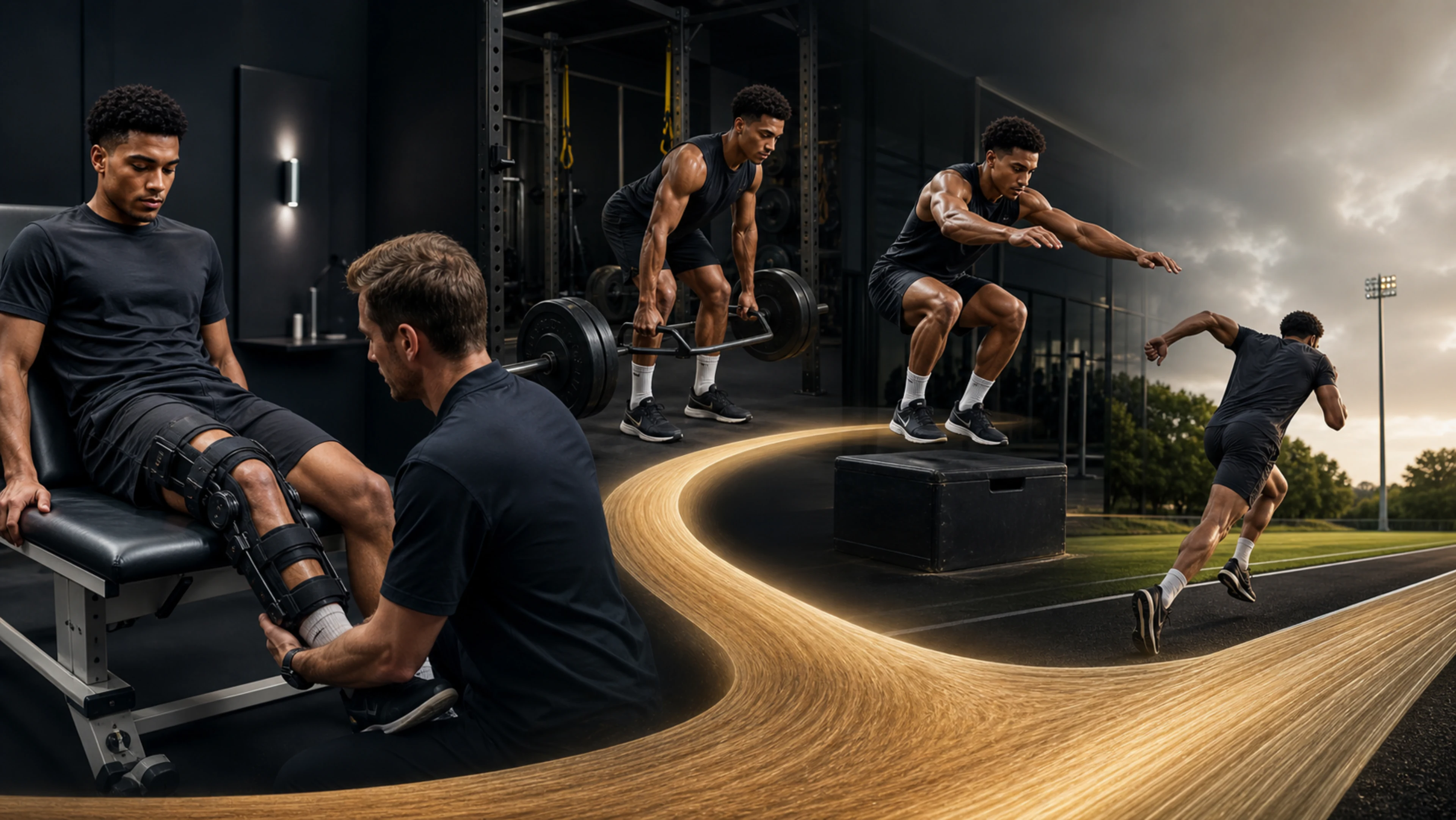
A rare injury whose cost does not end with surgery
The patellar tendon connects the patella to the tibia and transmits quadriceps force to extend the knee. A rupture interrupts the extensor mechanism and, when complete in an athlete, usually requires surgical repair followed by a long process of rebuilding strength, movement, and sport exposure.
In a retrospective analysis of 103 professional athletes in baseball, basketball, football and football, Nguyen and Hsu found a return to the sport in 76,7% of cases after repair of the patellar tendon. The definition was to compete again; it did not guarantee immediate return to the previous level nor equality between modalities, positions and demands.
The athlete was a 20-year-old Australian football defender who was injured during a maximal single-leg jump in an aerial contest. Before the injury, he played approximately 90 minutes, covered around 12 km, accumulated nearly 1,800 m above 19 km/h, and 250 m above 25 km/h per match.
He also presented chronic bilateral proximal patellar tendinopathy, so the history needed to enter the context. The account, however, does not show that tendinopathy caused the rupture. The surgery used anchors, a graft, and reinforcement, making it even less defensible to carry each week of this case over to a different repair.
The calendar organized the process. The athlete's response authorized every progression.
Thirty weeks in six different jobs
The case did not evolve as a ladder in which a block ends and the next begins. Protection, strength, conditioning and motor learning were overlapping according to tissue restrictions and the next problem that needed to be solved.
weeks
Protect without disconnecting
Extension immobilizer and crutches for support; quadriceps activation, isometry, neuromuscular stimulation, flow restriction in light tasks and contralateral training.
Dominant restriction · repairweeks
Restore gait and range of motion
Open orthosis at 10° per week, removal of crutches and progression of unilateral force. Orthesis left at week 8, still in a period considered sensitive.
Milestone · brace removedweeks
Reintroduce running
Greater exercise range, light plyometrics, and one antigravity-treadmill session preceded the return to field running. Early runs showed longer ground-contact time and less flexion in the affected knee.
Exposure · up to 60% of maximum speedweeks
Construct speed and direction
The weekly volume advanced from 6 to 14 km. High speed appeared around week 15; sprint over 25 km/h began at week 17, with planned and then reactive direction changes.
Milestone · formal testing at week 16weeks
Transforming capacity into football
Less gym volume to absorb more field. Contacts, individual marking, jumps under fatigue and the “J mark” entered, an aerial task in which the athlete still reported worse performance and confidence.
Integration · group from week 20weeks
Demonstrate readiness in a real environment
Small-sided games, open training, aerial contests, and progressively greater football volume followed. Return came in a preseason match at week 30; the athlete later played 86 minutes in the second official match.
Outcome · competitive returnThe sequence reveals an important choice: the athlete did not wait to regain all strength to start running, nor did he wait to run perfectly to find the ball again. Each quality came into a dose compatible with the necessary protection and was gaining complexity.
This principle talks with recent biomechanical data. In healthy adults, Silva et al. showed that the load on the patellar tendon varies by the combination of peak, impulse and speed of application. Walking, squatting, running, jumping and cutting do not form a simple list of “light to heavy”; each task changes the type of demand.
Not every metric returns at the same rate
In week 16, the first objective panel still showed large differences. Isometric extensor strength (66%) and belt squat (70%) values were presented in comparison between limbs. The countermovement jump height (88%) and the reactive strength index (68%) were compared with the pre-injury level. The four percentages use two different references.
At the end of the next block, the jump height with counter-movement and the force in the belt squat were within 5% of the pre-injury value. At the same time, unilateral vertical tests still exhibited 15% to 20% asymmetry and the isokinetic dynamometer indicated a deficit close to 25% in knee extension.
There's no contradiction. Each test captures a different combination of force, strategy, speed, coordination and segment contribution. A bilateral jump can return to the reference value while a unilateral task still exposes relevant difference. And symmetry can improve because the affected limb evolved, because the contralateral limb fell or both.
| Layer | Question answered | Evidence used in the case | What it could not establish on its own |
|---|---|---|---|
| LayerClinical and tissue | QuestionDoes the knee tolerate the current dose? | EvidencePain, joint effusion, examination findings, range of motion, and the response over the following 24–48 hours. | LimitAbsence of pain does not prove competitive readiness. |
| LayerCapacity | QuestionAre strength and power sufficient? | EvidenceKnee extension, leg press, split squat, and jump tests. | LimitAn isolated test does not replicate the game. |
| LayerExposure | QuestionHas the athlete encountered the required demands? | EvidenceVolume, high speed, sprint, change of direction, contact and jumps. | LimitCompleting meters does not guarantee movement quality. |
| LayerSports function | QuestionHe solves his own role? | EvidenceMarking, aerial contests, open training, and small-sided games. | LimitControlled training does not contain all the pressure of competition. |
| LayerTrust | QuestionDoes he accept and execute the critical gesture? | EvidenceReport and repeat of “J mark” fresh and under fatigue. | LimitFeeling ready doesn't replace physical capacity. |
The usefulness lies in convergence. No layer works as a veto or automatic permission outside the clinical context.
How the ideas connect
Why the team advanced with an incomplete criterion
By week 26, the isokinetic deficit had fallen to 14%–16%, but remained above the 10% target. The decision to progress did not erase that result; it placed it alongside three other bodies of evidence.
Fieldwork
The athlete had already accumulated substantial exposure to football movements, high speed, sprint, change of direction and open tasks.
Jumps and horizontal force
Vertical and horizontal tests had improved, including tasks considered relevant to the mechanism and position.
Interpretation of test
The team considered that the dynamometer concentrated a lot of strength at the tendon point and considered enough production close to 2.5 times the body weight, maintaining training to reduce the deficit.
The calendar offered margin
There were still about eight weeks until the competition. Integrating the athlete into the group did not mean ending the development of force.
A documented exception, not a new 15% rule
The case does not validate releasing every athlete with similar deficit. It shows that a previous criterion can be reviewed when the team explains why, what evidence compensates for uncertainty and how the deficit will continue to be treated.
This logic accompanies Berne's consensus on returning to sport: to return should be understood as a continuum — return to participation, return to sport and return to performance — and as a decision on shared risk management between athletes and professionals.
The most sporting detail didn't show up at the lab.
The defender presented difficulty and little confidence in a specific air action called “J mark”: running in angle away from the ball, spinning and jumping to intercept it. No leg press or isokinetic test alone would reproduce the sequence of perception, rotation, approximation, impulse, contact and decision.
The team repeated the task in different conditions, including under fatigue. This was not a peripheral motivational resource. It was progressive exposure to the gesture in which tissue, coordination and trust needed to work again together.
The case also recalls that returning to the game does not end rehabilitation. The athlete rarely missed training the following season, sat out only one match because of illness and, just over a year after surgery, showed complete symmetry on the Biodex at approximately 3.1 times body weight.
What a performance team can take from this case
- Define criteria before you need to defend them.Strength, jump, exposure, function, symptoms and complete training must have known method, unit and time of collection.
- Separate criteria from automatic cutoffs.When a value is not reached, the exception needs explicit justification, shared decision and plan for residual deficit.
- Progress the nature of the load.Peak, volume, application speed, unpredictability, contact and fatigue change the work of the tendon, even when the exercise looks similar.
- Test the athlete and the role.General measures support the decision; position tasks check whether the capacity meets the real competitive problem.
- Monitor the delayed response.Pain, joint effusion, stiffness, confidence, and movement quality over the following hours and days help determine whether the load was absorbed.
- Plan beyond the return.The first match is a new exposure, not a closing ceremony. Residual deficits and weekly load still need to be managed.
The greater the distance between what the test measures and what the position requires, the greater the need to combine the number with specific exposure, clinical response and evidence of performance.
From concept to decision
The test still showed a deficit.
- Thirty weeks in six different jobs
- Not every metric returns at the same rate
- What a performance team can take from this case
What this case does not allow to promise
- Doesn't prove 30 weeks is enough for everyone. Time depends on repair, clinical evolution, modality, history and acceptable risk.
- It does not isolate the effect of stimulation, flow restriction or contralateral training. The interventions were combined; we do not know which portion of the result belongs to each one.
- It doesn't turn 15% into a safe limit. The decision was contextual and occurred with other favorable evidence and continuity of training.
- It doesn't guarantee transferability. A professional club has surgery, monitoring, equipment, team and field time that do not exist in every context.
- It does not establish causality between previous tendinopathy and rupture. History has been reported, but one case does not establish the causal mechanism.
Return is a decision, not a photograph
If the team had waited for every number to become identical, it might have delayed important exposures. Had it ignored the deficit because the athlete ran well, it would have traded objectivity for an impression.
The most difficult work was between these extremes: accepting that there was uncertainty, documenting why other evidence sustained progression and continuing to train what was not yet ready.
The best return criterion is not the one that eliminates risk. It is the one that makes risk visible, discussable, and manageable.
Frequently asked questions
How long does return take after a patellar tendon rupture?
The literature and case show great variation. The athlete described returned to a preseason match at week 30, but this time should not be used as a universal prescription. Type of repair, clinical criteria, strength, sports exposure and individual response change the decision.
Does symmetry below 90% prevent return?
It signals a difference that needs to be explained, but no percentage works alone for all injury and modality. The test, pre-injury level, function, symptoms, load already tolerated and the risk of the task must be considered together.
Does absence of pain mean the tendon is ready?
No. Low pain is favorable information, but it does not establish strength, tolerance to rapid loading, repeat-effort capacity, or readiness for the competitive action.
Can the case protocol be copied?
Not as a recipe. Surgery and context were specific. What can be used is architecture: progression by criteria, overlapping of capacities, position tasks, monitoring of response and multidisciplinary decision.