

In ten years working in high-performance sport, I have never seen an athlete voluntarily consume, day after day, the energy intake some pocket formulas begin to recommend once they estimate daily expenditure and simply add the cost of physical activity.
I am not talking about one exceptional meal, a short training camp, or an aggressive strategy delivered with support. I mean the diet an athlete can repeat between training sessions, travel, matches, sleep, gastrointestinal discomfort, appetite, and real life.
That experience does not prove a metabolic theory. It does expose a question physiology should not avoid: if a session had a measurable cost, why does that value not always appear in full in daily expenditure — and even less often in what the athlete can spontaneously eat?
Herman Pontzer’s work offers one possible answer. It is neither the only answer nor a settled truth. It replaces automatic addition with a more biological model: the body reallocates energy, adjusts behavior, and changes efficiency. The final total may rise by less than the spreadsheet predicts.
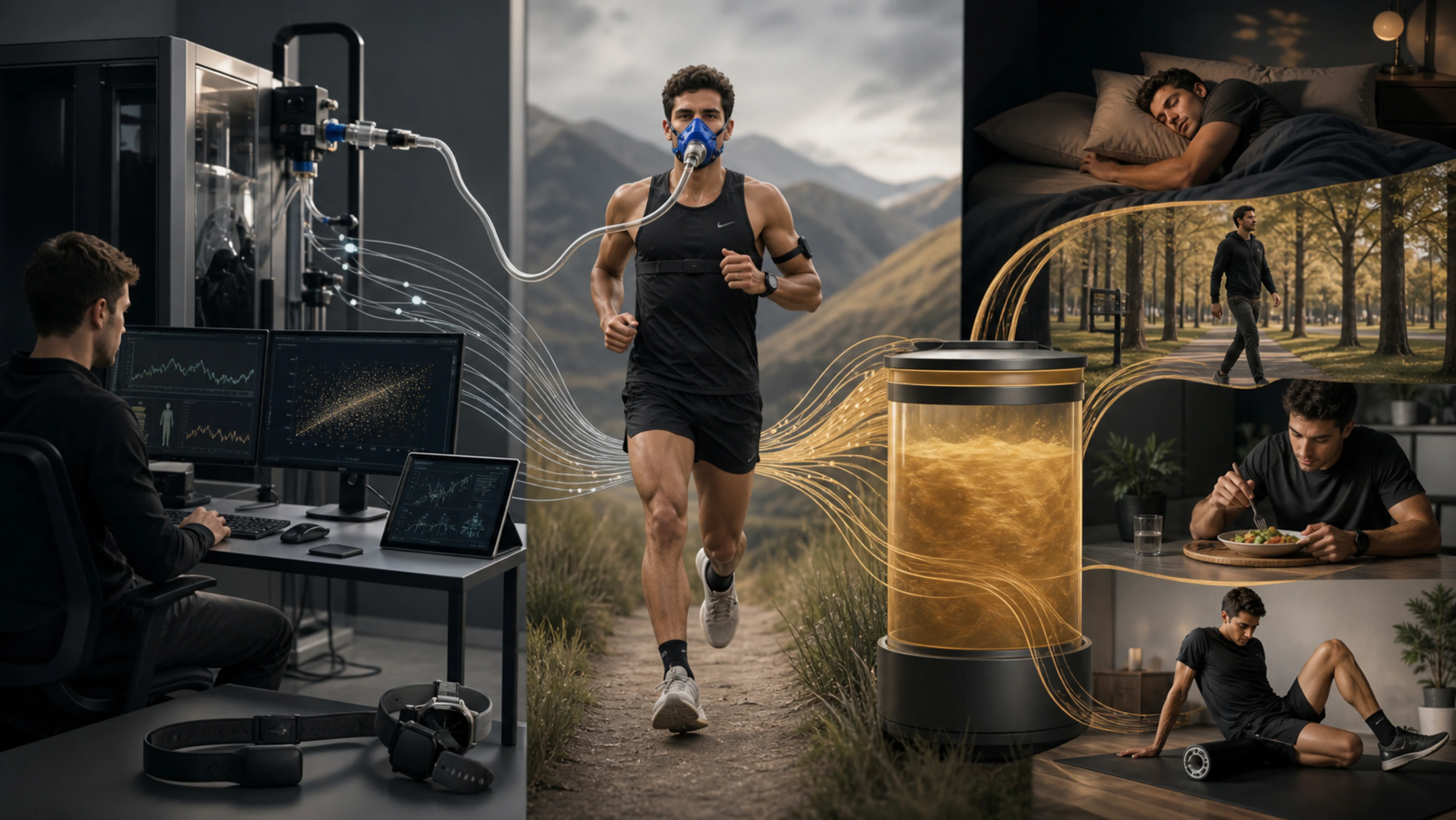
Three numbers that look alike — but are not
Much of the confusion begins when three different measures are treated as synonyms.
Gross session cost
The first is the gross cost of the session. Running, jumping, accelerating, braking, and sustaining mechanical work require energy. The constrained-expenditure model does not deny that cost.
Net daily increase
The second is the net increase in total daily energy expenditure. It depends on what happens during the other 22 or 23 hours: spontaneous movement, posture, sleep, thermogenesis, resting metabolism, and physiological processes that never appear on GPS data.
Voluntary intake
The third is the intake the athlete consumes voluntarily. It depends on appetite, satiety, energy density, logistics, gastrointestinal tolerance, food culture, and the ability to distribute food across the microcycle.
A session can cost 700 kcal without increasing total daily expenditure by exactly 700 kcal. And a measured expenditure of 3,500 kcal does not guarantee the athlete has the appetite, time, or tolerance to consume 3,500 kcal. Blurring these numbers can create both inflated diets and dangerously normalized deficits.
What Pontzer called constrained energy expenditure
In the additive model, every new block of activity is stacked on top of the others. If resting metabolism, the thermic effect of food, and ordinary daily movement remained unchanged, almost the full training cost would be added to total expenditure.
In the constrained model, exercise still carries a cost, but some of it may be compensated. An athlete may move less outside training, sit more, sleep differently, perform the same work more economically, or reallocate energy among physiological processes. Total expenditure may still rise — just not in a perfectly linear way.
As activity increases, the rest of the day may remain unchanged — or reorganize
Additive model
More activity is stacked on top of the other costs and raises the total in the same proportion.
Constrained model
More activity takes a larger share while other components may decrease.
The study that popularized this proposal measured total energy expenditure in 332 adults for seven days using doubly labeled water. Physical activity was recorded by accelerometry. After adjustment for body composition, age, sex, height, and study site, physical activity explained only about 7% of the variation in adjusted total expenditure.
The relationship rose at low and intermediate activity levels, then lost slope in the upper range of the sample. Across the four most active deciles, the curve was nearly flat. That pattern is compatible with compensation.
The study was cross-sectional, however: different people were compared during one period. Researchers did not increase training in the same individuals over several months. Nor did the sample consist of elite athletes. The study therefore supports a nonlinear population-level relationship; it does not demonstrate a universal individual metabolic ceiling.
Four papers, one broader story
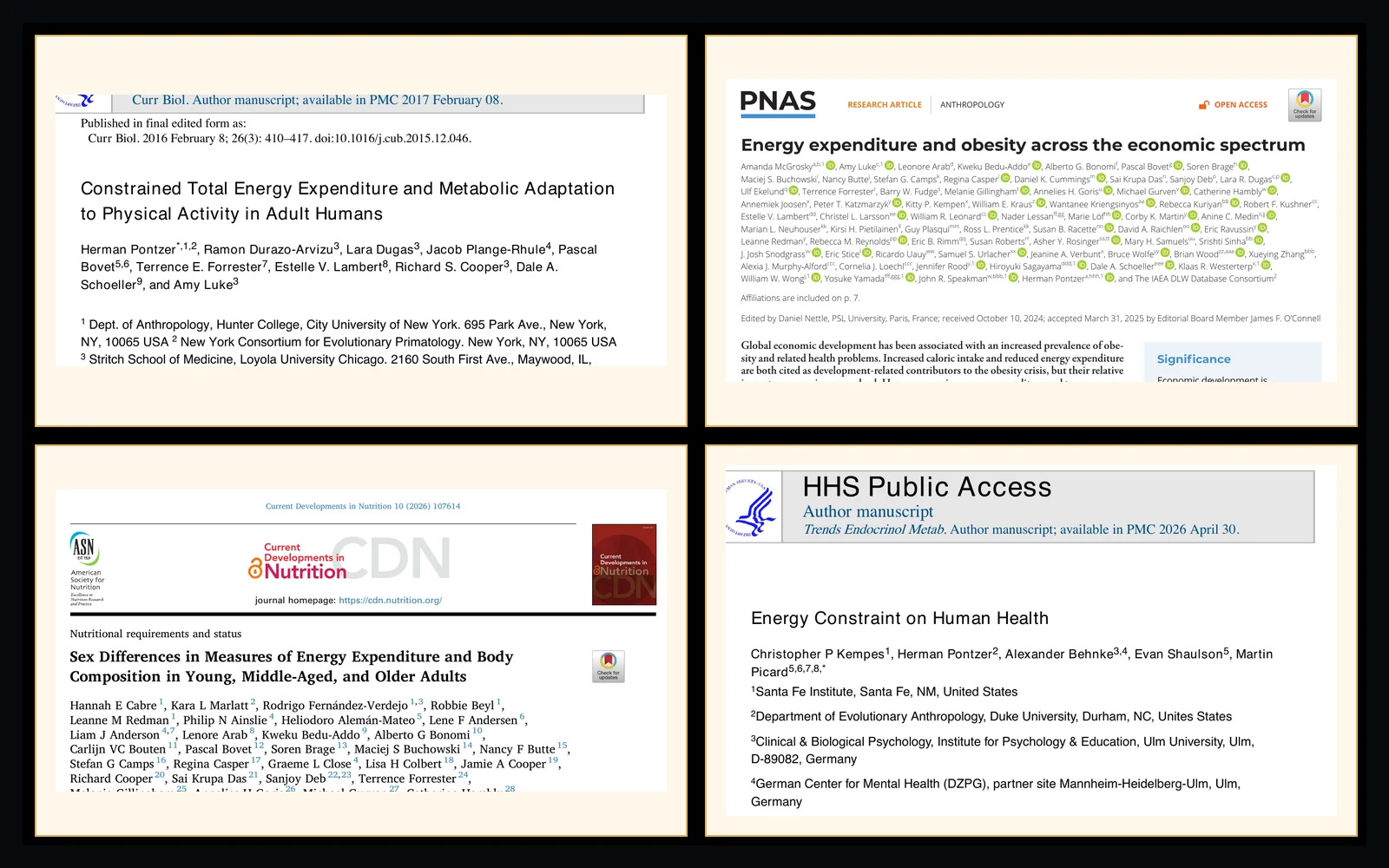
The four reviewed papers support different parts of the argument.
The 2016 paper presents a nonlinear pattern between habitual activity and total expenditure. The global study by McGrosky and colleagues, including 4,213 adults from 34 populations, shows that radically different lifestyles do not translate into proportional differences in expenditure once body size and composition enter the model. Absolute expenditure was higher in more economically developed populations because bodies were larger as well. After adjustment, the difference between the economic extremes was small: about 6% in total expenditure and 11% in basal expenditure, with no significant reduction in activity expenditure or physical activity level.
That second study also shifts the obesity debate. Expenditure differences accounted for only a small fraction of the greater adiposity associated with economic development; the data pointed to a much larger role for intake. This does not make exercise irrelevant. It shows why exercise cannot be treated as calorie credit that is freely interchangeable with food.
Cabre and colleagues analyzed 2,326 adults aged 30 to 70. Men had higher absolute expenditure, but sex differences disappeared after adjustment for fat-free mass and fat mass within each age group. The largest adjusted decline appeared in the transition to older age. The practical message is direct: sex and age alone do not determine energy requirements; body composition and context explain a decisive portion of the variation. Participants with a physical activity level above 2.5 were also excluded — another reason not to transfer these numbers directly to elite sport.
Finally, the review by Kempes, Pontzer, and colleagues proposes an energy budget divided among vital functions, stress costs, and growth, maintenance, and repair processes. Exercise expands stress costs during the session. Adaptation occurs afterward, when recovery, synthesis, and remodeling need energy.
This model is intellectually useful in high performance because it explains how “spending less than the formula predicts” may hide a shift in priorities. It is still a conceptual review, not a definitive test of the complete system. The authors acknowledge that validated measures capable of quantifying each compartment over time are still lacking.
How the ideas connect
The theory has support, but its magnitude remains contested
Later research has not delivered a single verdict.
An analysis of 1,754 adults estimated average compensation at 28%, with wide individual variation. In a 24-week exercise intervention, 48% of participants showed an average compensation of roughly 308 kcal per day, yet investigators did not detect adaptive declines in resting, sleeping, or 24-hour expenditure measured in a metabolic chamber.
In the other direction, studies published in 2025 and 2026 found a linear relationship between physical activity and total expenditure, without suppressed resting metabolism. One followed only 12 adults through ten-day periods of high and low activity and analyzed a separate cross-sectional sample of 268 people. Its results favored the additive model, but the short intervention cannot settle the question of long-term habitual adaptation.
Taken together, the data support that compensation can occur, varies among individuals, and should not be assumed in everyone. Its mechanism is not confined to resting metabolism. It may involve movement outside training, efficiency, intake, behavior, or components that remain poorly measured.
What my field experience adds — and what it cannot prove
When an athlete does not spontaneously reach the calculated intake, there are at least five plausible explanations.
- The equation overestimated the starting point or used an unsuitable activity factor.
- Training was counted twice: once inside the daily factor and again as session calories.
- The device or reference table overestimated exercise cost.
- The body compensated for part of the cost elsewhere in the day.
- The expenditure estimate is correct, but the athlete is eating less than required.
Ten years of observation make the spreadsheet difficult to accept as physiological truth. They do not let us automatically select one of these five explanations.
Data from professional football players illustrate this ambiguity. In six Premier League players, expenditure measured by doubly labeled water averaged 3,566 kcal/day and recorded intake averaged 3,186 kcal/day; the difference did not reach statistical significance. In 24 international-level female players, mean expenditure was 2,693 kcal/day, whereas four-day measured intake was 1,923 kcal/day and 88% were classified as having estimated low energy availability. In another sample of six male professionals during preseason, published in 2026, expenditure was about 3,167 kcal/day and intake about 2,617 kcal/day.
These are small samples, observed over short windows, with dietary recording methods vulnerable to underreporting. They do not establish a universal percentage. They do confirm that the field observation — athletes do not spontaneously match estimated or measured expenditure with intake — is not an isolated anecdote.
The most dangerous mistake is confusing adaptation with adequacy
When body weight remains stable while intake appears low, it is tempting to conclude that the true requirement was lower. That interpretation may be right. It may also be dangerously incomplete.
The body can preserve weight and performance for a time by reallocating energy. Reproductive function, bone health, immunity, mood, protein synthesis, and recovery may pay part of the bill before the scale changes visibly.
This is where Pontzer’s model meets the consensus on Relative Energy Deficiency in Sport (REDs). Problematic low energy availability occurs when intake leaves insufficient energy to support health and performance after exercise expenditure is accounted for. Low appetite is not proof of adequacy. Stable body weight is not proof either.
Do not force an athlete to eat merely to satisfy a formula disconnected from the observed response. Do not use the inability to reach that formula as permission to accept chronic underfueling.
From concept to decision
How to prescribe without becoming hostage to the number
In high performance, I treat the equation as an opening hypothesis. A prescription gains validity only when it survives contact with the microcycle and the athlete.
First, I check whether the method already includes activity before adding training. Then I compare the estimate with the intake the athlete can actually sustain, without treating self-report as perfect measurement.
Next, I monitor trends: completed load, session quality, repeat-effort capacity, moving-average body mass, recovery, sleep, mood, hunger, menstrual function, libido, injuries, illness, and gastrointestinal tolerance. Carbohydrate deserves separate attention because an athlete can meet total calories and still be underfueled for the specific work.
Adjustment should follow the microcycle. Match days, intense sessions, and recovery do not require the same energy distribution. Instead of chasing one fixed total, the goal is to identify the smallest intervention that improves the response without creating discomfort, purposeless fat gain, or an unreasonable logistical burden.
When the gap between calculation and field observation persists, the question is not “which number is correct?” It is “which hypothesis best explains the full pattern of signals?”
The calculation becomes valid when it meets the athlete
- Check whether training is already included in the activity factor.
- Compare the estimate, sustainable intake, and body-mass trend.
- Read load, performance, recovery, sleep, and health signals together.
- Periodize energy and carbohydrate around the microcycle’s actual demand.
The formula prescribes more food than the athlete eats: what Herman Pontzer helps explain
- Three numbers that look alike — but are not
- What my field experience adds — and what it cannot prove
- How to prescribe without becoming hostage to the number
The spreadsheet must answer to the athlete
Pontzer’s most important contribution is not the claim that exercise fails to increase expenditure. It is the recognition that the body does not receive each training session as an independent line in a sum.
My ten years in high performance converge with that principle: prescriptions built by mechanically adding training often produce food volumes that do not belong to an athlete’s spontaneous diet. Science offers plausible reasons for that gap — compensation, efficiency, behavior, and intake limits — without denying that some athletes are genuinely underfueled.
Formulas remain useful. The problem begins when they stop being estimates and start dictating physiology. In high performance, the best calculation is the one that corrects itself in response to the real athlete’s performance, recovery, and health.
Verified references
- Pontzer H, Durazo-Arvizu R, Dugas LR, et al. Constrained Total Energy Expenditure and Metabolic Adaptation to Physical Activity in Adult Humans. Current Biology. 2016;26(3):410–417. PMID: 26832439.
- McGrosky A, Luke A, Arab L, et al. Energy expenditure and obesity across the economic spectrum. PNAS. 2025;122(29):e2420902122. PMID: 40658837.
- Cabre HE, Marlatt KL, Fernández-Verdejo R, et al. Sex Differences in Measures of Energy Expenditure and Body Composition in Young, Middle-Aged, and Older Adults. Current Developments in Nutrition. 2026;10(1):107614. PMID: 41583128.
- Behnke A, Shaulson E, Pontzer H, Kempes CP, Picard M. Energy constraint on human health. Trends in Endocrinology & Metabolism. 2026. Online ahead of print. PMID: 42025458.
- Careau V, Halsey LG, Pontzer H, et al. Energy compensation and adiposity in humans. Current Biology. 2021;31(20):4659–4666.e2. PMID: 34453886.
- Flanagan EW, Sanchez-Delgado G, Martin CK, et al. No evidence for metabolic adaptation during exercise-related energy compensation. iScience. 2024;27(6):109842. PMID: 38947494.
- Howard KR, Prado-Nóvoa O, Zorrilla-Revilla G, et al. Physical activity is directly associated with total energy expenditure without evidence of constraint or compensation. PNAS. 2025;122(43):e2519626122. PMID: 41118225.
- Yegian AK, Pachus E, Redman LM, et al. Longitudinal and cross-sectional evidence that daily resting and activity energy expenditures are independent in humans. The Journal of Physiology. 2026;604(14):5952–5967. PMID: 42349903.
- Thurber C, Dugas LR, Ocobock C, Carlson B, Speakman JR, Pontzer H. Extreme events reveal an alimentary limit on sustained maximal human energy expenditure. Science Advances. 2019;5(6):eaaw0341.
- Anderson L, Orme P, Naughton RJ, et al. Energy Intake and Expenditure of Professional Soccer Players of the English Premier League. International Journal of Sport Nutrition and Exercise Metabolism. 2017;27(3):228–238. PMID: 28050927.
- Morehen JC, Rosimus C, Cavanagh BP, et al. Energy Expenditure of Female International Standard Soccer Players. Medicine & Science in Sports & Exercise. 2022;54(5):769–779. PMID: 34974499.
- Jenkinson A, Jones B, Chesson L, et al. Pre-Season Total Energy Expenditure and Dietary Intake of Professional Male Soccer Players. European Journal of Sport Science. 2026;26(3):e70149. PMID: 41760574.
- Mountjoy M, Ackerman KE, Bailey DM, et al. 2023 International Olympic Committee’s consensus statement on Relative Energy Deficiency in Sport (REDs). British Journal of Sports Medicine. 2023;57(17):1073–1097. PMID: 37752011.
Educational content. Estimates of expenditure, intake, and signs of energy availability do not replace individual assessment or justify automatic dietary adjustments.