

The calculation seems simple: if a session cost 600 kilocalories, the day's expenditure should increase by exactly 600. Repeat the session five times and the weekly deficit would be resolved.
That arithmetic works on paper. In the body, it meets a system that adjusts behavior, efficiency, and energy distribution.
It was this tension that a 2016 study turned into an influential hypothesis: Perhaps total energy expenditure does not grow indefinitely in direct proportion to activity. At low levels, moving more clearly increases expenditure. At higher habitual levels, some of this increase could be offset in other components of the day.
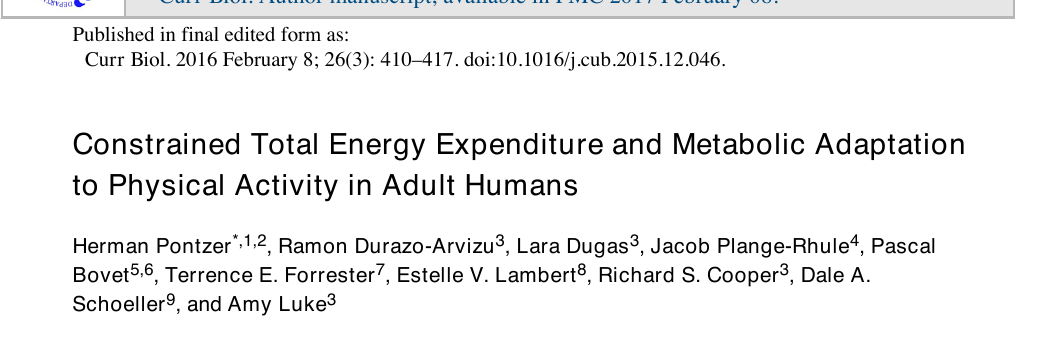
The idea became known as restricted total energy expenditure model. It's useful, but it's often mistranslated. The study did not show that exercise “does not burn calories”, that all people have a fixed ceiling or that physical activity does not help with weight control. It showed something more interesting: the body is not a passive sum of training sessions.

The additive model is intuitive. The body is more dynamic
Daily energy expenditure can be organized into large components: resting metabolism, thermic effect of food, exercise and movements performed outside of training.
In the additive model, each new unit of activity is simply stacked on top of the others. Walking, running or training more would make the total expenditure increase in the same proportion.
In the restricted model, the immediate cost of exercise continues to exist, but the body can compensate for part of it. The person can sit more, reduce spontaneous movements, make the gesture more economical or change some physiological component. The result would be an increase in total spending smaller than the sum predicted by the session.
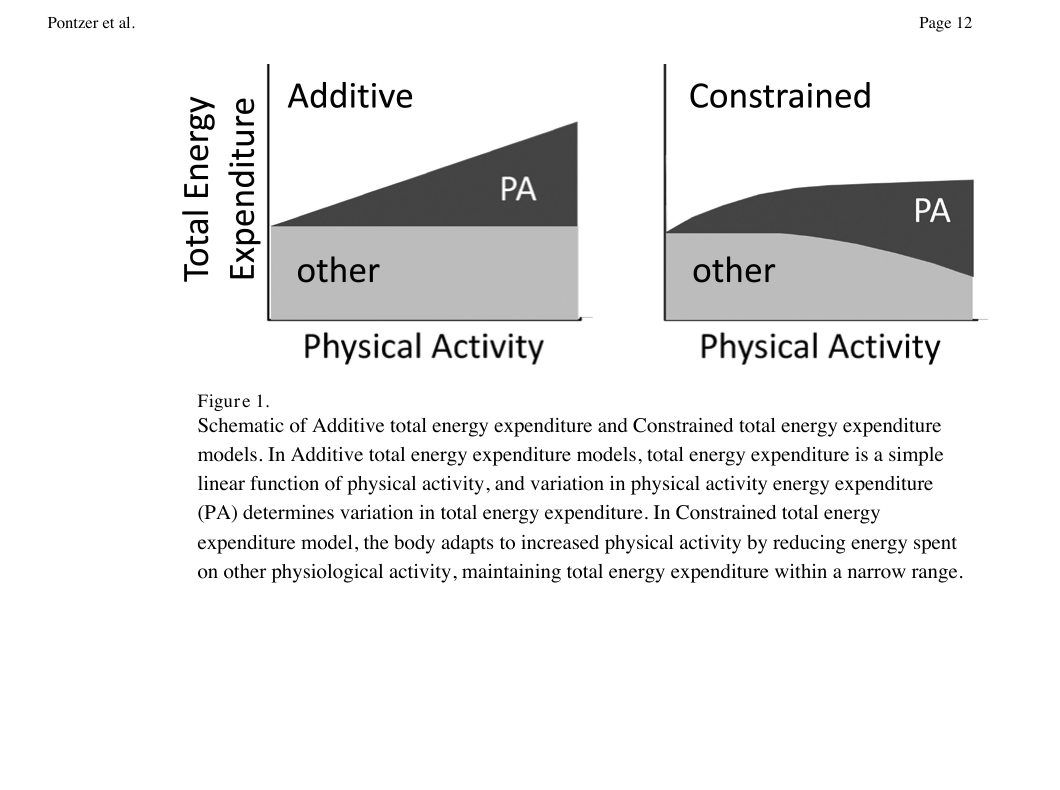
This compensation does not need to happen the same way for everyone. It also doesn’t mean that total spending is set in stone. The correct question is not “does the exercise add up or doesn’t it add up?”, but how much of the cost of the activity appears as a net increase in daily expenditure, for which person and for how long.
What the researchers found
Pontzer and colleagues analyzed 332 adults from five populations in Africa and North America. Total expenditure was measured with double-labeled water over seven days, while activity was recorded by accelerometer.
After adjusting the data for body composition, sex, age, height and location, activity continued to be associated with spending. The relationship, however, was not linear. It was stronger at low and intermediate levels and lost slope in the most active range of the sample.
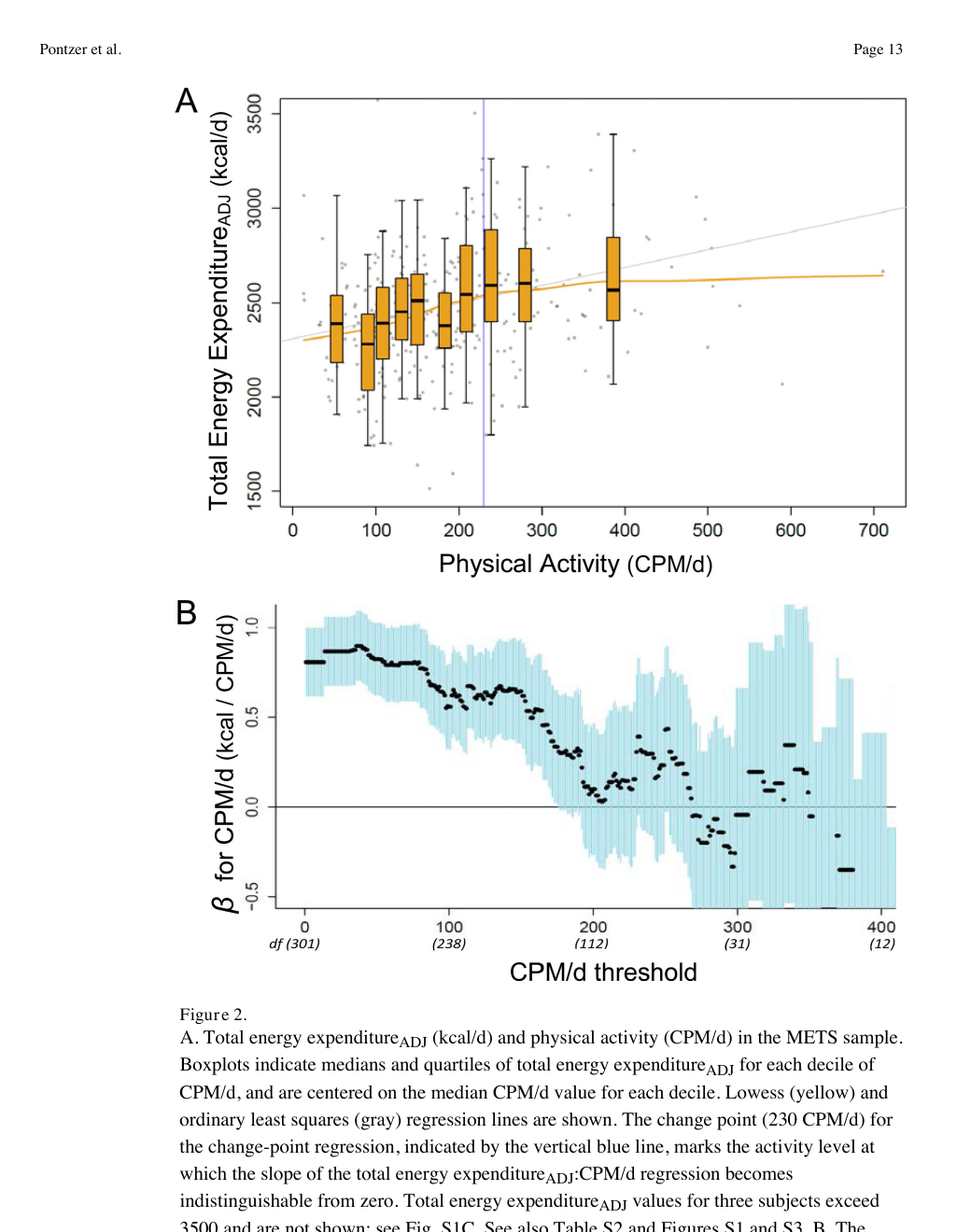
Activity explained only about 7% of the variation in adjusted energy expenditure. That does not make activity irrelevant: it shows that two people with similar movement levels can have very different daily energy expenditures.
The study also estimated a change point at 230 CPM/d, but the confidence interval was too wide. This value should not be converted to steps, minutes, or clock zones. It describes that sample and that accelerometer, not a universal biological boundary.
The result supports a non-linear relationship in that sample. The cross-sectional design does not allow us to conclude that an individual metabolic adaptation caused the plateau.
The population plateau is not an individual ceiling
The main caution is methodological: the study compared different people during a single period. It did not increase each participant's training and track their energy expenditure over several months.
Therefore, the flat curve may be compatible with adaptation, but does not prove that adaptation caused the finding. Differences in movement efficiency, occupation, nutrition, sleep, body composition and activities poorly captured by the accelerometer may also participate in the relationship.
The proposed mechanism itself was indirect. The authors calculated a residual expenditure component and suggested that it could represent unrecorded movements or physiological processes. They did not measure a specific reduction in immunity, reproductive function, tissue repair or organ activity.
A constraint-compliant pattern it is not proof of a universal metabolic ceiling.
Newer science has made history better — and less simple
Subsequent data reinforced the existence of compensation for some people. In 2021, an analysis of 1,754 adults estimated that, on average, 28% of extra spending linked to activity did not appear as a net increase in daily spending. Individual variation, however, was large and the design did not resolve the causal direction.
Exercise trials brought different responses. An analysis published in 2024 identified compensation in 48% of participants in a 24-week intervention, but found no adaptive reduction in resting metabolism or sleep to explain the effect.
In 2026, a small 12-week study found signs of adaptation in rest, sleep and walking economy, even though average total spending increased. Another study from the same year, with periods of high and low activity, observed a practically additive increase in total expenditure and no suppression of resting metabolism.
It is not a contradiction that should be hidden. It is the portrait of a variable biological system, studied with different protocols, durations and populations. The compensation hypothesis is plausible and supported, but the magnitude and mechanism are not yet closed.
Exercise remains a central tool
Turning this debate into “exercise doesn’t make you lose weight” is a mistake. Net spending can increase even when it is lower than calculated. Partial compensation is not cancellation.
Body weight is also not the only outcome. Cardiorespiratory capacity, strength, metabolic sensitivity, vascular function, autonomy and mental health can improve without a major change in the scale. Physical activity recommendations exist for this set of benefits, not just for calories.
The weight response still depends on intake. Hunger, food reward and the perception of “credit” after training can modify the balance in a way that is as relevant as the expense.
The practical criterion is to abandon rigid linear predictions. The value shown by the equipment describes a session or offers an estimate; it is not a metabolic check that guarantees the same deficit at the end of the day.
In high performance, compensation may be a warning sign, not an advantage
For the athlete, interpretation requires even more care. Total expenditure that rises less than expected does not automatically authorize a reduction in energy supply.
In phases of high load, the body can preserve weight while redistributing energy between training, recovery and physiological functions. If this stability is accompanied by persistent fatigue, worsening performance, menstrual or libido changes, increased frequency of injuries, poor sleep or slow recovery, the “plateau” should not be celebrated as efficiency.
The International Olympic Committee consensus on relative energy deficiency in sport reinforces that problematic low energy availability can compromise health and performance in athletes of both sexes. The diagnosis does not depend on a single number and requires clinical and multidisciplinary evaluation.
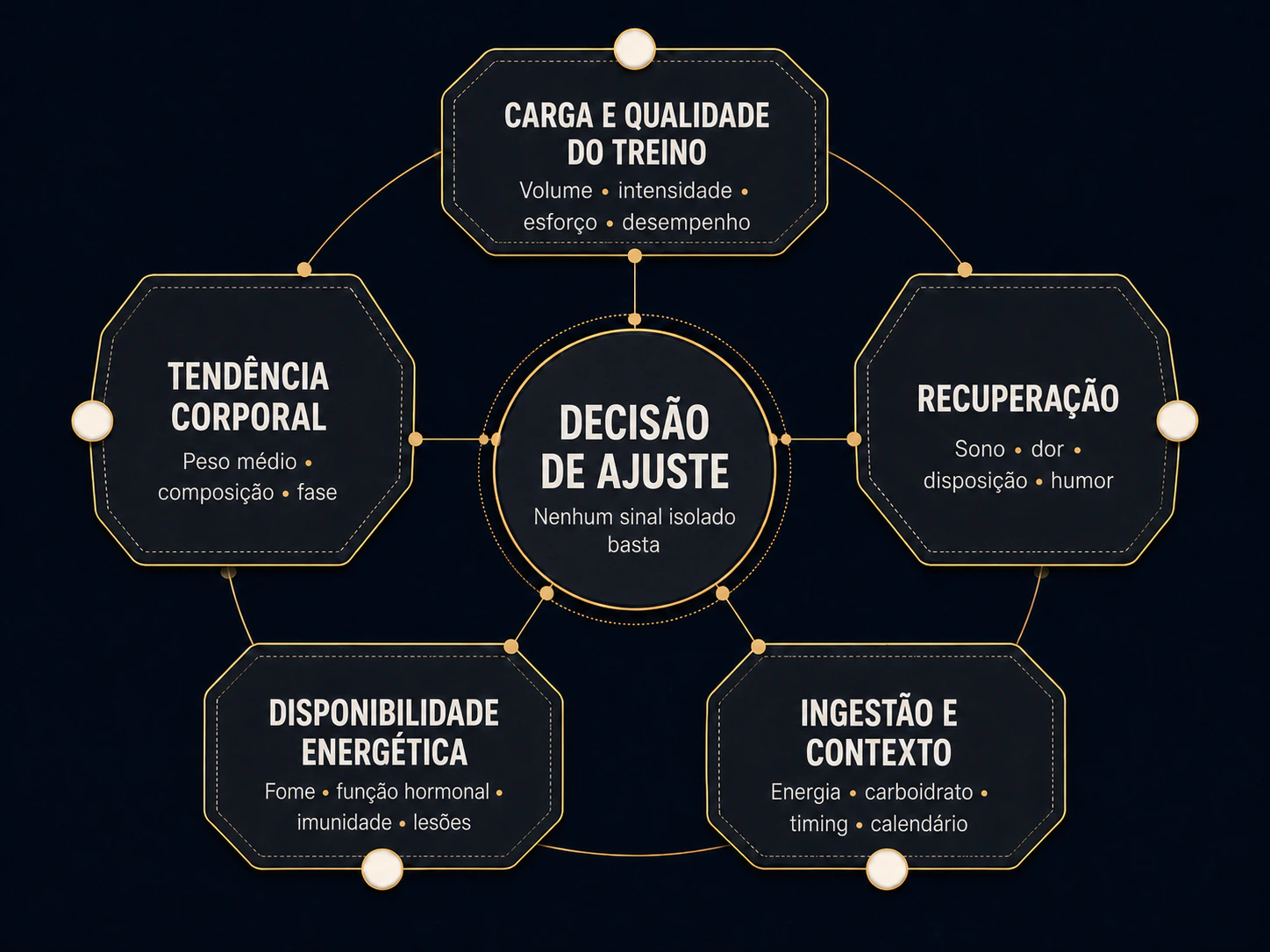
In the field, the decision improves when the estimated expense is compared with a series of answers:
- Training load and quality.Volume performed, intensity, perceived effort and ability to repeat performance.
- Body tendency.Moving average of weight, body composition when indicated and changes consistent with the phase.
- Recovery.Sleep, pain, disposition, mood and readiness for the next session.
- Signs of energy availability.Hunger, menstrual function, libido, bone health, immunity and injury history.
- Intake and context.Energy, carbohydrate, protein, timing, gastrointestinal tolerance and competitive calendar.
None of these variables alone completes the diagnosis. Together, they show whether the strategy is supporting adaptation or just keeping the balance stable at the expense of the process.
What changes in practice
Fat reduction
Use exercise to increase capacity, preserve lean mass, and contribute to the deficit, but review the actual response every two to four weeks.
Athletes
Periodize energy and carbohydrates according to the demand of the microcycle. Stable weight does not allow automatic fuel reduction.
Professionals
Use equations and wearables as starting points. Adjust prescription with repeated measures, trend, and context.
If the result diverges from the prediction, investigate intake, hunger, non-training movement, adherence, sleep and estimation error before concluding that the metabolism has “stuck”.
Also read about mitochondria and energy production, circadian rhythm and recovery and protein for athletes.
More exercise, more energy expenditure?
- The additive model is intuitive. The body is more dynamic
- The population plateau is not an individual ceiling
- What changes in practice
The body does not deny the cost of training. It negotiates the rest
The 2016 article remains valuable because it broke with an overly mechanical idea: that each calorie of exercise simply adds to the body's unresponsive daily expenditure.
Your mature reading is not that the exercise has stopped working. It's just that energy expenditure is regulated, variable and context dependent. In some people, the compensation will be small. In others, it may reduce an important part of the expected result. And we still don't know how to explain all the mechanisms with the same confidence.
When losing weight, this calls for better expectations. At high performance, it calls for smarter monitoring. In both cases, the safest decision begins when we stop treating the body like a calculator and start observing it as a system.
Verified references
Usage Note: educational content. Expenditure estimates and clinical signs do not replace individual assessment nor authorize automatic adjustment of intake or load.