

In the rupture of the anterior cruciate ligament, the rush usually chooses the verb before understanding the knee: operate. The problem is that two similar resonances can hide very different clinical trajectories.
One athlete may regain enough extension, strength, and stability to train and compete without episodes of giving way. Another may retain functional instability despite a well-designed rehabilitation programme. Between those extremes are meniscal injuries, sporting demands, fear, load tolerance, schedules, and goals that change the trade-offs of each pathway.
The period before surgery should not be treated as a waiting room. It can prepare a knee scheduled for surgery to reach the procedure in better condition. It may also reveal that, in selected cases, reconstruction is not necessary at that time.
After a rupture of the ACL, structured rehabilitation is treatment from day one. Surgery is a possibility within this process — not the automatic starting point for all people.
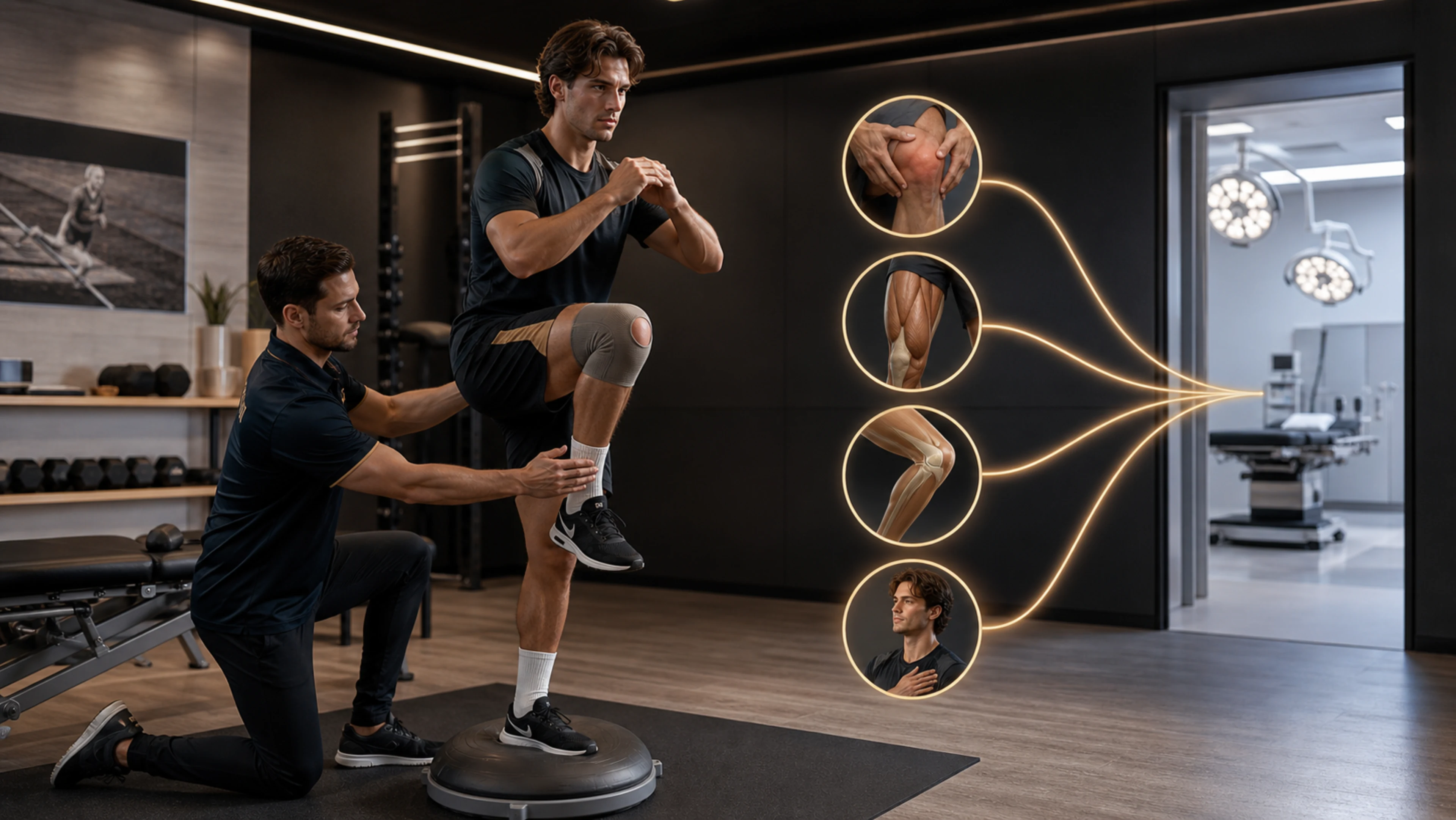
Pre-habilization and non-operative treatment are not synonymous
Pre-habilitation
A period of rehabilitation before a planned reconstruction. It aims to reduce joint effusion, restore range of motion, strength, and control, and establish baseline measures for postoperative rehabilitation.
Knee gets better before surgery.Rehabilitation first
A strategy in which the athlete progresses through non-operative treatment and reassesses the need for reconstruction according to stability, function, associated injuries, and goals.
The knee response is part of the decision.The two pathways begin with similar work but answer different questions. Prehabilitation aims to improve the starting point for surgery. A rehabilitation-first strategy uses the athlete’s progress to test whether surgery will add enough benefit to justify its cost, risk, and time.
Three trials, three populations — and a less comfortable conclusion
The most cited numbers in this discussion seem contradictory until one observes who was studied. KANON and COMPARE included people with acute rupture. ACL SNNAP studied non-acute lesions with persistent symptoms of instability. That difference changes the clinical question.
The bars used the same scale, but the studies had different populations and follow-up times.
Base: 59 participants in KANON’s optional-surgery strategy, 82 in COMPARE, and 160 in ACL SNNAP. ‘Without reconstruction’ describes status at the end of follow-up, not healing or return to sport.
In KANON, 121 young, active adults received structured rehabilitation; half were allocated to early reconstruction and half to the option of delayed surgery. At five years, 30 of the 59 participants in the optional-surgery strategy had undergone reconstruction. The groups did not differ significantly in knee function, quality of life, activity, meniscal surgery, or radiographic osteoarthritis.
In COMPARE, 167 adults with an acute rupture were followed for two years. Of the 82 who began with rehabilitation, 41 later underwent reconstruction. Early surgery finished 5.3 points higher on the IKDC, a statistically significant difference, but below what the authors considered clearly important to patients.
Among 316 patients with non-acute injury and persistent instability, KOOS4 at 18 months favoured the surgical strategy by 7.9 points. In this clinical context, the trial concluded that reconstruction was clinically superior and cost-effective.
This contrast does not invalidate rehabilitation. It shows that ‘ACL tear’ is too broad a category on which to base treatment. Someone assessed soon after an acute injury, before testing their capacity to compensate, is not equivalent to someone who presents months later with persistent episodes of giving way.
The question is not what treatment wins on average. That's what trajectory this knee is demonstrating.
Pre-habilitation produces individual evidence
A good initial phase is not a generic exercise catalogue. It reduces the factors that block function and measures whether the knee can tolerate progressions ever closer to real demand.
| Domain | What to assess | How the decision changes |
|---|---|---|
| DomainJoint irritability | TrackPain, joint effusion, and response during the 24 hours after loading. | DecisionIt shows whether the knee tolerates progression or if the dose still exceeds its capacity. |
| DomainRange of motion | TrackComplete extension, flexion and comparison with the contralateral side. | DecisionA stiff, inflamed knee is a poor starting point for either pathway. |
| DomainStrength | TrackQuadriceps, knee flexors, calf and asymmetries at standardized angles. | DecisionSeparates ligament instability from disability aggravated by inhibition and loss of strength. |
| DomainFunctional stability | TrackEpisodes of giving way, hops, landings, deceleration, and sport-specific tasks. | DecisionIt reveals whether the athlete controls the load when the task approaches the sport. |
| DomainPerception and readiness | TrackSelf-reported function, confidence, fear, and understanding of the process. | DecisionPhysical capacity without confidence may not survive the competitive environment. |
| DomainContext | TrackAssociated injuries, sport, position, calendar, work and informed preference. | DecisionThe same stability may be sufficient to run and insufficient to pivot under contact. |
There is no single test capable of indicating or excluding surgery. The decision integrates clinical examination, image, longitudinal evolution, future demand and shared preference.
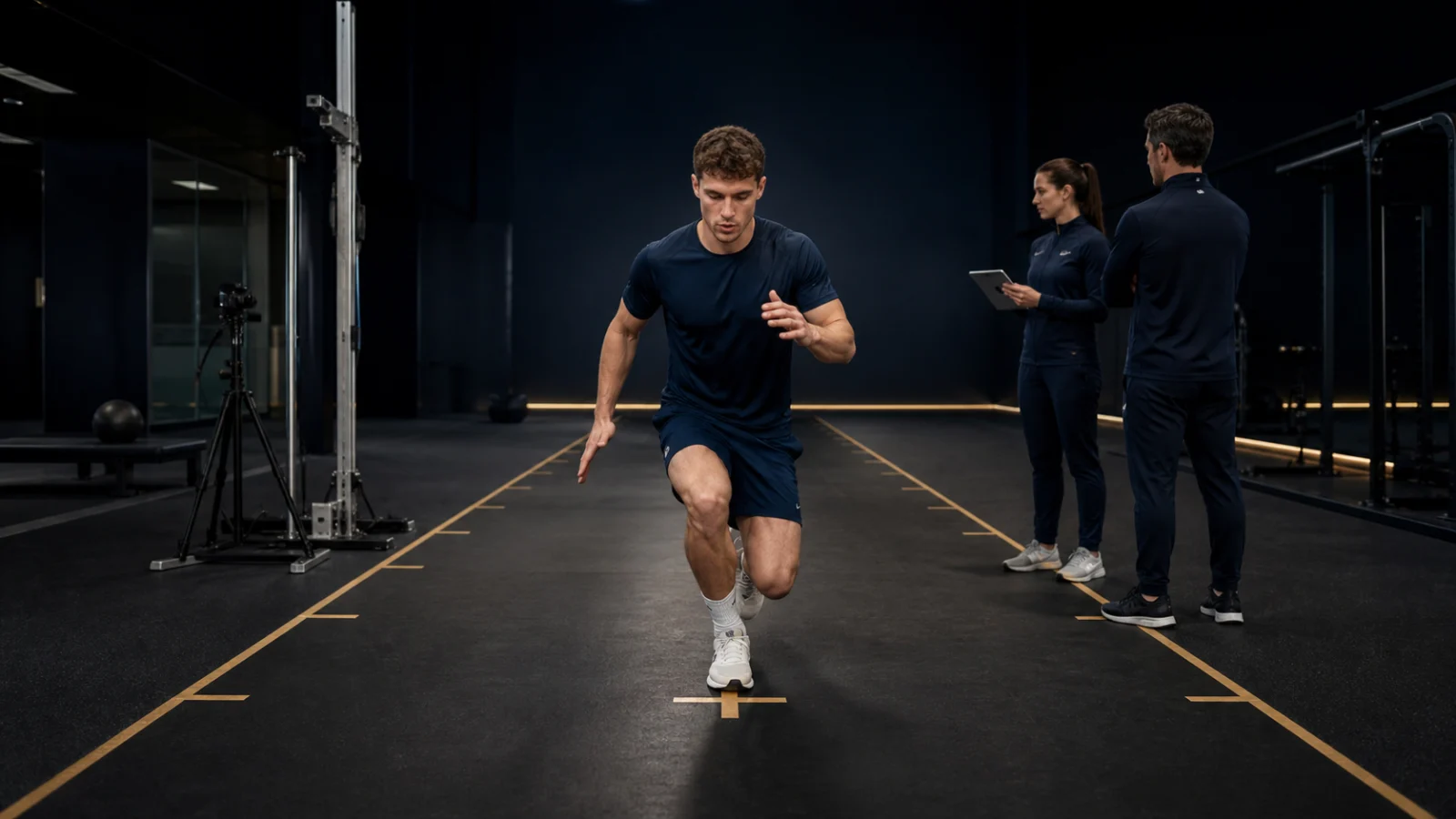
Systematic reviews suggest that pre-habilization can improve quadriceps strength, self-reported function and some jump tests after reconstruction. Confidence still needs to be proportional: by 2022, the OPTIKNEE synthesis classified this evidence as low; a review of 2025 found favorable results and good safety in 36 studies, but still requested more robust controlled trials and better described protocols.
Coper is not identity: it is a classification that can change
Some people recover enough dynamic stability for demanding activities without reconstruction and were called copers. Others continue to experience episodes of giving way and are classified as noncopers. Vocabulary is useful for organizing reasoning, but dangerous when it becomes a definitive label.
Classic screening of potential coper
Fitzgerald et al. · historical criteriaCompares the time of the injured limb with the contralateral limb.
Self-reported function in activities of daily living.
The patient's general perception of his current function.
In the period defined by the screening protocol.
These cut-offs are a screening tool, not automatic clearance to return to sport or a universal rule against surgery. They require clinical context, standardised testing, and reassessment.
In the Delaware–Oslo cohort, 271 athletes underwent ten progressive sessions of neuromuscular training and strength. Almost half of those initially classified as noncopers changed to potential coper. At two years, post-training classification was associated with success regardless of whether the final treatment was surgical or non-operative.
This changes the reading of the first evaluation. A weak, inflamed, newly injured knee may seem unable to compensate. Part of this disability belongs to acute trauma and muscle inhibition, not necessarily to an inevitable surgical destination.
How the ideas connect
When Surgery Takes Priority
Rehabilitation first does not mean persisting indefinitely with a pathway that is failing. Recurrent instability can expose the meniscus and cartilage to further episodes. Associated injuries may have their own timelines. An athlete who needs to pivot, cut, and absorb contact at high speed faces different demands from someone who wants to cycle, run in a straight line, or maintain daily activities.
Continue without surgery
- Isolated injury and functionally stable knee.
- No episodes of giving way during relevant tasks.
- Good response to the progression of force and control.
- Sport or occupational demand compatible.
- Informed preference and structured monitoring.
It does not mean discharge. Rehabilitation continues until capacity and exposure are consistent with the goal.
Reconstruction becomes more compelling
- Persistent functional instability despite good rehabilitation.
- Recurrent episodes of giving way.
- Sport or work involving pivots, turns, cuts, and contact.
- Repairable meniscal lesion or other compromised structures.
- Competitive objective incompatible with stability achieved.
Knee locking, suspected associated injury or acute worsening require orthopedic evaluation without waiting for a generic protocol to end.
The American Academy of Orthopaedic Surgeons guideline also organizes decision by level of activity, instability and associated injuries. It considers the non-surgical management in selected profiles reasonable, but favors reconstruction when there is functional instability, high pivot demand or combined lesions.
The ACL can heal — but the image does not decide alone
A secondary KANON analysis found MRI evidence of ACL continuity in 16 of 54 participants allocated to rehabilitation with optional surgery at two years. Among the 30 who remained in rehabilitation alone, 16 showed this sign. The group with an appearance of healing reported better outcomes, but the analysis was small and did not randomise people to heal or not heal.
Cross Bracing Protocol further increased interest by reporting ligament continuity in 72 out of 80 people after initial immobilization at 90 degrees of flexion and progressive rehabilitation. It was a series of cases without control group; 11 participants suffered new injury. The authors requested long follow-up and clinical trials before transforming the protocol into routine.
MRI continuity is a structural finding. The clinical decision still depends on stability, symptoms, function, associated injuries, and demand. An image that appears healed does not automatically mean the knee is ready to compete.
A better flow to decide
From injury to shared decision
The flow is explanatory and does not replace individual evaluation. An early indication may redirect the process before the prolonged rehabilitation stage.
Torn ACL: the decision starts before surgery.
- Three trials, three populations — and a less comfortable conclusion
- Coper is not identity: it is a classification that can change
- A better flow to decide
The decision that rehabilitation improves
ACL rupture does not offer a universal response because surgery and rehabilitation do not compete under equal conditions. Reconstruction can restore mechanical stability and be the most coherent choice for some athletes. Rehabilitation can prevent unnecessary operation in others. And almost everyone benefits from reaching the decision with less edema, more movement, more force and repeated data.
The error is confusing speed with accuracy. Early operation can be correct when there is clear indication. To rehabilitate before can be correct when there is still a legitimate question to answer.
The best time to decide is not when the MRI ends. It's when image, function, context and objective finally tell the same story.
Frequently asked questions
Does every complete ACL rupture require surgery?
Not necessarily. Some people with isolated lesions recover functional stability with rehabilitation and do not present false in relevant activities. Pivot demand, instability, associated injuries and sports objective increase the weight of reconstruction.
Does pre-habilitation delay surgery?
When there is no reason for early intervention, prehabilitation uses this period to reduce joint effusion, restore range of motion and strength, and record baseline measures. Timing should be defined with the clinical team because associated injuries may require a different degree of urgency.
How long does it take to know if the non-operative treatment will work?
There is no single timeframe. The trials used different strategies and populations. The decision should follow clinical criteria and functional progression, not a date alone; recurrent episodes of giving way or associated injuries may bring the surgical discussion forward.
Does the ligament appear continuous on the MRI mean it healed?
It's promising structural evidence, but it doesn't end the evaluation. Clinical stability, symptoms, strength, specific tasks and exposure tolerance remain necessary to interpret the functional significance of the image.