

On Monday, the division seems logical. Anyone who played more than 60 minutes recovers. Those who played little or didn't enter need a compensatory stimulus.
The session corrects part of the difference created by the game and prevents the non-starter from going through the season accumulating less exposure than they need to be prepared.
But there is a question that this organization alone cannot answer: What will happen to this player next Sunday?
If a player comes off the bench in the previous match, completes a substantial compensatory session on MD+1, and then starts the next match, the week is no longer a substitute's week. It now combines compensation, training, and a full new competitive exposure.
In U23, U21 and U19 teams from the same club, players who went from non-starter to starter had one of the highest accumulated external loads of the week.

The week has memory — and also destiny
Much of the periodization in football organizes the microcycle based on what has just happened. The previous game determines who recovers, who compensates, and how much remains to restore certain exhibits.
This retrospective logic is necessary. The problem starts when it becomes the only logic.
Between one Sunday and the next, the player can change roles due to a technical decision, suspension, injury to a teammate, rotation, travel, integration between categories or strategy for the opponent. Therefore, the study separated athletes into four trajectories:
- SS: starter in the previous game and starter in the next;
- SN: holder before and non-holder after;
- NS: non-holder before and holder after;
- NN: not a starter in both games.
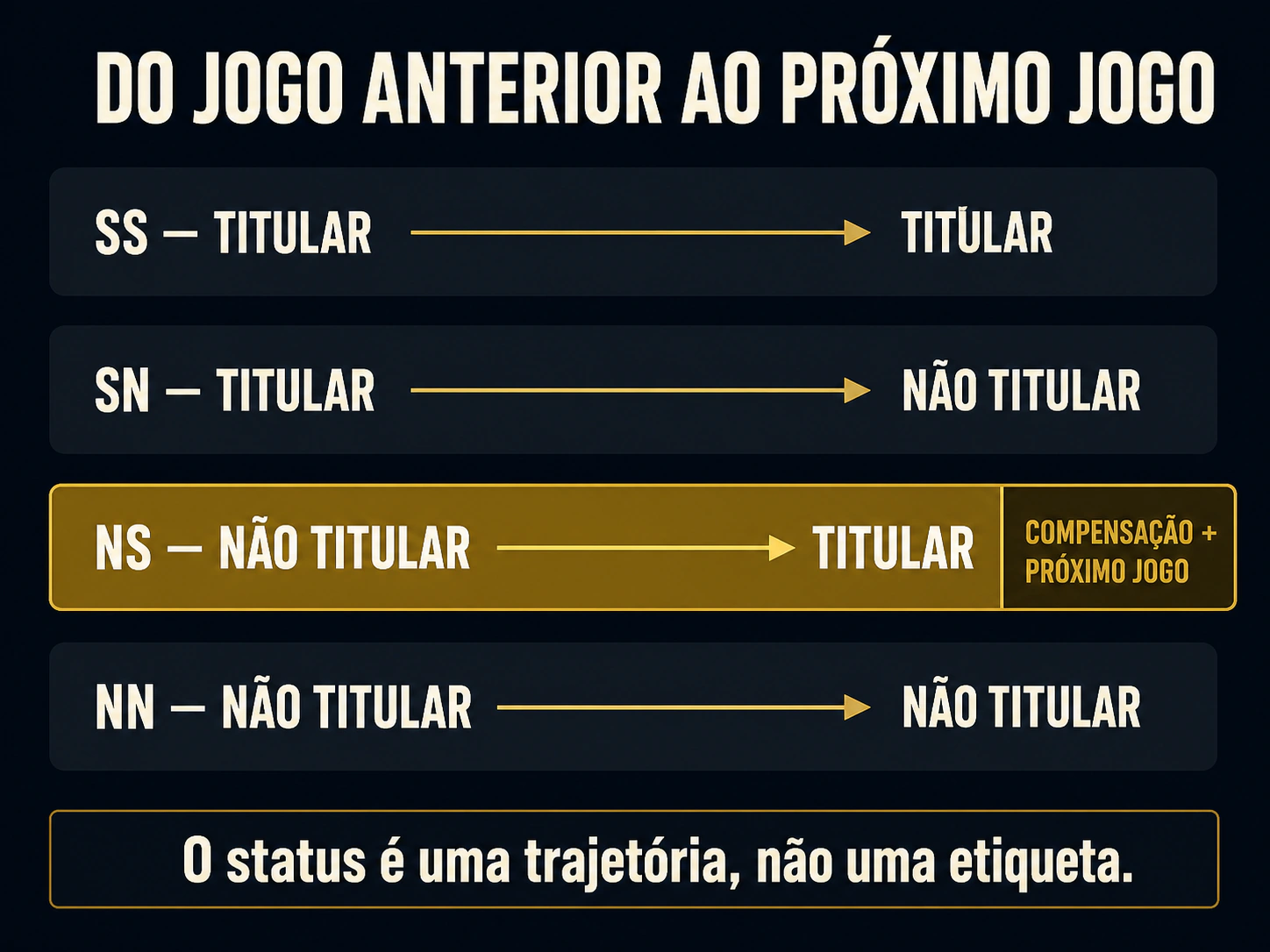
This classification changes the question. Instead of comparing “starters versus reserves” as fixed groups, it follows the transition between two matches. And the most sensitive transition was NS: the player who didn't start the first game, but would start the second.
What was measured
The study followed 60 players from the U23, U21 and U19 categories of a professional club. Training sessions and matches were recorded by GPS, and the accumulated external load was added from Monday to Sunday.
The analysis included total distance, player load, acceleration load, accelerations, decelerations and distances in different speed ranges. The design only considered regular weeks, with games on Sundays and five or six training sessions.
Monday was the turning point. Anyone who had played more than 60 minutes recovered. Those who had participated less received a compensatory session designed to replace a relevant part of the competitive stimulus. The following Sunday, the new match completed the weekly sum.
| Category | NN | NS | SN | SS |
|---|---|---|---|---|
| U23 | 26,997 m | 35,649 m | 23,293 m | 34,428 m |
| U21 | 25,165 m | 34,749 m | 23,197 m | 31,810 m |
| U19 | 26,272 m | 33,995 m | 24,069 m | 33,257 m |
Article data faithfully redesigned. NS = not a starter in the previous match and starter in the next.
In all three categories, the NS and SS groups had more overall burden than NN and SN. In global variables, the week was around three to four times the demand for a match.
As speed increased, this multiple tended to drop — a reminder that accumulating distance does not, in itself, guarantee sufficient exposure to the game's faster actions.
The NS player receives load from both sides
The pattern is consistent with the architecture of the week. The NS athlete arrives on Monday with low competitive exposure and, therefore, receives compensation. Afterwards, participate in microcycle training. The following Sunday, start the game and add a full charge to the accumulated.
The SN athlete takes the opposite path. He starts the week recovering from the previous game and ends it without the same exposure in the next game. Not surprisingly, his total is lower.
This observation prevents a wrong interpretation. The study did not find that “reserves overtrain” nor that compensation is inadequate. Part of the difference happens because the groups were defined by the game that ends the week.
When planning only looks at the minute played yesterday, he may not see tomorrow's likely demand.
More load does not automatically mean excessive load
The word “bigger” is often quickly converted into “excessive”. The study does not authorize this exchange.
There was no measurement of fatigue, pain, sleep, alertness, perceived exertion, injury or performance. Therefore, we do not know whether the NS players arrived at the second game more tired, more prepared or simply more exposed.
The compensatory session may be exactly the stimulus that preserves readiness in players who did not play. Removing it whenever there is a chance of starting would also create a risk of underexposure. In football, protecting a player does not necessarily mean doing less; it means delivering the right dose, at the right time, for that trajectory.
There is also no universal number drawn from this article. The sample came from a single club, with young players, one-game weeks and absolute speed thresholds. Behavior may change across senior professionals, two-game schedules, other positions and different compensation models.
The error is not MD+1 itself. It is finalizing the decision on MD+1
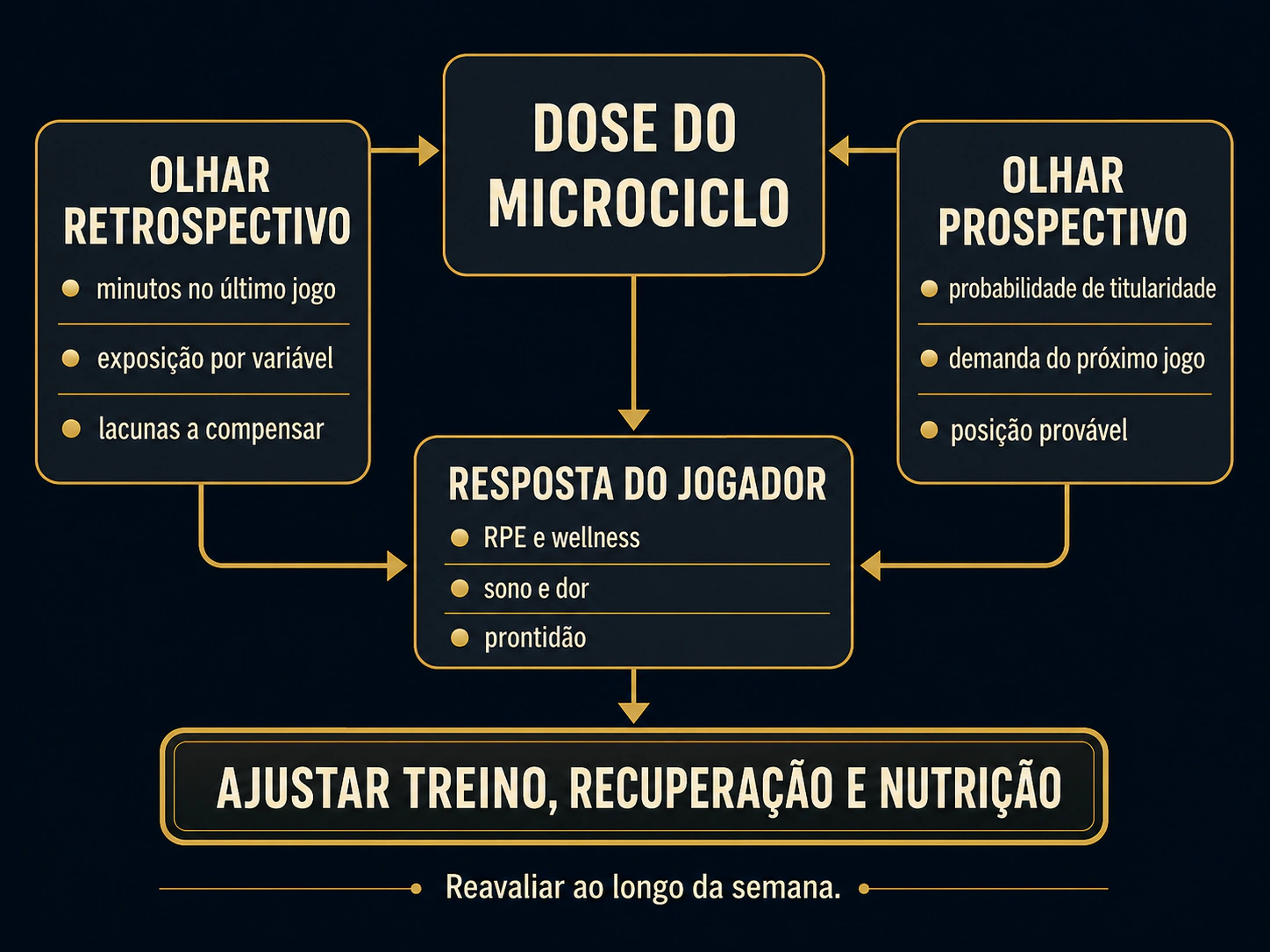
Post-game compensation needs to address a real gap. But your dose shouldn't just be born from the past. It can incorporate the probability of participation in the next game and be revised as the week progresses.
This suggests reasoning in two directions:
- Retrospective: How much did the athlete perform in the previous game and which stimuli were below the target?
- Prospective: what is the chance of him starting or accumulating many minutes in the next game?
These questions do not eliminate uncertainty from the lineup. They make uncertainty explicit.
A player with low exposure on Sunday and a low probability of starting the next match may need a substantial compensatory session. Another player with the same previous exposure but a high probability of starting may need the same stimulus quality distributed differently.
Monitoring that accompanies the transition
In practice, projected status may fall into the same flow as the committee already discussing minutes, position, return from injury and individual needs.
- After the game: close the exhibition held.Record minutes, distance, high speed, sprint, accelerations, decelerations and position-specific demands.
- Before compensation: estimate the next role.Classify the probability of participation as low, intermediate or high.
- Mid-week: update load and scenario.Reevaluate the accumulation after MD-4 and MD-3 and adjust sessions without chasing volume just for the last game.
- Close to the game: comparing external load with internal response.Perceived effort, wellness, sleep, muscle pain and readiness help contextualize the GPS.
- After the decision: learn from the cycle.Compare the plan with what actually happened and use the history to improve the next prediction.
Reserve yesterday, starter tomorrow.
- The week has memory — and also destiny
- The NS player receives load from both sides
- Monitoring that accompanies the transition
Nutrition also needs to account for next Sunday
The same error can happen when supplying. If the nutritional strategy classifies the athlete only based on the previous game, the non-starter may receive less energy and carbohydrates precisely in the week in which he accumulates compensation, training and a full match.
Demand is not defined by the label “reserve”; it emerges from the actual microcycle and the likely role. This doesn't mean overfeeding every player who can start. It means periodizing with concrete signs: load performed, next session, projected minutes, gastrointestinal tolerance, body composition objective, recovery and individual response.
For the NS group, the priority is usually twofold: recovering compensatory work without erasing the stimulus and arriving at the next game ready to compete. When the lineup changes, the meal plan also needs to change — ideally before the athlete takes the field.
Also read about circadian rhythm and recovery, mitochondria and energy production and protein for athletes.
Plan players, not labels
The study by Casamichana and colleagues does not provide a formula for reducing the compensatory session. It provides a better question.
The athlete who didn't start the last game may be the one who will accumulate the most load until next Sunday. If the committee only sees the past match, the microcycle appears coherent from day to day and yet produces weekly exposure that no one anticipated.
The solution is not to abandon compensation or treat every high load as a threat. It's integrating what happened, what will probably happen and how the player is responding between one thing and another.
In football, starter and reserve are transitional states. Periodization needs to be equally dynamic.
Verified references
Usage Note: the study describes external load in a club and does not establish that greater exposure caused fatigue, injury or worsening of performance. The application must be individualized.