

A spreadsheet can be correct in every cell and wrong as a system.
The training session was completed. The protein target was met. The recovery protocol was followed. Sleep received a score. Weekly load remained inside the planned range. Yet the athlete reaches competition without the response everyone expected.
This does not necessarily mean that one of those parts failed. They may have been organized as independent departments while the body received them as a single story.
Performance is not the sum of the best components. It is a property that emerges from the relationships among stimulus, resources, athlete state, skill, environment, and decision-making.
Training remains essential. Nutrition remains essential. Recovery remains essential. But none has complete sporting meaning outside the work that must be produced, the moment in which it is applied, and the system receiving it.

Why we divide what the body integrates
Science needs to decompose problems. To discover the effect of an intervention, it tries to control everything else. This reduction is a methodological virtue: without it, separating signal from noise would be difficult.
The mistake begins when we transfer that division into practice as though it described how an athlete actually functions.
In the laboratory, we can study carbohydrate, sleep, load, strength, or attention separately. In competition, they arrive together. Carbohydrate availability changes the ability to sustain a given workload; the session changes energy and recovery needs; travel changes sleep; sleep changes perceived exertion, mood, and readiness; pain and anxiety can change movement and decisions. The calendar changes the value of every choice.
This is why contemporary work on integrated periodization proposes coordinating training, recovery, nutrition, psychological skills, and skill acquisition rather than periodizing exercise alone. The goal is not to make everything complicated. It is to stop one specialty from optimizing its part while worsening the shared outcome.
What makes performance a system
A system is not merely a collection of items. It has relationships, feedback, delays, boundaries, and context.
- RelationshipsThe effect of one variable depends on others. The same session does not mean the same thing with sufficient sleep and available energy as it does after travel, pain, and low intake.
- FeedbackThe response to the plan informs the next decision. Without feedback, periodization becomes a calendar, not regulation.
- DelaysSome decisions create an immediate sensation, but their real value appears days or weeks later. Acute fatigue can coexist with future adaptation.
- NonlinearityDoubling an input does not necessarily double the output. More load can produce adaptation, stagnation, or maladaptation depending on accumulated dose and athlete state.
- ContextPerformance exists only in relation to a task. Competition requires capacity to meet time, space, an opponent, pressure, and uncertainty.
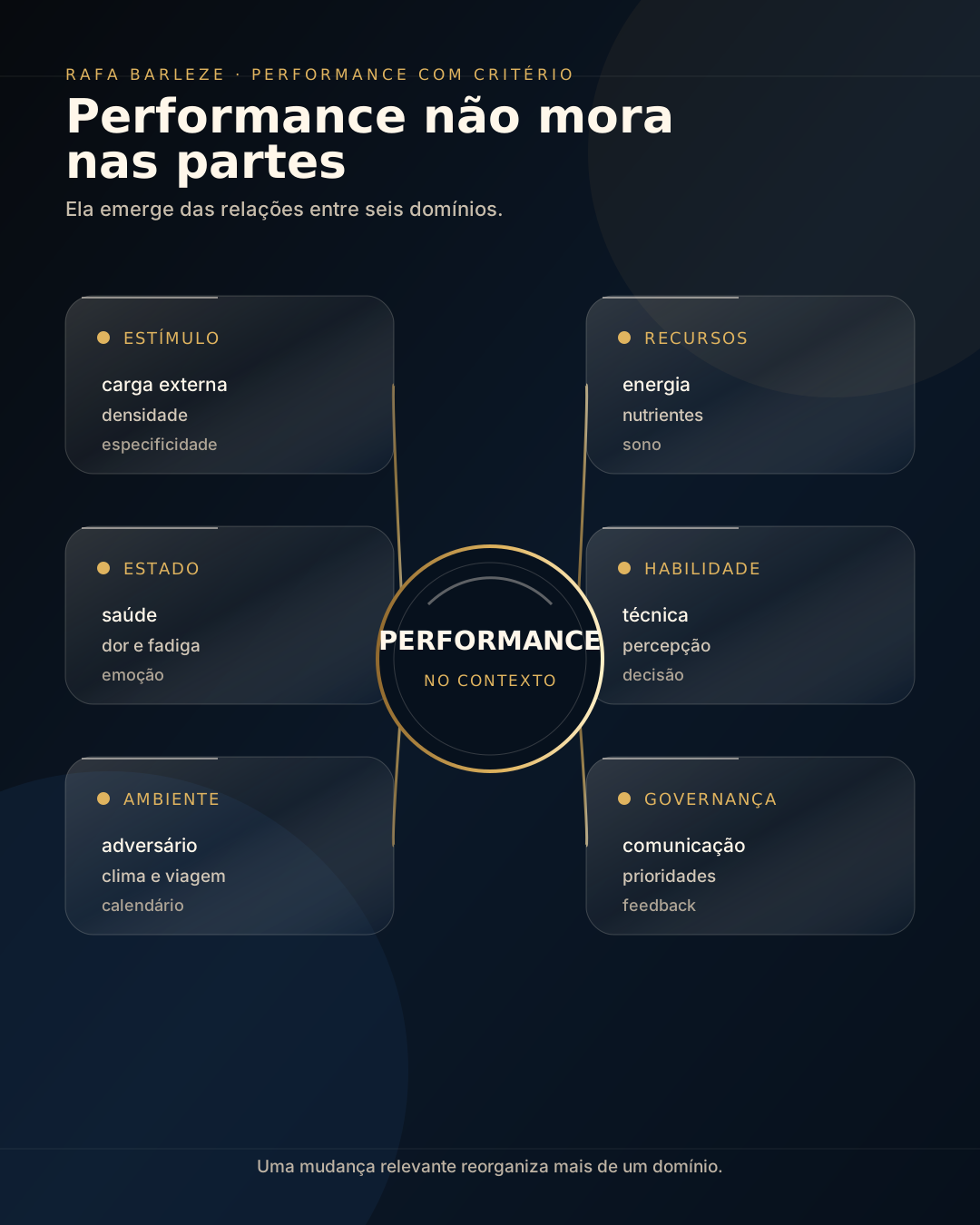
Research applying complex-systems thinking to sport helps make this visible. In injury and rehabilitation, for example, the outcome rarely belongs to one factor; it emerges from interactions that change over time. In sports organizations, priorities, communication, roles, and well-being can also influence what happens on the court. This does not make every cause unknowable. It makes the search for one universal explanation inadequate.
Training is a stimulus. Adaptation is a response from the system
External load is the work performed: distance, speed, repetitions, kilograms, accelerations, duration. Internal load is the psychophysiological response to that work: heart rate, perceived exertion, metabolic disturbance, subjective experience, and other responses depending on the measure selected.
The distinction is decisive. A coach prescribes an exposure; a coach does not directly prescribe the adaptation.
Two athletes can complete the same session and receive different internal doses. The same athlete can respond differently across two weeks. That does not justify calling every fluctuation “individuality.” Some apparent individual response may be measurement error or ordinary day-to-day biological variability. Rigorous individualization requires a baseline, a reliable measure, a meaningful change, and context—not a reaction to every number that moves.

The best program, therefore, is not the one that looks perfect before it starts. It is the one with enough quality to generate a hypothesis and enough sensitivity to learn from the response.
How the ideas connect
Nutrition and recovery do not sit beside training. They change what it means
Nutrition is not merely replenishment afterward. Energy and nutrient availability contribute to the ability to perform the work, adaptive signaling, tissue synthesis, immune function, and recovery between exposures.
This is why “clean eating” is a poor high-performance criterion. A diet can look exemplary while delivering too little energy for the load. The IOC consensus on REDs describes problematic low energy availability as the origin of physiological and psychological impairment that can, individually and synergistically, compromise health, availability, and performance. Improving a power-to-weight ratio on paper while hormonal function, bone health, immunity, glycogen synthesis, and the ability to train deteriorate is the definition of optimizing the part and losing the system.
Recovery is not the absence of training or a collection of devices. It is the process of restoring availability for the next demand while balancing sporting and non-sporting stress. Sleep, intake, load spacing, symptom management, and psychological safety often matter more than the most sophisticated tool in the room.
Even recovery must be periodized. Between two matches, accelerating restoration may be the priority. During a developmental block, removing every disturbance may conflict with the stimulus meant to teach the body to adapt. The mature question is not “what is the best recovery method?” but “recover what, for which demand, in how much time, and at what cost?”
Skill exists only when it meets the environment
An athlete can improve strength, speed, and aerobic capacity without a proportional improvement in competitive performance. There is no contradiction: physical capacities expand possibilities, but sport demands the selection and coordination of actions under real constraints.
In ecological dynamics, skill emerges from the relationship among individual, task, and environment. In football, acceleration is not just force production; it occurs in response to space, the ball, a teammate, an opponent, and time. Training isolated components may be necessary. The problem is assuming that integration will happen automatically.
The gym builds resources. The field must teach the system to use them. Competition tests whether that use survives uncertainty.
The danger of winning a metric and losing the athlete
Systems create goal conflicts. The nutritionist may pursue body composition; the strength and conditioning coach, load; the physical therapist, symptom reduction; the head coach, immediate availability; the athlete, a sense of confidence. Everyone can be technically correct and collectively misaligned.
- Maximizing instead of fitting.More training, less fat, more control and more data always seem desirable. In biological systems, the optimum is rarely the maximum.
- Confusing a marker with an outcome.Improving a test, sleep score, or enzyme does not guarantee improvement in the competitive task.
- Reacting to a point and ignoring the trajectory.One value may be noise. Trend, magnitude, reliability, and context change its interpretation.
- Fragmenting responsibility.When each department issues a recommendation and no one resolves the conflicts among them, the athlete becomes the place where the multidisciplinary team offloads its lack of integration.
In professional football, lower injury burden and greater match availability were associated with better sporting performance across 11 seasons. The observational design does not allow availability to be treated as the sole cause of winning, but it leaves a valuable principle: a capacity that is unavailable at the competitive moment has limited value.
A performance system needs governance
Integration does not mean putting many professionals in the same room. It means producing a coherent decision.
An operating model can begin with six questions:
1. Which demand must appear?
Define the sporting outcome before the tool: sustain speed late in a match, tolerate contact, repeat sprints, decide under pressure, increase maximal strength, or arrive available for the next fixture.
2. What is the athlete’s current state?
Combine history, recent exposure, symptoms, well-being, performance, and context. State is not a color generated by an algorithm; it is a hypothesis with uncertainty.
3. What is the smallest adequate dose?
Choose a stimulus sufficient to move the capacity without unnecessarily consuming the resource required by the next demand.
4. Which resources make that dose usable?
Plan energy, carbohydrate, protein, fluids, sleep, spacing, and psychological support around the work, not as an independent routine.
5. Which signal will show whether the response was acceptable?
Select a small number of measures that can inform load, state, and response. The monitoring framework published in 2026 reinforces a minimal, adequate, and accurate selection: economical in resources, sufficient for the objective, and grounded in validity and reliability.
6. Who integrates conflict and decides?
Define responsibility, shared language, and a review point. Data without conversation produce a dashboard. Expertise without governance produces competing recommendations.
Sophistication lies in how well the system learns
From concept to decision
Performance is not training, nutrition, or recovery in isolation. Performance is a system.
- What makes performance a system
- Training is a stimulus. Adaptation is a response from the system
- A performance system needs governance
Individualization is not improvisation
Systems thinking can become an excuse to abandon standards: “everything depends,” “every athlete is unique,” “practice is complex.” That would be a regression.
Complexity does not eliminate protocols. It requires protocols that know where they end.
Good decisions still depend on evidence, definitions, reliable measurement, and safety. The difference is that these elements feed a responsive process rather than a universal recipe. Individualization means adjusting a defensible starting point to the observed response within clear clinical and sporting boundaries.
Not every deviation requires change. Not every sign of fatigue requires rest. Not every improvement in sensation justifies more load. And relevant symptoms should not be absorbed by a dashboard; they require appropriate assessment.
The philosophy of the system: control less, understand more
Performance culture still imagines the athlete as a sophisticated machine. The correct input goes in; the predicted adaptation comes out. When the result fails, we look for the defective part.
But an athlete is a living, open, historical system. Athletes carry previous exposures, learn, compensate, anticipate, feel, interpret, and change with the environment. Their variability is not only error; in part, it is how a living organism remains adaptable.
This does not diminish planning. It makes planning humbler and more precise.
Excellence stops being the attempt to control every detail and becomes the ability to organize relationships, recognize bottlenecks, protect resources, and correct course before the system sends the bill.
The best isolated training session does not win. The best isolated diet does not win. The best isolated recovery protocol does not win.
The whole athlete performs, at a specific moment, against a demand that never asks which department did the best work.
Frequently asked questions
Does treating performance as a system mean everything matters equally?
No. Importance changes with the sport, athlete, phase, and demand. Systems thinking does not make factors equal; it helps identify which relationship or bottleneck is limiting the outcome now.
If everything interacts, is measuring isolated variables still useful?
Yes. Isolated measures can inform relevant parts when interpretation respects validity, error, baseline, and context. The problem is not measuring one part; it is treating that part as the complete explanation.
What is the main sign that the system is working?
There is no universal indicator. The overall picture should show that the athlete tolerates the process, develops the intended capacity, and expresses it when the task demands it while maintaining health and availability compatible with the objective.
Is more recovery always better?
No. Recovery must serve the next demand and the block's objective. Between closely spaced competitions, rapid restoration may be central; during development, some disturbance is part of the adaptive signal.
Is technology necessary for systems thinking?
No. Technology can expand observation, but integration begins with a clear demand, a few reliable measures, communication, and decision review. A simple system that learns is often better than a sophisticated dashboard that only accumulates data.
Verified references
- Rebelo A, Bishop C, Thorpe RT, Turner AN, Gabbett TJ. Monitoring Training Effects in Athletes: A Multidimensional Framework for Decision-Making. Sports Medicine. 2026;56(7):1603–1624. DOI: 10.1007/s40279-026-02417-4.
- Mujika I, Halson S, Burke LM, Balagué G, Farrow D. An Integrated, Multifactorial Approach to Periodization for Optimal Performance in Individual and Team Sports. International Journal of Sports Physiology and Performance. 2018;13(5):538–561. DOI: 10.1123/ijspp.2018-0093.
- Impellizzeri FM, Marcora SM, Coutts AJ. Internal and External Training Load: 15 Years On. International Journal of Sports Physiology and Performance. 2019;14(2):270–273. DOI: 10.1123/ijspp.2018-0935.
- Bourdon PC, Cardinale M, Murray A, et al. Monitoring Athlete Training Loads: Consensus Statement. International Journal of Sports Physiology and Performance. 2017;12(Suppl 2):S2-161–S2-170. DOI: 10.1123/IJSPP.2017-0208.
- Kellmann M, Bertollo M, Bosquet L, et al. Recovery and Performance in Sport: Consensus Statement. International Journal of Sports Physiology and Performance. 2018;13(2):240–245. DOI: 10.1123/ijspp.2017-0759.
- Walsh NP, Halson SL, Sargent C, et al. Sleep and the Athlete: Narrative Review and 2021 Expert Consensus Recommendations. British Journal of Sports Medicine. 2021;55(7):356–368. DOI: 10.1136/bjsports-2020-102025.
- Mountjoy M, Ackerman KE, Bailey DM, et al. 2023 International Olympic Committee's (IOC) Consensus Statement on Relative Energy Deficiency in Sport (REDs). British Journal of Sports Medicine. 2023;57(17):1073–1098. DOI: 10.1136/bjsports-2023-106994.
- Hägglund M, Waldén M, Magnusson H, et al. Injuries Affect Team Performance Negatively in Professional Football: An 11-Year Follow-Up of the UEFA Champions League Injury Study. British Journal of Sports Medicine. 2013;47(12):738–742. DOI: 10.1136/bjsports-2013-092215.
- Dijkstra HP, Pollock N, Chakraverty R, Alonso JM. Managing the Health of the Elite Athlete: A New Integrated Performance Health Management and Coaching Model. British Journal of Sports Medicine. 2014;48(7):523–531. DOI: 10.1136/bjsports-2013-093222.
- Bittencourt NFN, Meeuwisse WH, Mendonça LD, Nettel-Aguirre A, Ocarino JM, Fonseca ST. Complex Systems Approach for Sports Injuries: Moving from Risk Factor Identification to Injury Pattern Recognition. British Journal of Sports Medicine. 2016;50(21):1309–1314. DOI: 10.1136/bjsports-2015-095850.
- Hulme A, McLean S, Read GJM, Dallat C, Bedford A, Salmon PM. Sports Organizations as Complex Systems: Using Cognitive Work Analysis to Identify the Factors Influencing Performance in an Elite Netball Organization. Frontiers in Sports and Active Living. 2019;1:56. DOI: 10.3389/fspor.2019.00056.
- Woods CT, McKeown I, Rothwell M, Araújo D, Robertson S, Davids K. Sport Practitioners as Sport Ecology Designers. Frontiers in Psychology. 2020;11:654. DOI: 10.3389/fpsyg.2020.00654.
- Armstrong LE, Bergeron MF, Lee EC, Mershon JE, Armstrong EM. Overtraining Syndrome as a Complex Systems Phenomenon. Frontiers in Network Physiology. 2022;1:794392. DOI: 10.3389/fnetp.2021.794392.
- Bonafiglia JT, Preobrazenski N, Gurd BJ. A Systematic Review Examining the Approaches Used to Estimate Interindividual Differences in Trainability and Classify Individual Responses to Exercise Training. Frontiers in Physiology. 2021;12:665044. DOI: 10.3389/fphys.2021.665044.
Educational content. Systems thinking does not replace clinical assessment, safety criteria, or the responsibility to interpret measures in the athlete’s context.