

The first sprint shows power. The sixth reveals the system.
This difference seems small, but it completely changes the way we interpret conditioning in sports classified as “anaerobic”. Football, basketball, fights, tennis and various power tests contain very short, intense actions that depend on quick energy. The competition, however, rarely ends after a single action.
In sports dominated by explosive actions, VO₂max is often underestimated because it does not alone determine the first acceleration, jump or hit. The mistake is to confuse the predominant energy source of an action with the systems necessary to repeat it.
Treating aerobic capacity as an isolated solution would be equally inaccurate. VO₂max does not replace speed, strength, technique, power or anaerobic capacity. It works as part of the infrastructure that allows you to recover these qualities and repeat them with less loss.
This is a decisive distinction for high performance: the aerobic system may not star in the action that appears in the replay, but it works intensely in the interval that makes the next action possible.
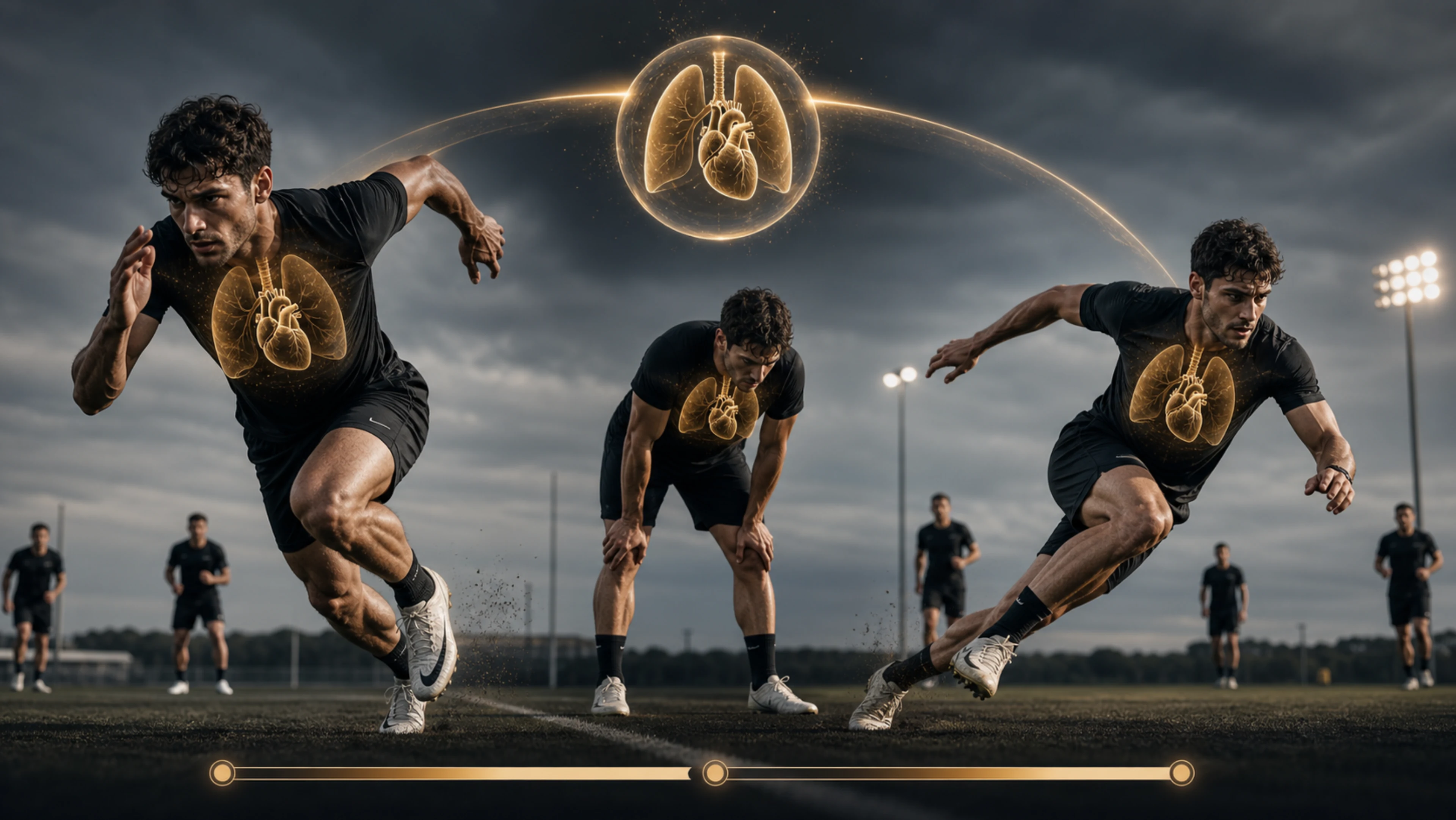
The action may be anaerobic. The sequence is not
In a short sprint, jump or heavy lift, initial power depends mainly on the ATP already available in the muscle, phosphocreatine and rapid glycolysis. This is why these actions are correctly described as predominantly anaerobic.
The error starts when the action classification is transferred to the entire modality.
After a sprint, the athlete needs to restore phosphocreatine, reorganize the metabolic balance and produce strength again. This process occurs while he walks, jogs, repositions himself, receives instructions or waits for the next repetition. In this window, oxidative metabolism — the system that uses oxygen — assumes an important role.
A classic study by Bogdanis and colleagues helps visualize the mechanism. Eight men performed two cycling sprints separated by four minutes. After 3.8 minutes, phosphocreatine had returned to approximately 79% of the resting value, and its resynthesis correlated strongly with the recovery of power and speed at the start of the second sprint. In the second effort of 30 seconds, the aerobic contribution increased and offset part of the reduction in anaerobic energy production.
The study is small, uses cycling and does not reproduce a match. It does not authorize turning a laboratory number into a universal rule. The useful finding is in the mechanism: between maximal efforts, recovering rapid energy depends in part on oxidative capacity.

When the repetitions accumulate, oxygen gains space
Aerobic contribution tends to increase as efforts are repeated. McGawley and Bishop measured oxygen consumption in eight female soccer players during sets of five six-second maximal sprints. VO₂ was higher in the last sprint than in the first; in the final effort, it came close to the VO₂max measured by the athletes. The estimated aerobic contribution for this sprint was also related to VO₂max.
This helps explain a common scenario: two athletes can produce similar accelerations when they are fresh, but separate when the game requires a sequence of intense actions with incomplete recovery.
In 41 professional football players, Jones and collaborators found an association between VO₂max relative to body mass and the average and total time in six 40-meter sprints with short recovery. Those with greater relative aerobic capacity tended to complete the series better.
The central word is association. The design does not allow us to conclude that increasing VO₂max alone will cause a proportional improvement in sprints.
Athletes with better conditioning may differ in body composition, training, economy of movement and other relevant characteristics. Even so, the mechanistic and observational set points in the same direction: when the modality requires repetition, the aerobic system stops being a distant supporting role and begins to influence the preservation of performance.
How the ideas connect
VO₂max is ceiling, not complete diagnosis
VO₂max represents the highest rate at which the body can capture, transport and use oxygen during intense exercise. It's an important measurement, but summing up all aerobic capacity to this number would be like evaluating a car solely by its maximum engine power.
For intermittent performance, the following also matter:
- the speed or power that the athlete produces when reaching VO₂max;
- physiological thresholds, which help describe how much work can be sustained before major metabolic disruption;
- the speed with which oxygen consumption responds when exertion begins;
- the economy of gesture;
- the anaerobic and neuromuscular capacity that determines the quality of the sprint itself.
This nuance appears in elite Brazilian players evaluated by da Silva, Guglielmo and Bishop. Speed at lactate accumulation threshold and speed associated with VO₂max showed stronger relationships with performance in repeated sprints than VO₂max alone. In other words, the ceiling mattered, but how the athlete approached and used that ceiling helped explain the task better.
Another study, with 45 young players, found better aerobic performance and heart rate recovery in the more fit group, but similar repeated sprint capacity between the high and low aerobic fitness groups. The result does not deny the participation of the aerobic system. It shows that, above a certain level or in certain protocols, other qualities can become the bottleneck.
When aerobic capacity deserves priority
The investment tends to have a greater return when:
- initial power is adequate, but performance drops quickly with repetitions;
- competitive intervals are short and incomplete;
- the athlete needs to sustain a high density of actions during games, rounds, rallies or series;
- recovery between training blocks is slow and limits the quality of the planned volume;
- tests show low aerobic capacity in relation to the demands of the sport and the competitive level.
Conversely, adding more conditioning may have little immediate return when the main limitation is in acceleration, maximum strength, technique, musculoskeletal tolerance or availability to train. An athlete who is already very conditioned may also just need to maintain aerobic capacity, preserving energy for more crucial qualities at that moment in the calendar.
At high performance, every adaptation has a cost. The best stimulus is not the one that produces the greatest fatigue, but rather the one that resolves the bottleneck with the least possible conflict with the rest of the microcycle.
From concept to decision
How to develop the system without turning the athlete into a distance runner
The first principle is specificity. Improving the aerobic system does not require the power athlete to accumulate large volumes of continuous running.
Three stimulus families can fulfill different functions:
- Lower intensity aerobic work.Builds or maintains volume at a relatively manageable neuromuscular cost. The chosen modality must respect impact, injury history and total load.
- Intense intervals.They increase working time near high oxygen consumption rates. The relationship between effort and pause needs to be built for the objective, not copied from a generic protocol.
- Repeated sprints and specific tasks.They bring the energetic, mechanical and perceptual demands of the competition closer. They deliver specificity, but also increase the cost; are not automatically the best choice in every session.
Bailey and colleagues showed, in recreationally active adults, that six sessions of repeated sprints over two weeks accelerated VO₂ kinetics and improved tolerance to intense exercise. It is an interesting sign that very intense stimuli can produce oxidative adaptation. The study was not carried out with elite athletes and did not measure competitive performance, therefore it serves as proof of mechanism and adaptation, not as a ready-made recipe.
The practical decision must integrate season phase, calendar, exposure to sprints, strength training, technical load, surface, position, injury history and individual response. Sometimes the best cardio session will be short and intense. At other times, a lower impact modality will offer the same physiological objective with less mechanical wear.
The aerobic engine behind power.
- The action may be anaerobic. The sequence is not
- VO₂max is ceiling, not complete diagnosis
- How to develop the system without turning the athlete into a distance runner
Evaluate the series, not just the best effort
If the hypothesis is that aerobic capacity sustains repetition, monitoring needs to look at more than the best sprint.
- better time or greater power, to represent maximum action capacity;
- average time or average power, to show series performance;
- drop between repetitions, interpreted with caution so as not to reward those who start slowly;
- an aerobic test compatible with the modality;
- perception of effort, technical quality and recovery between blocks;
- full microcycle load, because conditioning does not exist outside the calendar.
Comparing this data helps to separate three scenarios: fast athlete who does not sustain; conditioned athlete who does not produce enough power; balanced athlete whose problem appears elsewhere. The same average result can hide completely different needs.
The central shift
The real advantage is between one action and another
Calling VO₂max an “advantage code” works as a provocation. As a prescription, the idea needs more criteria.
The aerobic system does not automatically make an athlete faster, stronger or more explosive. It increases the ability to recover energy, tolerate work density and preserve qualities when competition requires repetition. Its value increases when the modality uses high power several times — and decreases when another component is the true limiting factor.
The first sprint continues to be built on strength, speed, technique and anaerobic capacity. The aerobic advantage appears in the possibility of delivering quality action again, when the body is no longer at the same starting point.
In the field and in science, power decides the action; recovery helps you decide how often it will remain available.
Frequently asked questions
Does high VO₂max make someone faster?
Not necessarily. Speed depends on strength, technique, coordination, neuromuscular properties and anaerobic capacity. VO₂max tends to be more relevant for recovering and preserving performance when sprints are repeated.
Is continuous running mandatory for power athletes?
No. Continuous work is a possible tool, not a universal requirement. Intervals, lower impact modalities and specific tasks can also develop aerobic components.
Is a VO₂max test enough to assess fitness?
No. The result makes sense when it is combined with speed or power associated with VO₂max, thresholds, economy, intermittent tests, repeated sprints and the real demand of the modality.
How much VO₂max does an athlete need to have?
There is no universal value. Modality, position, sex, competitive level, test protocol and individual profile change the reference. The most useful criterion is whether current capacity limits repetition of the relevant actions.
A meta-analysis by Chen and colleagues (2026), with 17 trials and 386 footballers, found improvement in short sprints, repeated sprints and change of direction after repeated sprint training, but not a demonstrated global improvement in aerobic capacity. This reinforces the need to measure each adaptation: improving the series of sprints does not, in itself, prove an increase in VO₂max.