

For a long time, bodybuilding was taught using a simple map: few repetitions for strength, 8 to 12 for hypertrophy and many repetitions for muscular endurance.
The map is useful. The problem begins when a didactic zone becomes a biological border.
If the goal is to increase muscle mass, 8 to 12 repetitions are still an excellent choice. They allow you to use a relevant load, accumulate work in a reasonable time and perceive with relative clarity when the series approaches the limit. What the data does not support is that the muscle stops growing on the seventh or thirteenth repetition.
Which track delivers a stimulus high enough, repeatable and compatible with that person, that exercise and that moment of the programming?

Why 8 to 12 became the classic range
The popularity of this area did not happen by chance. In many situations, it offers very good value for money.
With moderate loads, the set tends to last long enough to accumulate productive reps, but not so long that local discomfort or conditioning limits exercise before the target muscle. It is also a band that adapts to machines, free weights and most accessory exercises.
Therefore, 8 to 12 can be an excellent starting point. It just should not be confused with the arrival point of all prescriptions.
A heavy squat, a lateral raise and a machine knee bend do not present the same technical demands, the same risk of deteriorating form or the same systemic cost. Forcing all three to fit into the same range can make the program more organized on paper and less intelligent in practice.
What the evidence allows us to conclude
Reviews and meta-analyses published in the last decade converge on one point: hypertrophy can occur with high, moderate and low loads, provided the sets are sufficiently demanding and the program delivers enough work over time.
A meta-analysis by Refalo and collaborators brought together 45 studies and compared training with loads above 60% of one repetition maximum (1RM) to loads equal to or less than 60%. Gains in lean mass, muscle size and fiber area were similar between categories. The higher loads, however, produced greater gains in maximal and isometric strength.
Another network meta-analysis, by Lopez and colleagues, included 28 studies and 747 adults. When the sets were taken to voluntary failure, low loads — defined as more than 15 maximum repetitions —, moderate — 9 to 15 RM — and high loads — up to 8 RM — promoted similar hypertrophy. For strength, high and moderate loads outperformed low loads.
In 2023, a Bayesian meta-analysis evaluated 119 studies and 3,364 participants in the hypertrophy network. All prescription combinations analyzed were better than not training, and the different loads promoted comparable muscle growth. For hypertrophy, the use of multiple sets appeared to be a more consistent component of the prescription than searching for a single rep zone.
Load helps define repetitions, skill, time and fatigue. For specific force, high loads maintain an advantage. For muscle size, there is more flexibility.
A wide range does not mean all extremes are equal
The study by Morton and collaborators illustrates this flexibility well. Forty-nine trained men performed 12 weeks of strength training with 20 to 25 repetitions using approximately 30% to 50% of 1RM or with 8 to 12 repetitions using approximately 75% to 90% of 1RM. All sets were until voluntary failure. The groups increased lean mass and fiber area without significant differences; in the bench press, the group with higher loads gained more strength.
A trial published in late 2025 reinforced this interpretation with a within-participant design. Twenty men trained their arms and legs for ten weeks; one limb used 8 to 12 repetitions at approximately 70% to 80% of 1RM, while the opposite limb performed 20 to 25 repetitions at approximately 30% to 40% of 1RM. Sets continued to volitional fatigue, and muscle growth was similar with high and low loads. The finding adds consistency, but remains limited to healthy young men performing high-effort sets.
But there is a practical limit to turning “wide range” into “everything works the same”.
In a 12-week trial with 30 men, Lasevicius and colleagues compared 20%, 40%, 60% and 80% of 1RM with volume-load equalization. All conditions produced adaptation, but 20% of 1RM was less than 80% for hypertrophy and strength. The 40%, 60% and 80% conditions showed more similar growth responses.
The message is proportional: very light loads may work, but they become less efficient and less predictable. The set gets long, discomfort increases, and other limiters can interrupt the exercise before the target muscle receives the intended stimulus.
Likewise, very heavy sets can generate hypertrophy, but require more skill, longer intervals and greater strength specificity. Using them in every exercise is rarely the best way to distribute your training.
How the ideas connect
The number of repetitions only becomes meaningful when the effort comes in.
Two people can do 15 reps with the same load and produce completely different sets. One ends the movement with many repetitions available. The other ends very close to not being able to complete the next one with adequate technique.
This distance is often described as repetitions in reserve — RIR. If the athlete believes they could perform two more repetitions, the set ended at approximately 2 RIR.
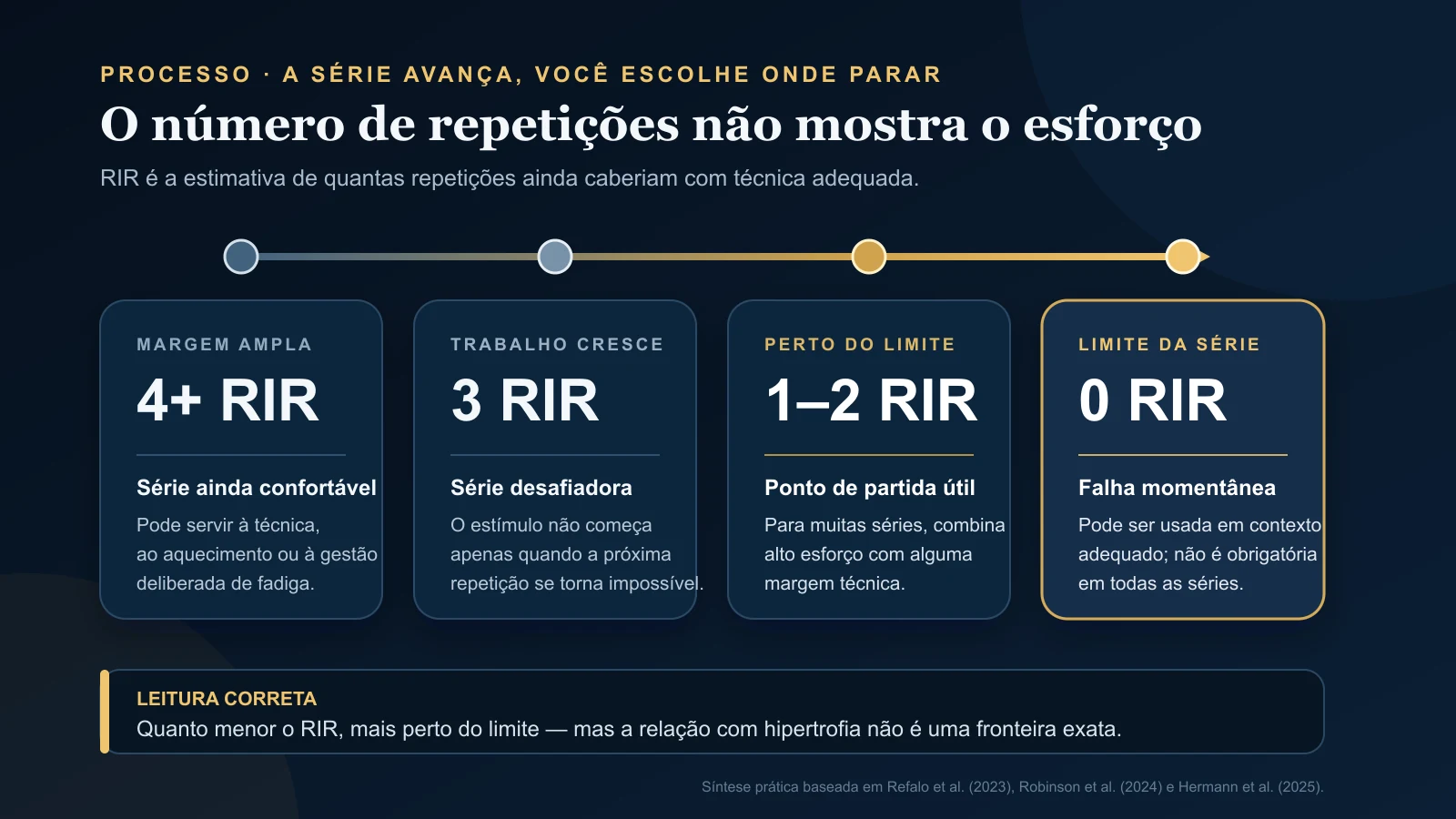
A review of 15 studies found no evidence that reaching momentary muscle failure is superior to stopping earlier for hypertrophy. An exploratory meta-regression published in 2024 found an association: the closer to failure the sets ended, the greater the muscle growth tended to be. The authors themselves cautioned that the exact relationship remains uncertain, because the RIR needed to be estimated from the studies and the models had only a modest fit.
A 2025 essay added nuance. In 42 trained adults, a single set per exercise, twice a week, produced adaptations both when performed to failure and when interrupted with 2 RIR. Some hypertrophy measures modestly favored failure, but absolute differences were small.
The set needs to be hard, but taking every set to failure is not mandatory.
As an operational starting point, many sets can end with approximately 1 to 3 reps in reserve. Getting closer to failure tends to make more sense on stable machines and accessory exercises. Maintaining a larger margin may be prudent in complex movements, phases of greater sporting load or when technique deteriorates before the target muscle.
This RIR range is a practical criterion, not a universal limit established for all people.
How to choose the track in practice

5 to 8 repetitions
They make sense when hypertrophy needs to go hand in hand with strength gains. They tend to fit best into stable multi-joint movements, as long as the execution remains safe and repeatable. The cost is greater technical and load demands. Not every exercise needs to receive this type of exposure.
8 to 15 repetitions
It is the most versatile area for much of the program. Balances load, time, control and proximity to failure. For those who need a simple reference, it remains a good standard — as long as there is progression and the series are not always easy.
15 to 30 repetitions
They can be very useful on machines, isolated exercises, phases with limited equipment or when smaller loads are better tolerated. For them to work, the effort needs to be high. This usually brings more local heat and longer series.
Above or below these ranges, hypertrophy does not become impossible. It just increases the chance that the practical cost will outweigh the additional benefit.
Hypertrophy: is 8 to 12 still the best range?
- What the evidence allows us to conclude
- The number of repetitions only becomes meaningful when the effort comes in.
- How to choose the track in practice
In high performance, “works” is not the only criterion
For a bodybuilder, increasing muscle volume may be the central goal. For a football, wrestling, running or indoor sports athlete, hypertrophy is usually an intervention in the service of another capacity: producing force, tolerating contact, protecting a structure or correcting a relevant asymmetry.
Heavy sets can be important for strength, but they need to be combined with field training, speed and the competitive calendar. Very long sets can reduce the external load, but generate discomfort and local fatigue that hinder the following session. The moderate range often wins on cost-effectiveness, not because it has a unique anabolic mechanism.
- Higher loads.Use in movements where specific strength also matters.
- Moderate repetitions.Accumulate much of the hypertrophy work here.
- High reps.Reserve for accessories or when they reduce an unwanted cost.
The final criterion is to observe whether the person progresses, tolerates the session and is able to repeat the work over the weeks.
From concept to decision
What rep range doesn't solve
No Zone corrects a program with little meaningful work, poor exercise selection, inconsistent range, lack of progression, or insufficient recovery.
There is also no hypertrophy separate from the nutritional context. Energy and protein need to sustain the process, although this does not turn an isolated meal into a magical trigger. To delve deeper into this part, see the articles about protein for athletes and anabolic window.
The rep range is one variable within the system. It structures the dose; it does not replace it.
The best rep range is the one you can turn into quality work
Current science has not retired 8 to 12 repetitions. It just removed the hypertrophy monopoly from this range.
Between approximately 5 and 30 repetitions, there is room for muscle growth when the sets are challenging and the program is well constructed. This does not mean that all choices have the same cost, that extremely light loads are equally efficient, or that failure needs to be pursued on every attempt.
The best program doesn't pick one number for every exercise. He chooses the range that allows him to apply tension, preserve technique, control fatigue and progress in that reality.
In the field and in science, the strongest decision rarely comes from a magic zone. It arises from a criterion that continues to function when the context changes.
Frequently asked questions
Do I need to train to failure to gain muscle mass?
Not in all series. Training close to failure favors stimulation, but momentary failure has not shown universal superiority. A small range of repetitions can balance stimulus and recovery.
Is doing 3 sets of 10 repetitions a good strategy?
It can be a good starting point, as long as the load is adjusted, the sets are challenging and there is progression over time. The format alone does not guarantee hypertrophy.
Do sets of 20 to 30 repetitions work?
They can work, especially when they end up close to failure. They tend to be more comfortable for some exercises and less efficient for others due to the duration and local discomfort.
To gain strength, is the range also wide?
Less. Although different loads can increase strength, high loads have a more consistent advantage for improving 1RM performance and specific maximal strength tasks.
Verified references
Reading noteThe approximate range of 5 to 30 repetitions is a practical synthesis of the studied spectrum, not a universal boundary. The evidence is weaker at the extremes and varies with proximity to failure, exercise, population, and measurement method.