

There is a recurring mistake in how we explain high performance: we give the decisive moment a power it does not have.
An athlete does not build a sleep routine in the locker room. They do not decide how to eat when they are already exhausted and late. They do not learn how to respond to a mistake after pressure has taken over the task. By the time execution begins, much of the response has already been trained, prepared, or left to chance.
That was the main idea I took from Charles Duhigg's The Power of Habit: high performance depends less on winning the same internal negotiation every day and more on removing repetitive decisions from the wrong moment.
The book popularized a simple model—cue, routine, and reward—and showed how individual behaviors and organizational routines can become automatic. Habit science has evolved, some explanations in the book require nuance, and not every narrative case can be treated as evidence. Even so, its central question remains highly useful in elite performance: what should already be decided before fatigue, pressure, or lack of time arrives?

First lesson: habit removes decisions from the wrong moment
Um hábito não é apenas algo feito muitas vezes. Na psicologia, ele é entendido como uma resposta que ganha automaticidade por ter sido repetida diante de pistas recorrentes. Objetivos e hábitos não precisam competir: a intenção escolhe a direção; a repetição em contexto estável facilita a execução (Wood & Rünger, 2016).
This distinction changes how we think about discipline.
If every session requires an athlete to decide again whether to prepare hydration, start the prescribed recovery nutrition, record a relevant symptom, or organize the next day's equipment, the system is charging attention for predictable tasks. The athlete may be able to pay that bill when rested. The problem appears during travel, congested competition schedules, a poor training session, or an emotionally difficult day.
Building a routine does not remove effort. It changes when effort is used: less negotiation during the crisis and more care when designing and rehearsing the response beforehand.
Automate the predictable to preserve attention for the unpredictable
In high performance, automaticity does not mean doing everything without thinking. It means reserving thought for what truly requires reading the context.
An athlete can automate a warm-up sequence, packing a bag, starting a recovery meal, or the first few seconds after a mistake. This frees attention to perceive an opponent, space, pain, a tactical change, emotional state, and signals from the team.
This logic appears directly in pre-performance routines: intentional sets of thoughts and actions performed before a task. Exercise and Sports Science Australia's position statement on performance under pressure includes these routines among the strategies that may help maintain task-relevant attention. Support is clearer in closed, self-paced skills; in open sports, preparation must be more flexible and include responses for what may go wrong (Schweickle et al., 2026).
That limit matters. A functional routine organizes entry into the task. A rigid superstition creates dependence on a sequence the competitive environment may not allow.
How the ideas connect
The loop helps, but diagnosis matters more than the diagram
The cue → routine → reward model is valuable because it forces us to abandon vague explanations such as “a lack of discipline.” It turns judgment into investigation.
Imagine an athlete who finishes training, picks up a phone, loses track of time, and delays the agreed recovery strategy. The visible routine is phone use. But what reward is being sought? Decompression? Social contact? A brief distance from a frustrating session? Simply removing the device may preserve the problem while eliminating the only perceived reward.
A more intelligent intervention can use the same cue—entering the locker room—and build a new sequence: begin the recovery plan, spend a few seconds recording any information that would change the team's decisions, and then allow a short decompression interval.
This is an application I propose, not a protocol tested in the book. Duhigg’s appendix recommends observing the routine, testing explanations for the reward, and investigating cues such as location, time, emotion, company, and the preceding action. A behavior’s function is a hypothesis to revisit: hunger, fatigue, and a need for connection can coexist. The goal is to learn from the response, not to discover a single cause in three days.
Consistent people build fewer internal battles
One of the book's strongest ideas is that sustained performance should not depend on everyday heroism. Later research reinforced this point through a different route.
Em seis estudos, com 2.274 participantes no total, pessoas com maior autocontrole relataram hábitos mais benéficos em alimentação, exercício, sono e estudo. Esses hábitos ajudaram a explicar por que elas avançavam em seus objetivos com menos necessidade de inibir impulsos a todo momento (Galla & Duckworth, 2015). O achado não transforma correlação em uma receita universal, mas corrige uma imagem popular: autocontrole eficiente pode aparecer como menos conflito, não como mais sofrimento.
This is also where the book requires an important update. The metaphor of willpower as a muscle that becomes depleted was highly influential. Later multilab replications, however, found small, unstable, or confirmatory effects compatible with zero (Hagger et al., 2016; Vohs et al., 2021). Fatigue, motivation, affect, beliefs, and priorities can all alter action control, but the idea of a simple, universal reservoir of willpower is not a secure basis for prescribing behavior.
The application remains valid for a better reason: a well-designed system reduces friction and protects execution when the athlete's state is not ideal.
A “keystone habit” is a heuristic, not a law
Duhigg uses the expression “keystone habits” for behaviors capable of reorganizing other patterns. It is an attractive idea, but I would treat it as a practical heuristic rather than a scientific category that can guarantee cascading effects.
Reading the sections on organizations and social movements broadens this idea. In the Alcoa case, safety involves communication, the ability to stop a risk, and an organizational response; change does not depend solely on each employee’s discipline. In high performance, I propose the same care: define who receives a report of pain, who can adjust the session, and how the team responds. The best organizing habit makes a useful action possible and safe, without punishing the person who reports a problem.
One example would be a session-closing protocol: when the work ends, the athlete starts the agreed recovery process, records signals that truly alter decisions, confirms the next exposure, and prepares the first step for the following day. This short chain may improve communication, information availability, nutrition, and adherence without requiring four separate reminders.
The criteria for choosing an organizing habit are straightforward:
- it occurs often enough to be rehearsed;
- it has an observable cue;
- it reduces friction in more than one relevant decision;
- it produces rapid feedback;
- it remains safe when context varies, or it has a clear review rule.
From concept to decision
The best routine includes an emergency exit
Habits are efficient precisely because they reduce deliberation. That advantage also creates risk: a response can remain automatic after it is no longer appropriate.
Training despite a new symptom, repeating the same nutrition strategy after session timing has changed, or insisting on a pre-match routine that increases anxiety are examples of consistency without contextual intelligence.
That is why the rule I take into high performance is: automate the execution of the predictable; never automate the diagnosis.
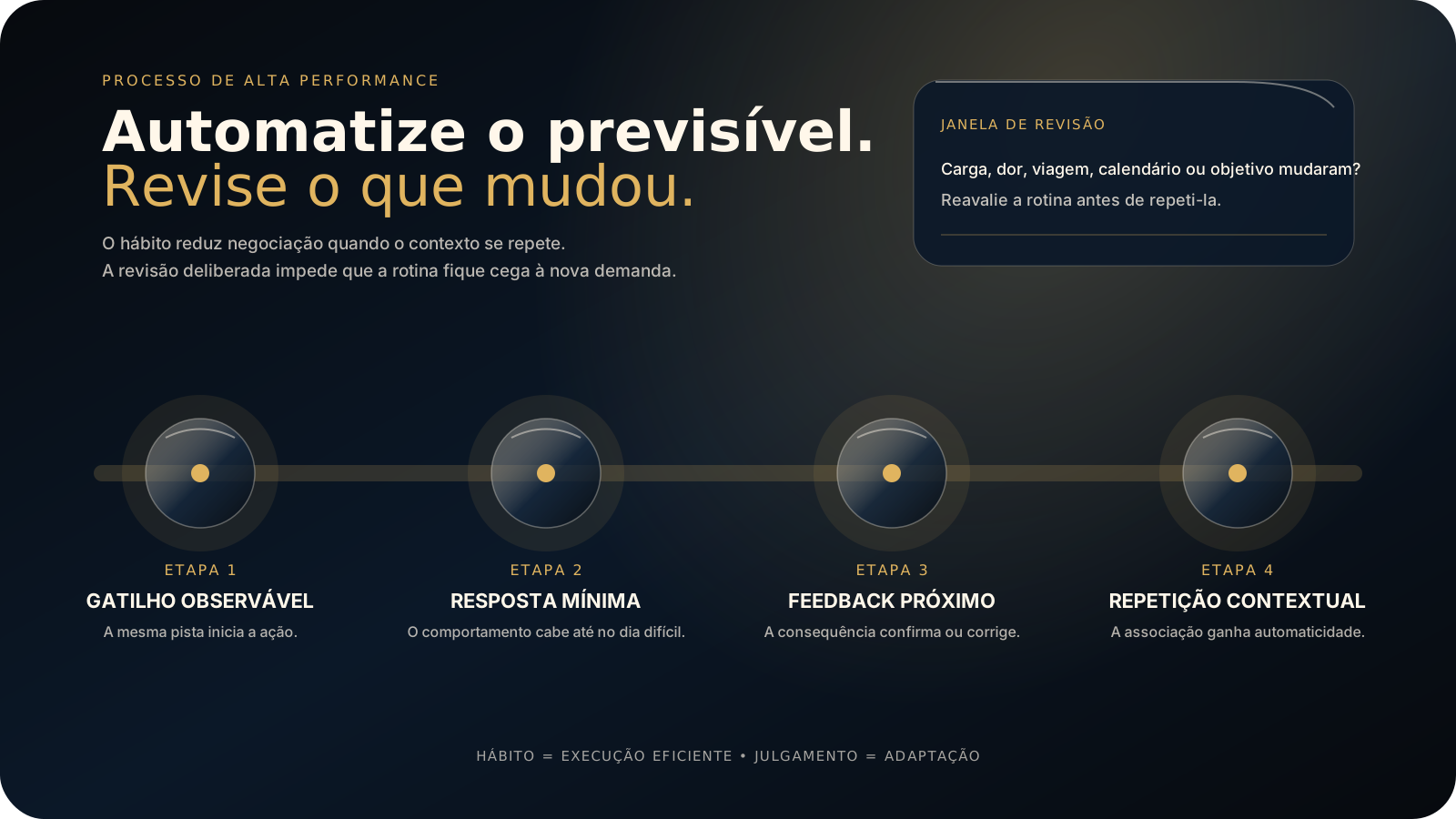
Every relevant routine should have a review window. Did load, pain, illness, travel, schedule, tactical role, the goal, or preference change? The protocol then becomes a conscious decision again before it is allowed to regain automaticity.
High performance starts before the decision
- Automate the predictable to preserve attention for the unpredictable
- The loop helps, but diagnosis matters more than the diagram
- The best routine includes an emergency exit
How to turn the idea into a real protocol
Choose a behavior, not a moral quality
“Be more disciplined” cannot be rehearsed. “When I enter the hotel room, I prepare hydration and the first snack for the next day” can be observed.
Link the action to a cue that actually occurs
Time, place, the end of an activity, or an object can work as a cue. More stable contexts support automaticity, but the cue must survive the reality of training and travel.
Define a minimum viable response
The basic version must fit a difficult day. The initial objective is to consolidate the connection between cue and behavior, not to build a perfect ceremony.
Write the response to the failure point
Plans in the form “if X happens, I will do Y” make the opportunity and response more accessible. In physical activity, findings are heterogeneous and appear stronger when sufficient intention and self-efficacy already exist; the plan helps bridge the gap between wanting and doing, but it does not manufacture a goal the person has not adopted (Kompf, 2020).
Keep feedback and reward close to the action
Marking completion, noticing reduced friction, receiving feedback from the team, or simply closing the task with clarity helps make the consequence visible. The reward should reinforce the desired behavior rather than compete with it.
Measure repetition and automaticity, not only a perfect streak
Time varies. In an 84-day trial of an eating behavior, participants who formed a habit took a median of 59 days to reach peak automaticity; repeatedly performing the action in response to the planned cue was the main predictor (Keller et al., 2021). This does not create a new magic number. It shows why “21 days” is a poor promise.
Schedule the review
Um ensaio randomizado com caminhada mostrou que contextos consistentes favoreceram automaticidade, mas isso não garantiu, por si só, manutenção do comportamento (Ebert & Lin, 2024). Hábito ajuda; não substitui capacidade, recursos, valor, suporte ou ajuste do plano.
The central shift
What the book cannot solve by itself
No habit loop fixes low energy availability, sleep deprivation, relevant pain, psychological distress, role conflict, or a prescription incompatible with the athlete's routine. Turning every problem into a habit problem can become a sophisticated way to blame the person for a system failure.
Nor should everything become automatic. Clinical decisions, load adjustment, tactical reading, and responses to new signals require judgment. Routine should support attention, not replace it.
That may be the most mature reading of The Power of Habit for high performance: the objective is not to live on autopilot. It is to choose carefully what deserves to be automated, build the context that makes a good response likely, and preserve the freedom to change when reality demands it.
High performance starts before the decision
We like to tell the story of performance as a succession of major choices. In practice, it is often sustained by small behaviors that arrive at the right moment without requiring another internal meeting.
Hydration is already prepared. The response to a mistake has already been rehearsed. The equipment removes a step. The team knows which signal must be communicated. The athlete does not have to prove commitment every time the day becomes difficult.
High performance is not the elimination of decisions. It is the ability to decide once what can be repeated, execute many times what remains valid, and think again the moment context changes.
FAQ
How long does it take to build a habit?
There is no universal timeline. Behavior complexity, frequency, context stability, motivation, and difficulty all change the trajectory. Repeating the response in the presence of a consistent cue is more useful than chasing a fixed number of days.
Does building habits make motivation irrelevant?
No. Motivation and goals help select and sustain the direction. Habit reduces the need to rebuild the decision at every opportunity. When the goal loses value or context changes, the routine may weaken or cease to be appropriate.
Are a pre-performance routine and a superstition the same thing?
No. A pre-performance routine organizes task-relevant thoughts and actions. A superstition assigns control to elements without a clear functional relationship and may become rigid. A routine should be individualized, rehearsed, and able to tolerate inevitable variation in the competitive environment.
In 2026, Zhu and colleagues synthesized 14 studies, with 6,069 participants, on context consistency and physical activity. Overall associations were small with physical activity and larger with habit strength. The synthesis supports observing stable cues in routine, but does not demonstrate that a specific cue causes the same change in everyone nor establishes a universal time frame for a behavior to become automatic.
Verified references
- The Power of Habit: Why We Do What We Do in Life and Business