

I finished Burn less interested in how many calories an athlete can burn and more interested in where the body stops spending energy when training begins to occupy too much of the budget.
Herman Pontzer wrote a book about metabolism, evolution, and health. For me, it also became a book about performance management. The idea running through it is easy to state and difficult to take seriously: energy is limited, and the body does not treat its costs as independent lines on a spreadsheet. It prioritizes, compensates, and negotiates.
That perspective does not turn Pontzer's model into a universal law. Since the book was published, experimental studies and reviews have continued to debate how much exercise expenditure is compensated for and through which mechanisms. But the reading leaves us with a valuable principle: the cost of a session and the net increase in daily expenditure are not necessarily the same thing.
More important than knowing only how much an athlete expends is understanding what the body stops supporting when training takes up too much energy.

The first lesson: expenditure is not an automatic sum
The finding that made Pontzer's work widely known came from the Hadza, a hunter-gatherer population in Tanzania. They walked and performed far more physical work than adults in industrialized societies. Even so, their total daily energy expenditure in the 2012 study was similar after adjustment for body size.
The proposed interpretation was constrained total energy expenditure: when habitual activity increases, part of the cost may be offset by changes elsewhere in the budget. These may include less movement outside training, greater efficiency, or changes in less visible physiological processes.
The important caution is not to turn the hypothesis into a caricature. Exercise costs energy. Athletes can reach very high daily expenditures. What the model challenges is a perfectly additive response: estimating a session at 800 kcal does not guarantee that total expenditure for the day will rise by exactly 800 kcal.
The current literature has not settled the debate. A 2026 review by Pontzer and Trexler found evidence of compensation, particularly in aerobic interventions and when exercise is combined with dietary restriction. Other recent studies observed a linear relationship between activity and expenditure, supporting the additive model. A conclusion proportionate to the evidence is less dramatic and more useful: compensation can occur, varies across people and contexts, and should neither be assumed nor dismissed.
The second: training can fit the schedule without fitting the body
An athlete can complete a session, maintain their pace, and even keep a stable weight without demonstrating adequate recovery. The idea of energy reallocation helps us ask questions, but completing training does not reveal how much the body stopped investing in each function. Energy expenditure compensation and low energy availability are related concepts, but they are not equivalent.
This is the most important bridge between Burn and high performance. When training load rises and energy supply does not keep up, the first visible problem is not always the workout. It may appear in recovery, menstrual function or libido, immunity, bone health, mood, sleep, or the ability to adapt to the stimulus.
The International Olympic Committee consensus on Relative Energy Deficiency in Sport, REDs, describes precisely this territory: problematic low energy availability can impair health and performance in both women and men. This does not mean that every case of fatigue is REDs or that one calculation establishes the diagnosis. It means that maintaining execution does not prove the system is sustainable.
In high performance, adaptation and sufficiency may look identical for a few weeks. Then they separate.
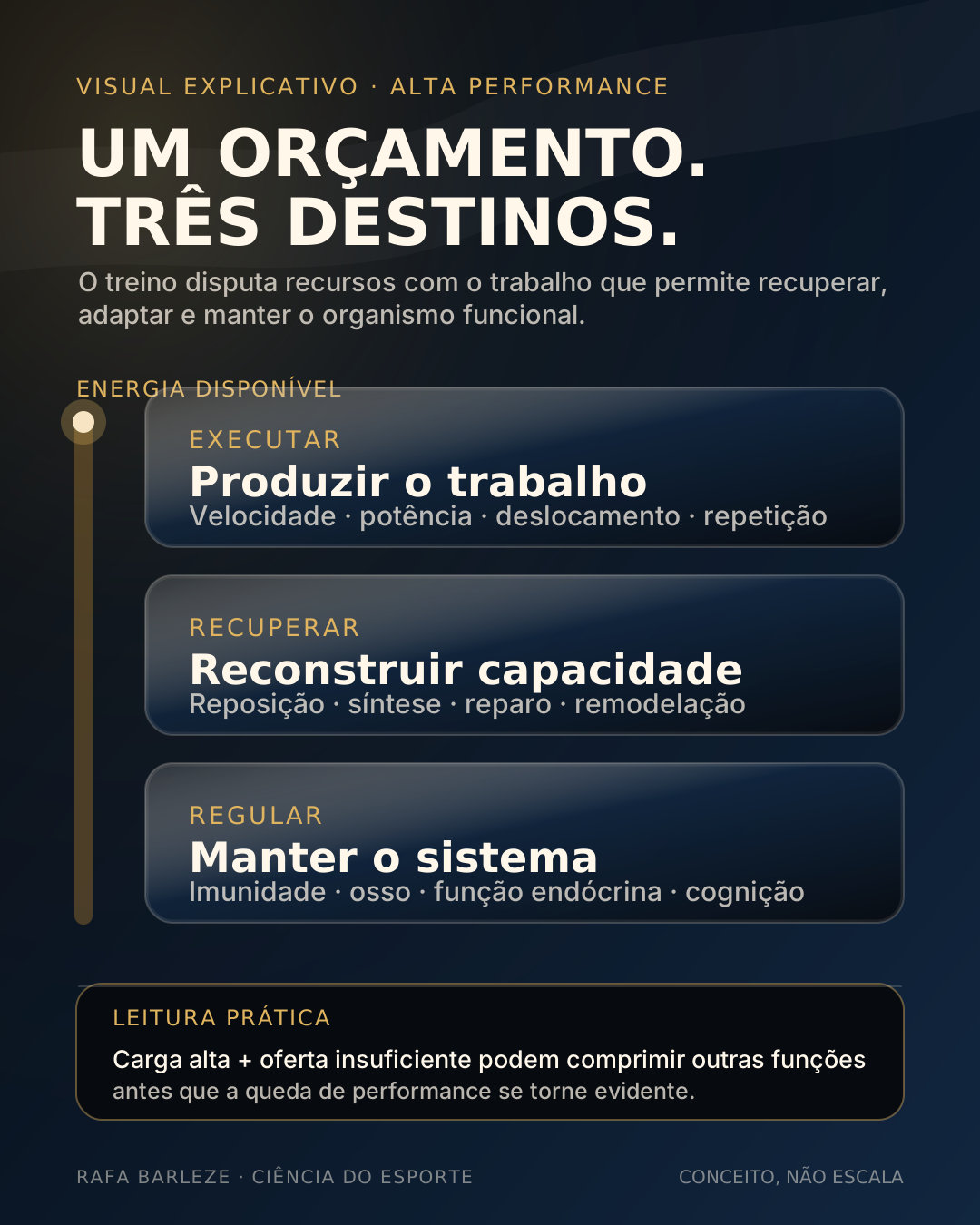
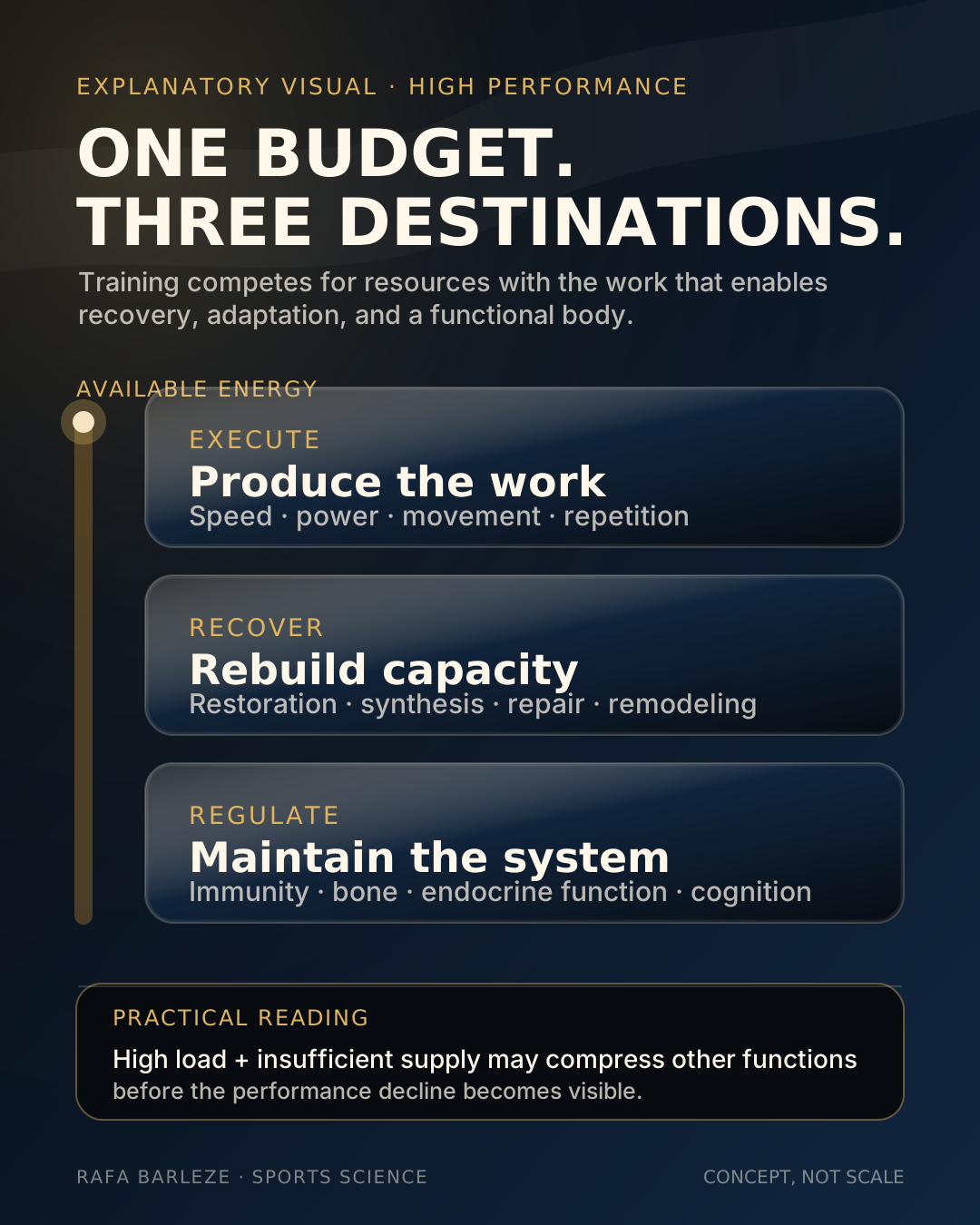
How the ideas connect
The third: adaptation also needs fuel
Training creates a cost. Improvement depends on what happens after it.
Glycogen restoration, protein synthesis, bone remodeling, tissue repair, immune responses, and endocrine coordination are not details sitting beside the program. They are part of the process that turns load into capacity.
This changed the language I use. Instead of asking only whether the athlete has enough energy to complete the workout, I began insisting on another question: does the athlete have enough energy to become better because of that workout?
The answers may differ. Caffeine, motivation, competitive context, and tolerance for discomfort can help preserve execution. None replaces the energy required to recover and adapt. Periodizing nutrition, then, is not only about placing carbohydrate around demanding sessions. Across the microcycle, it is about protecting enough energy for the body to respond to the work performed.
High performance is not the ability to tolerate the largest deficit. It is the ability to repeat quality work and convert it into adaptation.
The fourth: during prolonged efforts, the gut becomes part of the limit
One of the most fascinating chapters in Burn follows extreme races and expeditions. In the study published in 2019, Pontzer and colleagues compiled events lasting from half a day to many months. Maximum sustainable expenditure fell as duration increased. During the longest efforts, the curve approached a plateau near 2.5 times basal metabolic rate.
That value is not a training target or an individual ceiling that can be applied to every athlete. The study brought together very different events, small samples, and inevitably imperfect estimates. Its value lies in the proposed mechanism: at some point, the limitation is not only the ability to produce energy. It is the ability to eat, digest, and absorb enough to sustain the cost.
In practice, the gastrointestinal system stops being a supporting actor. Energy density, food form, feeding frequency, hydration, tolerance, and gut training become part of preparation. In congested schedules, stage races, ultra-endurance events, or phases with two daily sessions, having food available is not enough. The athlete has to be able to use it.
The limit to prolonged performance may depend less on the courage to continue and more on the ability to refuel without breaking the system.
From concept to decision
The fifth: stable weight and appetite do not clear the plan
Burn also makes us question two signals that often receive too much authority: the scale and hunger.
Stable weight may mean that intake and expenditure are well matched. For a time, it may also coexist with energy reallocation and loss of function in systems the scale cannot show. Eating to appetite can work in many settings, but hard sessions, travel, heat, stress, and gastrointestinal discomfort can suppress intake just when requirements rise.
The opposite error also exists. A formula that produces a high expenditure estimate does not obligate the athlete to eat until the spreadsheet is satisfied. Estimated total expenditure, session cost, and spontaneous intake are different measures with different uncertainties.
The decision depends on convergence: training quality, repeat-effort capacity, trends in weight and body composition, recovery, sleep, mood, hunger, menstrual cycle, libido, bone health, injury, illness, and gastrointestinal tolerance. No single marker gets to govern the decision.
Where I would not turn Burn into a protocol
At some points, the book is more categorical than the evidence allows. There is also a definition that needs correcting: energy availability is energy intake minus exercise energy expenditure, expressed per kilogram of fat-free mass per day. It is not total expenditure minus exercise. When discussing athletes with high workloads and reproductive dysfunction, Pontzer suggests that increasing food intake would have little effect and that the solution would be to reduce training.
That conclusion should not be transferred directly into practice. In the REFUEL randomized trial, 76 physically active women with menstrual disturbances were followed for 12 months. The group assigned to increase intake consumed, on average, about 330 additional kcal per day and improved menstrual function while maintaining habitual exercise.
This does not prove that adding 330 kcal will solve every case. It does show that increasing intake can be part of treatment. Depending on severity, schedule, and clinical signs, the decision may be to increase intake, reduce or reorganize load, and often combine both approaches.
The same caution applies to the familiar threshold of 30 kcal per kilogram of fat-free mass per day. The 2023 IOC consensus moved away from a universal diagnostic cut-off. Energy availability is difficult to measure in free-living conditions, and responses vary among individuals, sexes, physiological systems, and exposure durations.
The concept guides us. The athlete determines its clinical meaning.
The central shift
Training expends energy. Performance decides where it goes.
- The first lesson: expenditure is not an automatic sum
- The third: adaptation also needs fuel
- Where I would not turn Burn into a protocol
What I bring from Burn into high performance
- Use the equation as an opening hypothesis. The number has to survive contact with the microcycle and the athlete's response.
- Periodize availability, not only calories. A weekly average can hide decisive under-fueled days.
- Read the athlete as a system. Performance, recovery, health, behavior, and context need to tell the same story.
- Train the logistics of eating. The ability to consume and tolerate energy under high loads is trainable too.
- Intervene on both sides of the budget. When signs of insufficiency emerge, adjusting intake and load is smarter than defending either one on principle.
The best performance is not the one that spends everything
Burn’s final chapter broadens the perspective: food access, working conditions, transportation, social connections, and inequality also shape health. In sports, this changes the conversation. Before demanding adherence, we should check whether the athlete can eat their meals, rest between commitments, and communicate difficulties. Planning energy includes organizing the conditions that make the plan possible.
In high performance, training makes the loudest request. Recovery, immunity, bone, endocrine function, and cognition tend to collect their debts more quietly. The performance team's job is to listen before that cost becomes a performance decline, injury, or illness.
High performance is not the art of spending everything. It is directing enough energy to execute today while preserving enough to be better tomorrow.
Verified references
- Burn: New Research Blows the Lid Off How We Really Burn Calories, Lose Weight, and Stay Healthy