

A testosterone result below the reference range creates a misleading sense of clarity. There is a number, a reference interval beside it, and almost always a ready-made offer to ‘correct’ the result.
In practice, the decision is more demanding.
Testosterone is a biologically relevant variable. In men, true hormone deficiency can affect sexual function, bone mass, body composition, red blood cell production and quality of life. The error begins when any tiredness becomes “low testosterone”, any isolated value becomes a diagnosis and any laboratory increase becomes synonymous with more strength, muscle or vitality.
At high performance, there is an important difference between monitor a marker and turn it into a goal. A marker only deserves to be optimized when we know what it represents, how it was measured and what decision changes based on it.
This article focuses the diagnostic discussion on adult men. Women also produce testosterone and may present clinically relevant changes, but the investigation of hyperandrogenism, ovarian function and reproductive health requires another clinical path.
Before chasing “boosters”, you need to find out which question the exam actually responds.

A number measures concentration — it does not measure performance
Circulating testosterone does not exist in a single form. Some is strongly bound to sex hormone-binding globulin, the SHBG; another part binds more loosely to albumin; a small fraction circulates freely.
This helps you understand why total testosterone doesn't always tell the whole story. Changes in SHBG can alter the total value without producing a proportional change in the biologically available fraction. In situations where total testosterone is close to the lower limit or SHBG may be altered, guidelines recommend considering free testosterone with an appropriate method.
There is also variation between laboratories, assays and reference ranges. The Endocrine Society statement published in July 2026 draws attention to precisely this problem: the same sample can be classified in different ways when the method is not standardized. The value close to 300 ng/dL appears as a common clinical threshold in men, but does not function as a sentence independent of symptoms, repetition and context.
Being below the laboratory range deserves attention. It still does not tell you, on its own, why the value is low or whether there is hypogonadism.
Diagnosis requires convergence
Endocrine Society guidelines recommend diagnosing hypogonadism only when two dimensions appear together: compatible signs or symptoms and unequivocally and consistently low testosterone concentrations.
Confirmation usually requires two morning blood draws, performed while fasting on different days. The exam should also be avoided during an acute illness, because the body can temporarily reduce the reproductive axis in response to physiological stress.
Sexual symptoms, such as reduced libido and spontaneous erections, tend to be more informative than isolated complaints of energy or mood. Fatigue, poor sleep, decreased performance and difficulty concentrating are important, but they have many possible causes. The Endocrine Society itself reinforced in 2026 that symptoms alone also do not confirm the diagnosis.
When the result remains low, the next step is to investigate the origin. LH and FSH help to differentiate a primarily testicular problem from a hypothalamic or pituitary disorder. SHBG, free testosterone and other tests may be necessary depending on clinical history — not as an automatic panel for everyone.
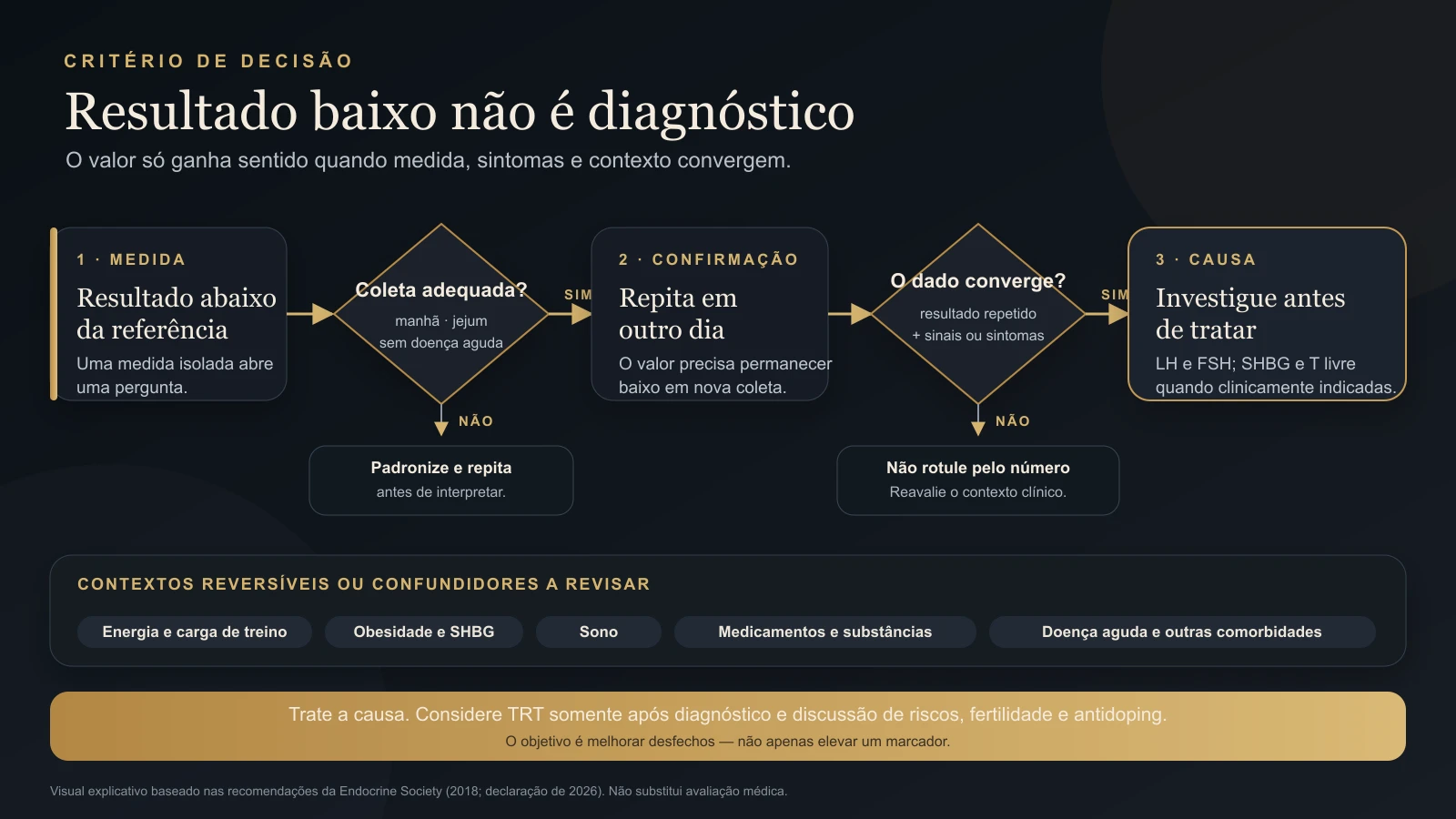
How the ideas connect
In athletes, the context can lower the marker before there is hormonal failure
An athlete may have low testosterone because there is a hormonal axis disease. It may also present a functional or transient reduction because the body is responding to a phase of great demand.
A low energy availability occurs when the energy ingested is insufficient to sustain, after the cost of exercise, the body's physiological functions. When this exposure becomes prolonged or severe, it can form part of the relative energy deficiency in sport, REDs.
The 2023 International Olympic Committee consensus recognizes that men may also experience reduced reproductive function in this scenario. Low libido and changes in testosterone can be part of the picture, especially in endurance sports, weight categories and aggressive fat loss phases. None of these signs alone diagnose REDs; they increase the need to look at available energy, training load, recovery, bone health and injury history as a system.
Sleep deserves the same proportionality. A meta-analysis of 18 studies and 252 men found reduced testosterone after total sleep deprivation for 24 hours or more, but found no significant effect of short-term partial restriction. Insufficient sleep remains a problem for health and performance; it just shouldn't be sold as if a perfect night works like hormone replacement.
To delve deeper into how light, schedules and routine help organize recovery, see the article on circadian rhythm, sleep and performance.
In obesity, reading also requires nuance. A 2025 clinical article describes that mild or moderate reductions in total testosterone may accompany a drop in SHBG, with LH and FSH preserved. This pattern may represent a reversible state linked to obesity and comorbidities, not permanent gonadal failure.
A meta-analysis of 44 studies, with 1,774 participants, found an increase in total and free testosterone after weight loss in men with excess adiposity. The finding does not transform weight loss into a “booster”; shows that, in some cases, treating the metabolic context also corrects the marker.
Other confounders include opioids, corticosteroids, some chronic diseases, sleep apnea, previous use of anabolic steroids and the acute disease itself. The list reinforces a principle: Before replacing a hormone, it is necessary to understand why the axis reduced its production.
The spike after training is not a hypertrophy score
Strength training can acutely elevate testosterone and other circulating hormones. This response helped popularize protocols designed to “maximize the hormonal environment” after the session.
The problem is transforming a brief oscillation into a dominant explanation for months-long adaptations.
In a study of trained young men, Morton and colleagues followed 12 weeks of resistance training. No systemic hormones measured before, after or throughout the intervention consistently explained the muscle mass gains. The intramuscular content of androgen receptors showed a more relevant relationship with hypertrophy than hormonal peaks in the blood.
This does not make testosterone irrelevant. Pathologically low levels and supra-physiological pharmacological exposure are completely different scenarios. What the study challenges is the idea that small sharp fluctuations, within usual physiology, should guide the selection of exercises, intervals or sets.
To gain muscle, the tension applied, the tolerable volume, the proximity of the effort, the progression, the protein, the energy and the ability to repeat the work are even more important. A workout doesn't have to win a 30-minute hormonal competition to produce adaptation.
This distinction speaks directly to the analysis of the best rep range for hypertrophy: the stimulus is built by the program, not by a momentary hormonal zone.
From concept to decision
Why a supplement ranking can lead to the wrong decision
Lists of supposed “testosterone boosters” often group very different interventions together according to their effect on laboratory value. The format seems to facilitate the choice, but it can bring together studies that do not answer the same question.
Populations, doses, products, durations and basal levels are very different. Raising testosterone in a deficient group does not allow us to assume the same effect in healthy men. A statistically significant change on the scan may also be too small to change libido, body composition, strength, or well-being.
A systematic review published in 2024 brought together 52 studies on 27 supposed “testosterone boosters”. Most did not increase total testosterone under controlled conditions. Some ingredients showed signs in specific populations, but the designs themselves were heterogeneous and the central outcome remained laboratory value.
An increase in testing only becomes relevant when it is reproducible, appears in the correct population and modifies a clinical or sporting outcome that really matters.
- Starting point.Did the person have a relevant disability or insufficiency at the beginning?
- Reproducibility.Did the increase appear in independent groups with comparable products?
- Ending.Did the change alter libido, strength, body composition, well-being, or another important outcome?
- Balance.Does the benefit outweigh cost, uncertainty, risk of contamination and interaction?
For the tested athlete, there is also a layer of governance. Exogenous testosterone and other anabolic agents are prohibited at all times under the 2026 WADA list. A legitimate medical indication does not automatically eliminate the need for therapeutic use authorization.
A practical protocol before trying to “boost testosterone”
- Define why the exam was requested.Is there a compatible symptom, change in fertility, bone loss, unexplained anemia, hormonal axis disease or medical follow-up?
- Standardize data collection.Prefer morning collection, fasting, outside of acute illness and without comparing different laboratories or methods as if they were equivalent.
- Confirm the result.A low value needs to be repeated on another day. If the second measurement does not confirm the first, variability is part of the explanation.
- Reconstruct the context.Review energy, weight loss, training load, sleep, adiposity, medications, alcohol, comorbidities, and current or previous hormone use.
- Treat reversible causes when they exist.The intervention needs to target the probable cause and a relevant outcome, not just the number.
- Consider therapy only after diagnosis.Replacement can benefit men with diagnosed hypogonadism, but requires a clear objective, risk assessment and monitoring.
Reproductive planning changes the decision. Exogenous testosterone reduces LH and FSH, decreases intratesticular testosterone and can partially or completely suppress sperm production. Therefore, guidelines advise against starting therapy in men who intend to preserve fertility in the short term without specialized evaluation.
The central shift
Low testosterone: when the number matters.
- A number measures concentration — it does not measure performance
- Diagnosis requires convergence
- A practical protocol before trying to “boost testosterone”
Testosterone deserves to be taken seriously — not turned into a trophy
A low result may be the clue to a real and treatable change. Ignoring it for fear of “medicalizing” it would also be a mistake.
The problem is in the order of decisions. When the exam becomes a diagnosis, the supplement becomes a treatment and the peak becomes performance, physiology becomes marketing.
The more solid path is less flashy: measure well, confirm, listen to symptoms, investigate the cause, and choose an intervention that improves health or performance—not just the lab report.
In the field and in science, authority is not in chasing the greatest number. It’s about knowing when that number changes the conduct.
Frequently asked questions
Testosterone below the reference level means I need replacement?
No. The diagnosis requires compatible signs or symptoms, a consistently low result in adequate collections and investigation of the cause. In some contexts, the change may be functional and reversible.
When is the best time to dose testosterone?
Guidelines recommend collection in the morning, on an empty stomach, and repeating it on another day when the result is low. Interpretation should avoid periods of acute illness and consider laboratory method.
Does poor sleep always reduce testosterone?
Not predictably for everyone. The evidence is most consistent for total sleep deprivation; Short-term partial restriction studies have produced less clear results.
Is there a proven supplement to increase testosterone?
Most boosters do not have a consistent effect. Some ingredients have signals in specific populations or products, but increasing laboratory value does not guarantee clinical or sporting benefit.
Creatine increases testosterone?
All studies do not support a consistent increase in total testosterone. This does not reduce the value of creatine for strength, power and training; it just shows that its benefit does not depend on “raising testosterone”.
Can testosterone replacement harm fertility?
Yes. Exogenous testosterone can suppress the axis that maintains sperm production. Men who desire fertility need to discuss this goal before starting any hormone therapy.
Verified references
Reading noteThis content is educational and does not replace individual diagnosis or medical prescription. A low result must be confirmed and interpreted by a qualified professional in light of symptoms, method and clinical context.