

I finished Daniel E. Lieberman's The Story of the Human Body with fewer certainties about what “natural” means — and a sharper criterion for thinking about performance.
The human body was not designed to break records, maintain a competition-level body-fat percentage year-round or endure a saturated schedule. It was selected, generation after generation, to survive and reproduce in changing environments. The result is not a perfect machine. It is a set of trade-offs: efficient at some tasks, vulnerable in others and remarkably able to adapt when it receives the right inputs.
That distinction changes the conversation. High performance is not the automatic expression of an athletic nature hidden inside us. It is a cultural project that uses training, nutrition, sleep, technology and cooperation to expand specific capacities without exceeding, for too long, what the organism can assimilate.
That was the main bridge I built between the book and elite sport.
High performance is not about overcoming biology. It is an informed negotiation with it.
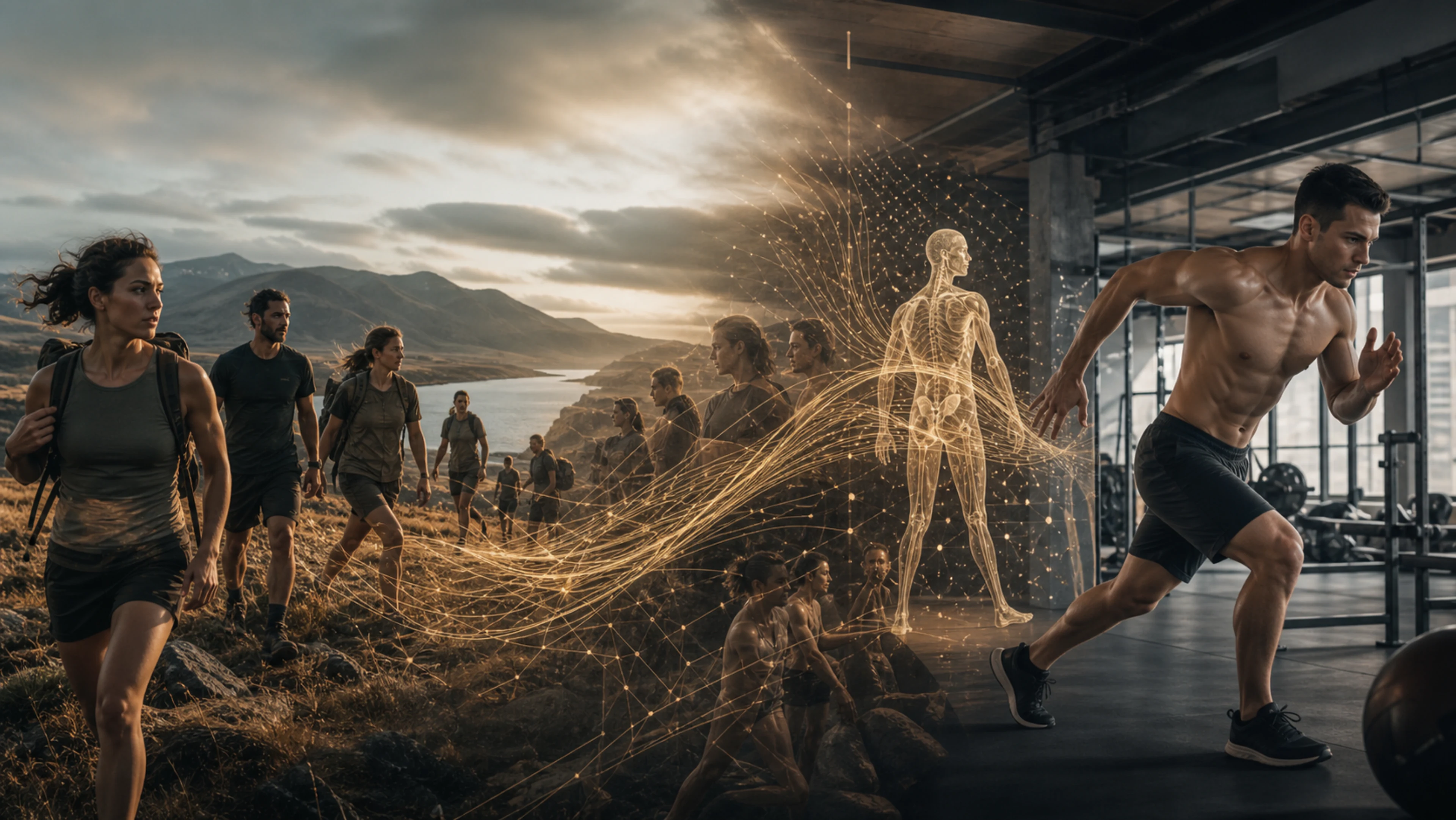
1. Evolution does not pursue maximum performance
One of Lieberman's most important ideas is also one of the most uncomfortable: natural selection did not make us as healthy, strong or fast as physically possible. It retained traits that, in a particular environment, increased the likelihood of leaving descendants.
We therefore have a body made of solutions that were sufficient, not ideal. Walking on two legs freed the hands and made locomotion more economical, but added costs for the feet, knees, hips and spine. A large brain expanded our ability to learn and cooperate, but created a substantial energy bill. Storing fat helped people survive scarcity, yet that same competence can struggle in an environment of continuous supply.
Sport forgets these trade-offs whenever it treats the organism as if it could tolerate “more” indefinitely: more volume, more intensity, less weight, more travel, more matches. Every adaptation has a cost. Energy and time allocated to one demand are no longer available to another.
The first lesson is straightforward: the body cannot optimize every capacity at the same time. Periodization begins by accepting that limit, then deciding which adaptation deserves priority in each phase and which cost is acceptable.
2. We inherited endurance capacity, not sport readiness
Lieberman describes a body shaped by walking, endurance running, heat dissipation, carrying and tool use. Bramble and Lieberman developed the hypothesis that sustained running played a meaningful role in the evolution of the genus Homo, drawing on a suite of anatomical and physiological features: long legs, elastic tendons, head stabilization, a large gluteus maximus and an exceptional capacity to shed heat.
This helps explain why humans can become competent endurance runners. It does not mean that everyone should run marathons, train barefoot or copy a hunter-gatherer lifestyle.
The decisive nuance is this: an evolved capacity is a starting point, not a training program.
No one is born ready to repeat high-speed sprints, sustain power late in an event, tolerate contact in football or execute a maximal lift. We inherit a trainable system. High-performance practice turns that general plasticity into specific capacity.
“Natural movement” is therefore too vague to prescribe training. Better questions are: What task must the athlete solve? Which tissues and systems need to adapt? What progressive exposure can increase that capacity at an acceptable level of risk?
How the ideas connect
3. Stress is information — and dose changes the response
The chapter on disuse made me think most directly about training. Lieberman shows how muscles, bones and other systems adjust their capacity to the demands they receive. If a stimulus disappears, tissue still costs energy without delivering an immediate advantage, so the organism reduces capacity. If the stimulus is progressive and recoverable, it can induce remodeling.
Training science knows this logic well, but the book places it on an evolutionary scale: we do not merely tolerate certain stressors; we depend on them to develop and preserve function.
The mistake is to turn “no stimulus, no adaptation” into “the more suffering, the better.” That is not the relationship. Load and response do not form a moral contest. Too little load does not challenge capacity. Excessive, abrupt or poorly distributed load can exceed recovery and accumulate damage. The International Olympic Committee consensus on load and injury emphasizes the need to integrate training, competition, psychological load, travel, well-being and the athlete's history — not merely add up kilometers or minutes.

High performance happens in the middle of this relationship. Training triggers the signal. Energy, sleep, time and context determine how much of that signal becomes useful capacity.
4. Energy is not what remains: it is the adaptation budget
The book also tells human history as an energy story. Large brains, slow development, long-distance movement, pregnancy, lactation and cooperation became possible because our ancestors increased dietary quality, processed food and shared resources.
Sport expresses the same logic in different terms: creating demand is not enough; the response must be funded.
When intake does not adequately cover exercise and the organism's other functions, low energy availability develops. The latest International Olympic Committee consensus on REDs describes a continuum. Brief, carefully managed reductions may be tolerated in some contexts, but problematic, prolonged or severe deficits can compromise metabolism, bone health, immunity, reproductive function, glycogen synthesis, well-being and performance in athletes of all sexes.
This corrects a common high-performance error: treating lightness as a synonym for readiness. A lighter body may temporarily improve a power-to-weight ratio and, at the same time, lose the capacity to train, recover and compete.
Performance nutrition is not a system for rewarding or punishing athletes with food. It allocates energy, carbohydrate, protein and micronutrients according to the session, phase, tolerance and objective. The best physique for a photograph is not necessarily the best organism for sustaining the calendar.
5. The human advantage has always been collective
The book can be read as a celebration of physical endurance. Its strongest message, to me, lies elsewhere: human success depended on cooperation.
Hunting, gathering, processing food, caring for children, transmitting knowledge and reducing the risk of scarcity required division of labor, sharing and language. Our expensive brain did not defeat the environment alone. It became valuable because it enabled people to coordinate information, tools and one another.
That is a powerful lens for sport. We talk constantly about individual talent, yet high performance is a collective construction. An athlete receives simultaneous signals from the technical coach, strength and conditioning staff, nutritionist, physiotherapist, physician, psychologist, competition schedule and life outside sport. Each area can be technically correct and the system can still make the wrong decision if no one integrates the loads.
Cooperation here is not merely a pleasant atmosphere. It is a performance technology: sharing relevant information, aligning priorities, anticipating conflicts and making decisions through one integrated view of the athlete.
From concept to decision
6. Environment usually beats willpower
Lieberman uses evolutionary mismatch to show how modern environments offer calories, comfort and ways to avoid effort at an unprecedented scale. The point is not to condemn modernity. Agriculture, sanitation, medicine and technology extended human life. Problems emerge when a convenience repeatedly removes a stimulus we depend on or makes excess the default.
A randomized crossover trial led by Kevin Hall helps illustrate this without moral judgment. Twenty adults lived in a controlled setting and received ultra-processed and unprocessed diets, each for two weeks, while being allowed to eat as much as they wished. During the ultra-processed phase, they consumed roughly 500 kcal more per day on average and gained weight; during the unprocessed phase, they lost weight. The trial was short and did not identify a single causal mechanism, but it demonstrated something useful: the structure of an environment can change behavior even when no one consciously decides to “overeat.”
In sport, the same principle reaches far beyond food. Training times, food availability, meeting length, travel, light at night, screen use and a culture of “handling everything” all shape recovery. The athlete sleep consensus recommends an individualized approach and notes that training, competition, travel, stress and anxiety can reduce sleep opportunity or quality.
The best protocol is fragile if it requires daily heroism. A mature performance operation makes the desired decision easier to repeat.
High performance is not about defeating biology
- 1. Evolution does not pursue maximum performance
- 3. Stress is information — and dose changes the response
- 6. Environment usually beats willpower
What I would not take literally from the book
An evolutionary lens is useful for generating questions, not for ending debates.
“Natural” does not automatically mean healthy. Natural selection can tolerate pain, disease and limitation as long as they do not reduce reproduction enough. Nor was there one ancestral diet, one movement routine or one ideal hunter-gatherer. Human populations survived across radically different environments through remarkable cultural flexibility.
The book therefore does not justify a universal Paleolithic diet, barefoot running for everyone or the rejection of technology. Some hypotheses presented in 2013 also need to be tested against later evidence. Evolution explains why a question is worth asking; trials, cohorts, biomechanics and athlete monitoring help answer what to do now.
Reading the entire book also calls for caution with lists of ‘mismatch diseases.’ Autism, ADHD, depression, and different cancers appear close together within that framework, but this does not make them a single causal category, diagnosis, or evolutionary destiny. The mismatch lens can suggest research questions; it should not blame people, simplify complex conditions, or replace clinical assessment and treatment.
Some recommendations reflect the state of the evidence in 2013, especially passages about alcohol, sleep, hygiene and the microbiome, dietary fats, fructose, and footwear. They need to be reviewed against current guidelines and studies before informing practice. Prevention and environmental design broaden care; treating symptoms and disease remains essential when indicated.
That caution avoids the naturalistic fallacy: turning “this happened” into “this ought to happen.”
Five questions I now bring to high performance
I finished the book with a framework more useful than any list of ancestral habits:
- Which specific capacity needs to change?Without a clear outcome, load becomes noise.
- What stimulus is sufficient to provoke it?The target is not the greatest load the athlete can survive, but the smallest dose that produces the necessary response within the calendar.
- Are there enough energy and time to pay for adaptation?Training without fuel and recovery may produce fatigue without building capacity.
- How is the athlete responding?Performance, symptoms, sleep, mood, appetite, pain, menstrual function when applicable and field data help distinguish adaptation from accumulating cost.
- Do the environment and the team support repetition?If the strategy requires a daily fight against the context, the problem is not located only within the athlete.
The central shift
Conclusion: cultivate rather than dominate
Lieberman ends the book by arguing that we should “cultivate our bodies.” For high performance, that image is more useful than trying to control a machine.
Cultivation requires stimulus, resources, time, observation and adjustment. It accepts that growth does not occur throughout the exposure itself, but in the response that follows. It also recognizes that too much comfort can allow capacity to atrophy, while too much stress can destroy what it was intended to strengthen.
High-performance athletes do not defeat their biology. They learn to work with it more precisely.
In the end, the best program is not the one that produces the most impressive training session. It is the one that enables the body to convert specific load into useful capacity, sustain that capacity under pressure and reproduce it when competition demands it.
Cultivating the body means giving a stimulus the resources, time and context it needs to become capacity.
Frequently asked questions
Does The Story of the Human Body advocate a Paleo diet?
No. The evolutionary argument itself recognizes extensive variation across populations and environments. It helps explain mismatch; it does not provide a universal diet.
Were humans “born to run”?
There is good support for the view that the genus Homo developed important adaptations for endurance running. That does not mean everyone should run long distances, nor does it replace progression, technique, clinical history and sport specificity.
How can evolution inform high performance today?
It offers a model for thinking about trade-offs, plasticity, energy availability, cooperation and environment. The final protocol still has to be decided using evidence from the sport and the athlete's own responses.
Verified references
- Lieberman DE. A história do corpo humano: evolução, saúde e doença. Tradução de Maria Luiza X. de A. Borges. Zahar; 2015. Edição original publicada em 2013.
- Bramble DM, Lieberman DE. Endurance running and the evolution of Homo. Nature. 2004;432:345–352. DOI: 10.1038/nature03052.
- Soligard T, et al. How much is too much? (Part 1) International Olympic Committee consensus statement on load in sport and risk of injury. British Journal of Sports Medicine. 2016;50:1030–1041. DOI: 10.1136/bjsports-2016-096581.
- Mountjoy M, et al. 2023 International Olympic Committee's consensus statement on Relative Energy Deficiency in Sport (REDs). British Journal of Sports Medicine. 2023;57:1073–1098. DOI: 10.1136/bjsports-2023-106994.
- Walsh NP, et al. Sleep and the athlete: narrative review and 2021 expert consensus recommendations. British Journal of Sports Medicine. 2021;55:356–368. DOI: 10.1136/bjsports-2020-102025.
- Hall KD, et al. Ultra-processed diets cause excess calorie intake and weight gain: an inpatient randomized controlled trial of ad libitum food intake. Cell Metabolism. 2019;30:67–77.e3. DOI: 10.1016/j.cmet.2019.05.008.
Educational content. An evolutionary lens does not replace clinical evaluation, safety criteria or contextual interpretation of an athlete’s responses.