

The office can reduce variables. The game exists because they all come back at the same time.
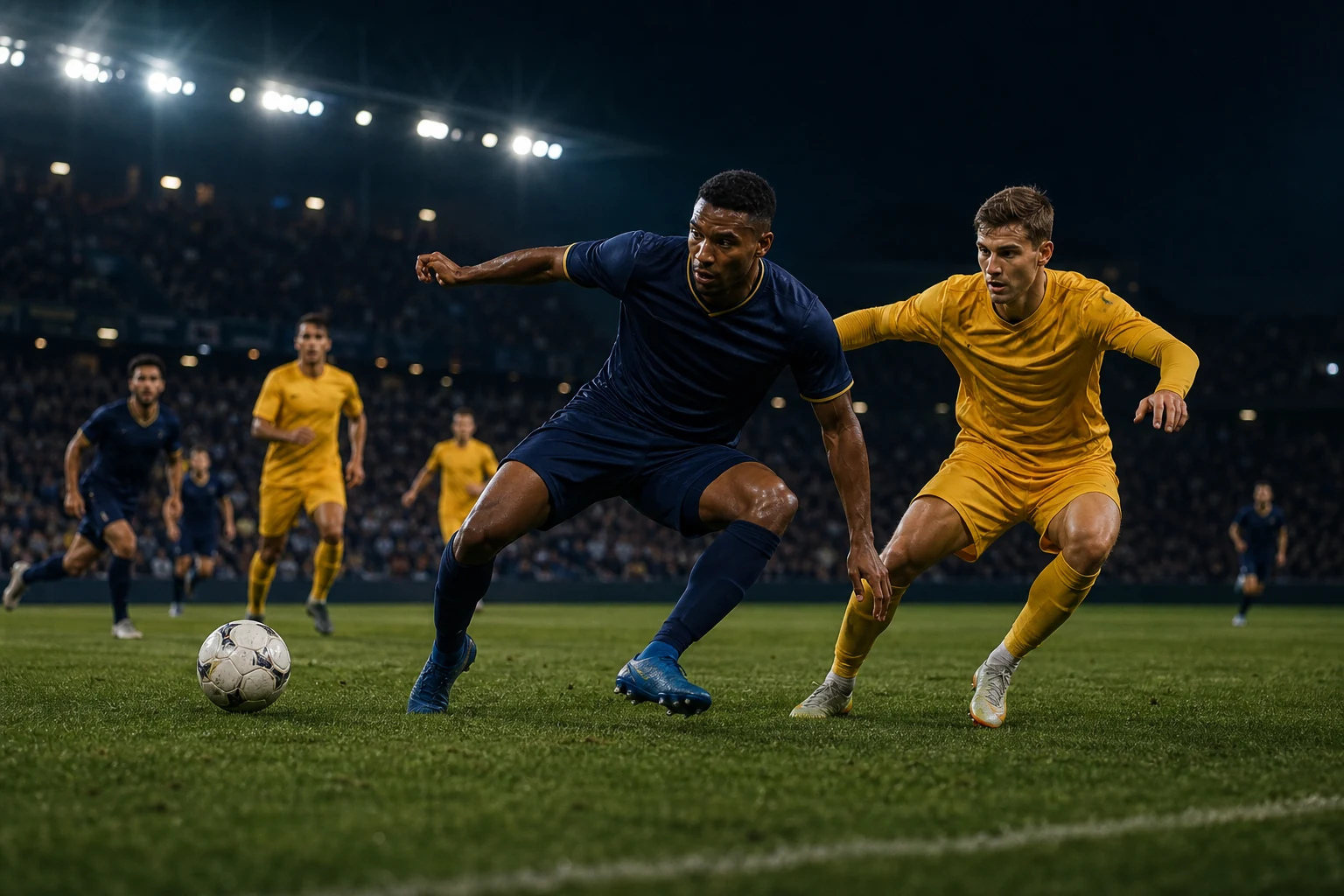
The game combines speed, information, opposition and consequence in the same action.
The ball that did not arrive cleanly
In the test, the athlete knew when to run, where to plant, and how many repetitions remained. In the match, the ball arrived bouncing, an opponent closed his dominant side, a teammate called for depth, and the score demanded urgency. Everything happened before any instruction could organise the scene.
He controlled the ball, protected it through contact, and accelerated. On the third step, he had to decelerate because the play changed. Then he ran again. The sequence lasted only seconds, but it combined speed, perception, decision, technique, contact, and consequence—elements the clinical assessment had separated in order to measure them.
That separation was necessary. Without it, it would be difficult to know which capacity needed rebuilding. The problem would arise if the return ended there, in an environment where the task waits for the athlete and almost nothing competes for his attention.
Preparation advanced when the restored capacities met real information again: limited time, unstable space, competing choices, and an outcome that mattered to the other ten players.
From the moment to the criterionMedical clearance confirms health status; the game asks whether those capacities remain available inside complexity.
A clinical assessment needs to be controlled to produce reliable information. Competition does the opposite: it superimposes stimuli, speeds up decisions and penalizes delays. There is no contradiction between the environments. There are different functions.
The error appears when performance in a controlled context is extrapolated to competitive chaos without a specific reconstruction step.
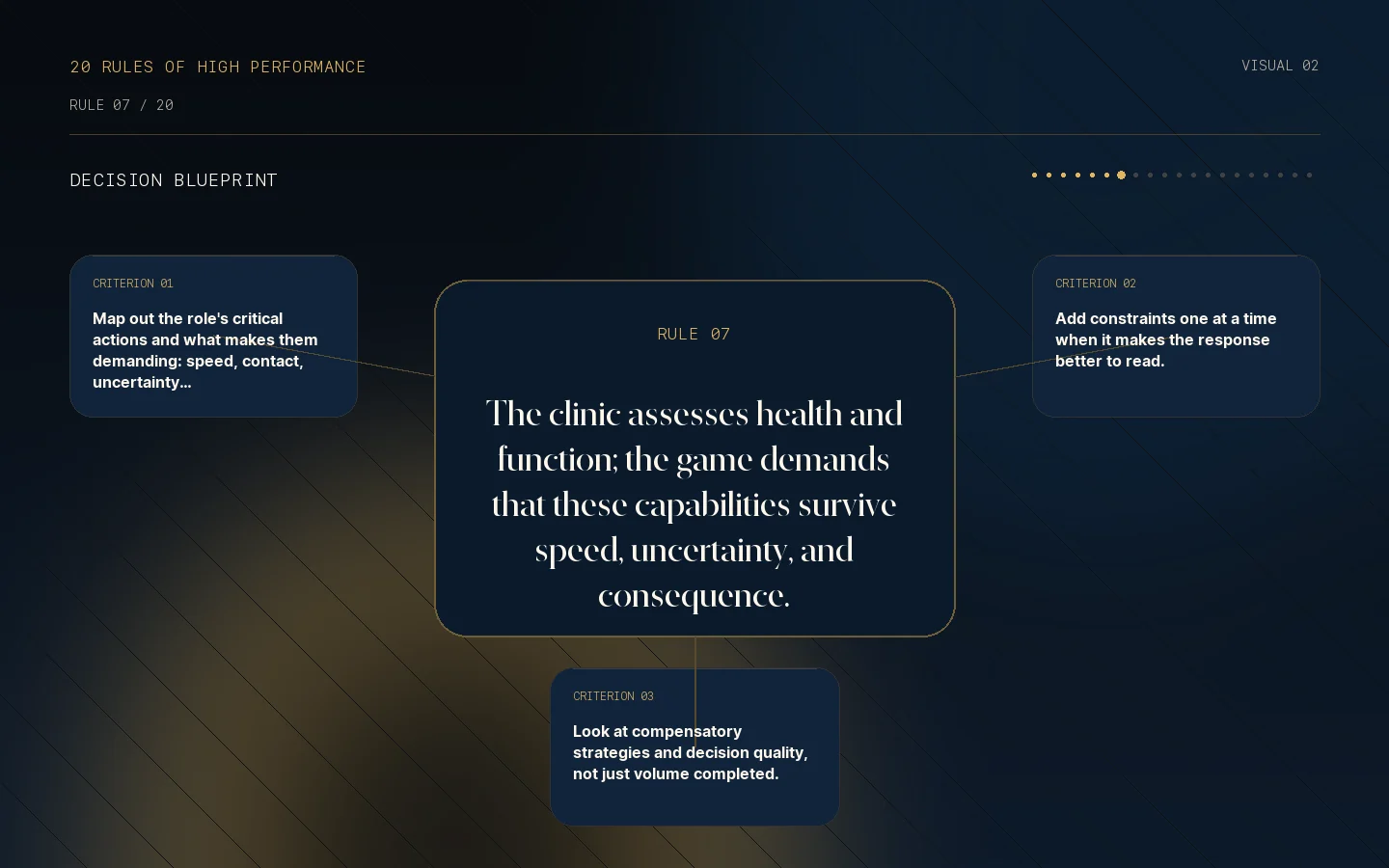
The clinic assesses health and function; the game demands that these capabilities survive speed, uncertainty, and consequence.
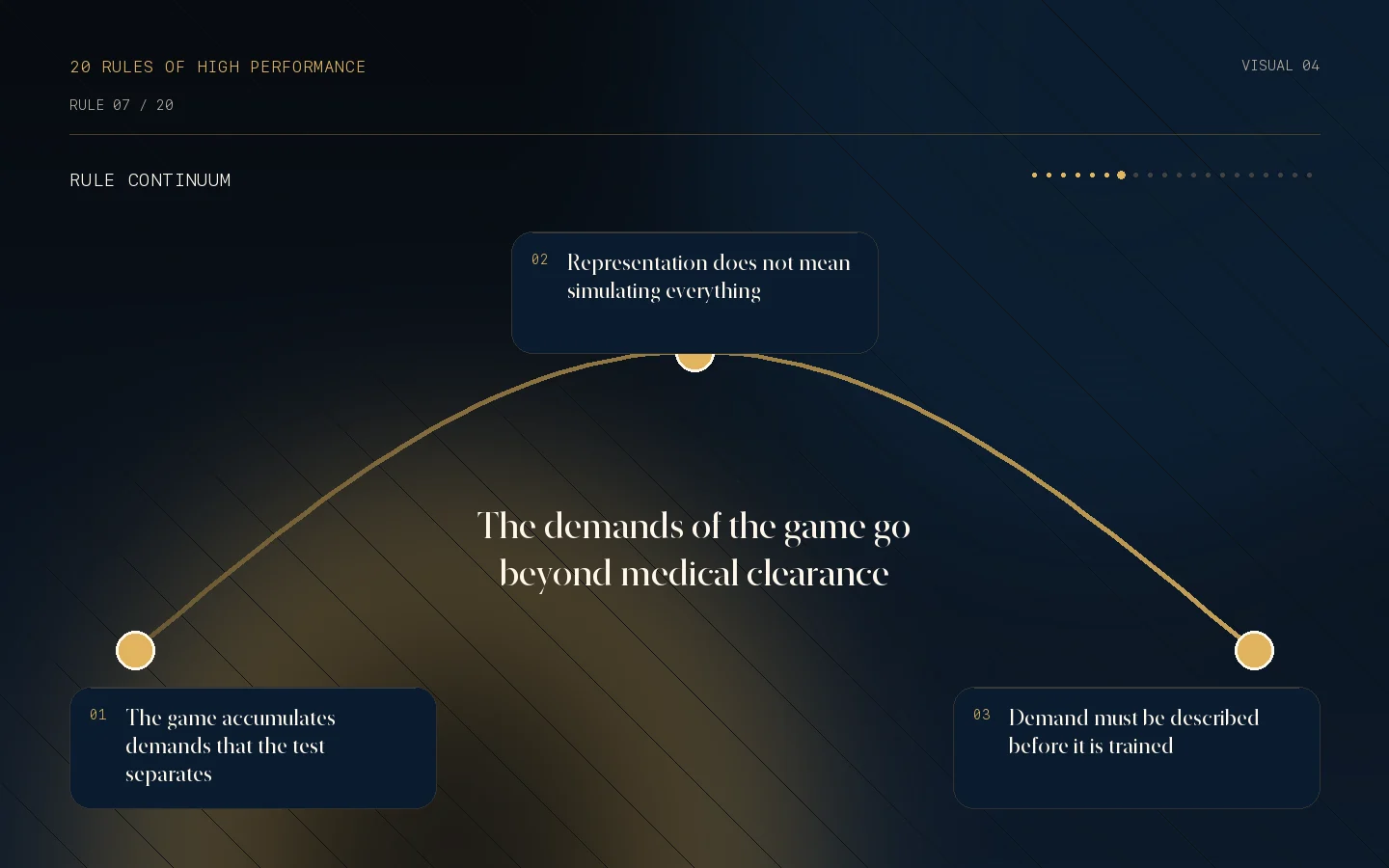
The game accumulates demands that the test separates
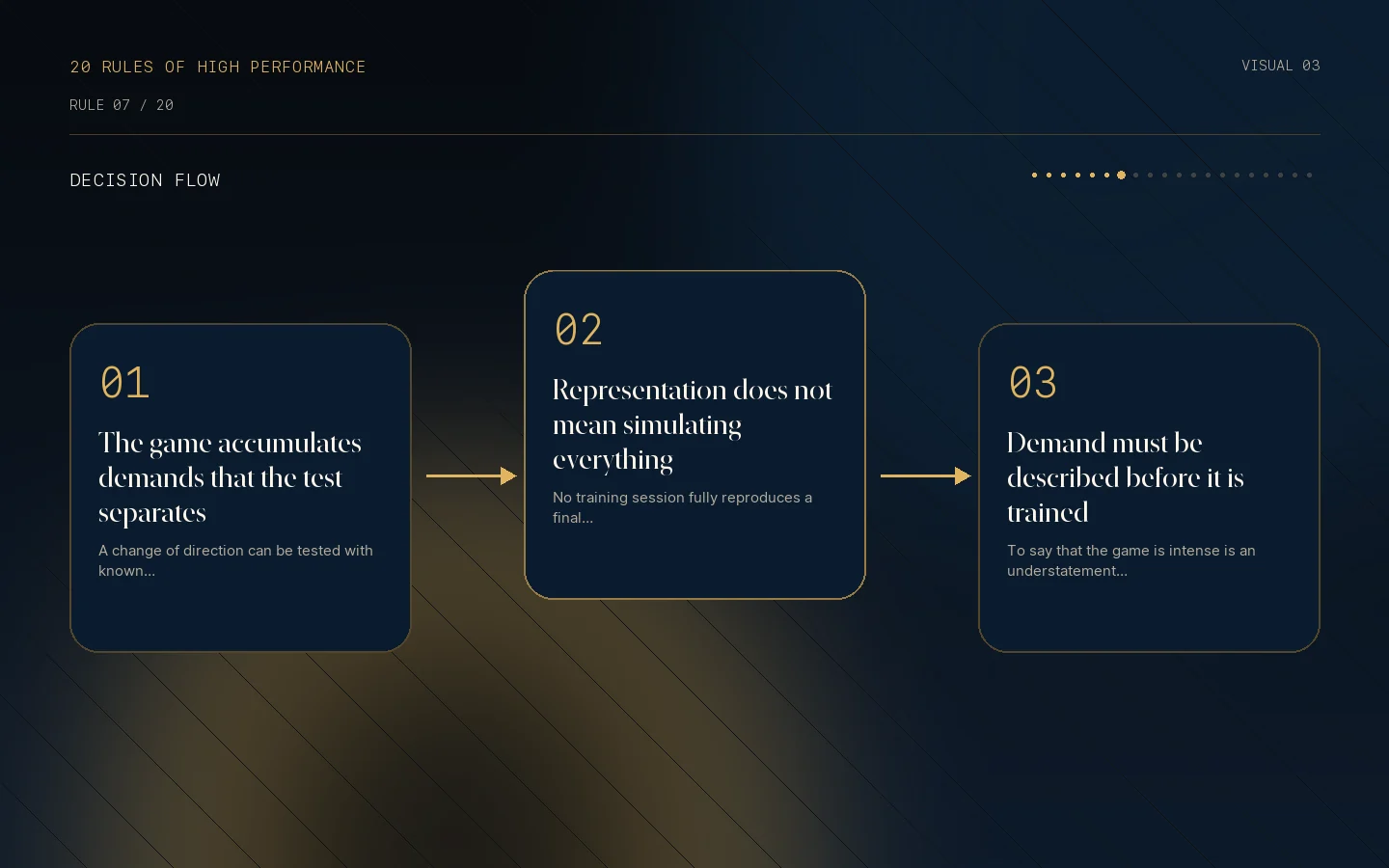
A change of direction can be tested with known trajectory, complete rest, and observed technique. In the game, it arises from the opponent's position, the speed of the ball, the available space, the score and the previous action. Physical capacity remains important, but it needs to be accessed at the right time.
The same goes for contact, jumping, landing and sprinting. Competition adds decisions, distractions and fatigue. This combination changes the tissue load and the athlete's behavior, even when the gesture looks like the test.
Therefore, readiness must progressively bring capacity and context closer together. Jumping well does not mean that the athlete competes well for an aerial ball; demonstrates that part of the problem is available.
The office can reduce variables. The game exists because they all come back at the same time.
No training session fully reproduces a final. Trying to copy all the variables too early eliminates control and increases noise. The progression must select the elements that most change the demand: speed, direction, opposition, contact, density, fatigue and consequence.
Representation does not mean simulating everything
No training session fully reproduces a final. Trying to copy all the variables too early eliminates control and increases noise. The progression must select the elements that most change the demand: speed, direction, opposition, contact, density, fatigue and consequence.
First, the team regains enough capacity to exhibit. Then, add information about the environment. Then uncertainty and repetition increase. The goal is to allow the athlete to learn how to regulate action again, not just perform a choreography.
The representative session also reveals protection strategies: shortening your stride, avoiding one side, arriving late at contact or always choosing the safest option. These signs may not appear in the laboratory.
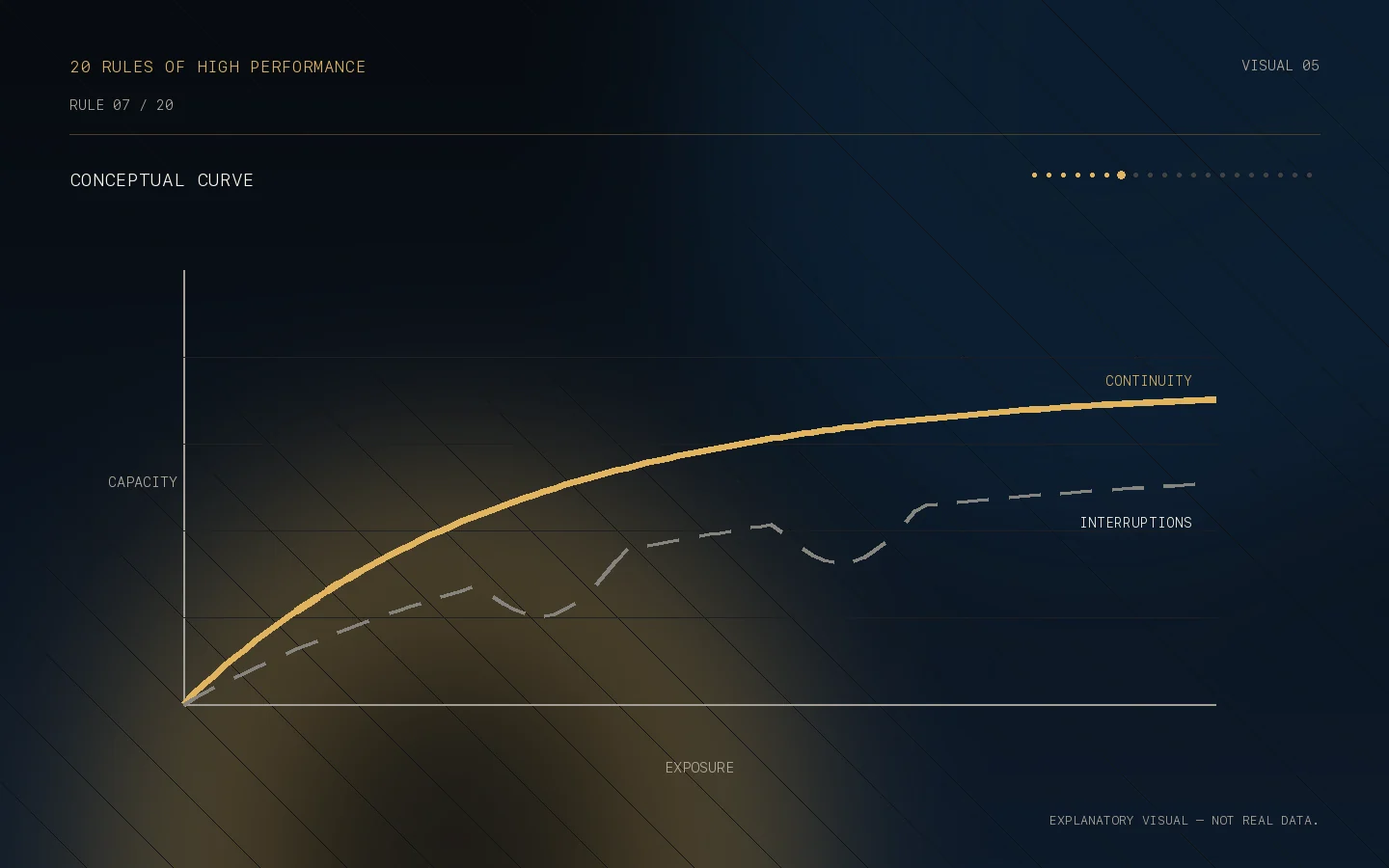
Explanatory visual — not real data.
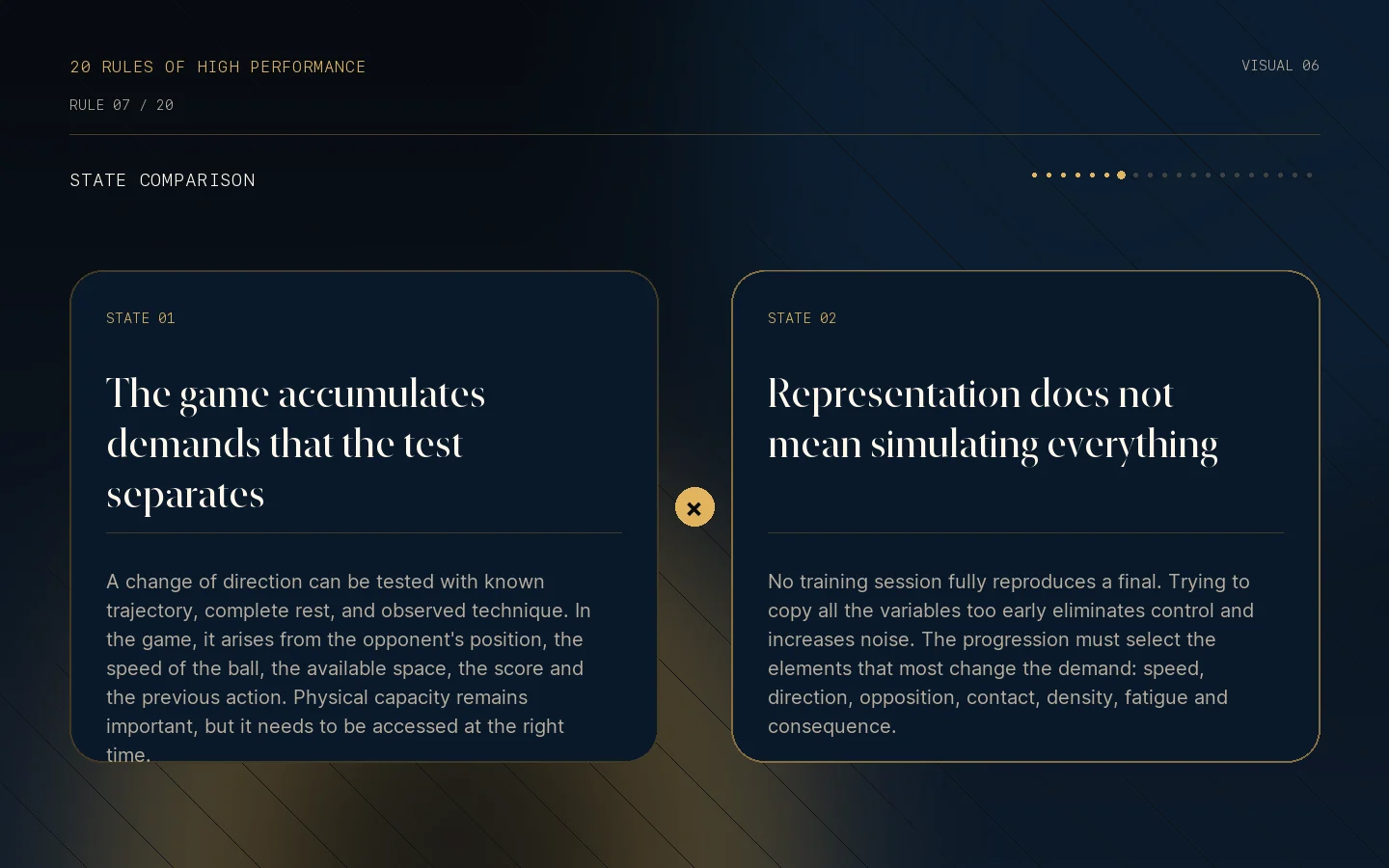
Representation does not mean simulating everything
Demand must be described before it is trained
To say that the game is intense is an understatement. The team needs to identify critical actions in the position, peaks in demand, duration of sequences, recovery between actions and scenarios that most expose the injured region.
The description does not need to become a rigid GPS goal. It must guide a set of exposures that prepare the athlete to recognize, execute and repeat what the game requires.
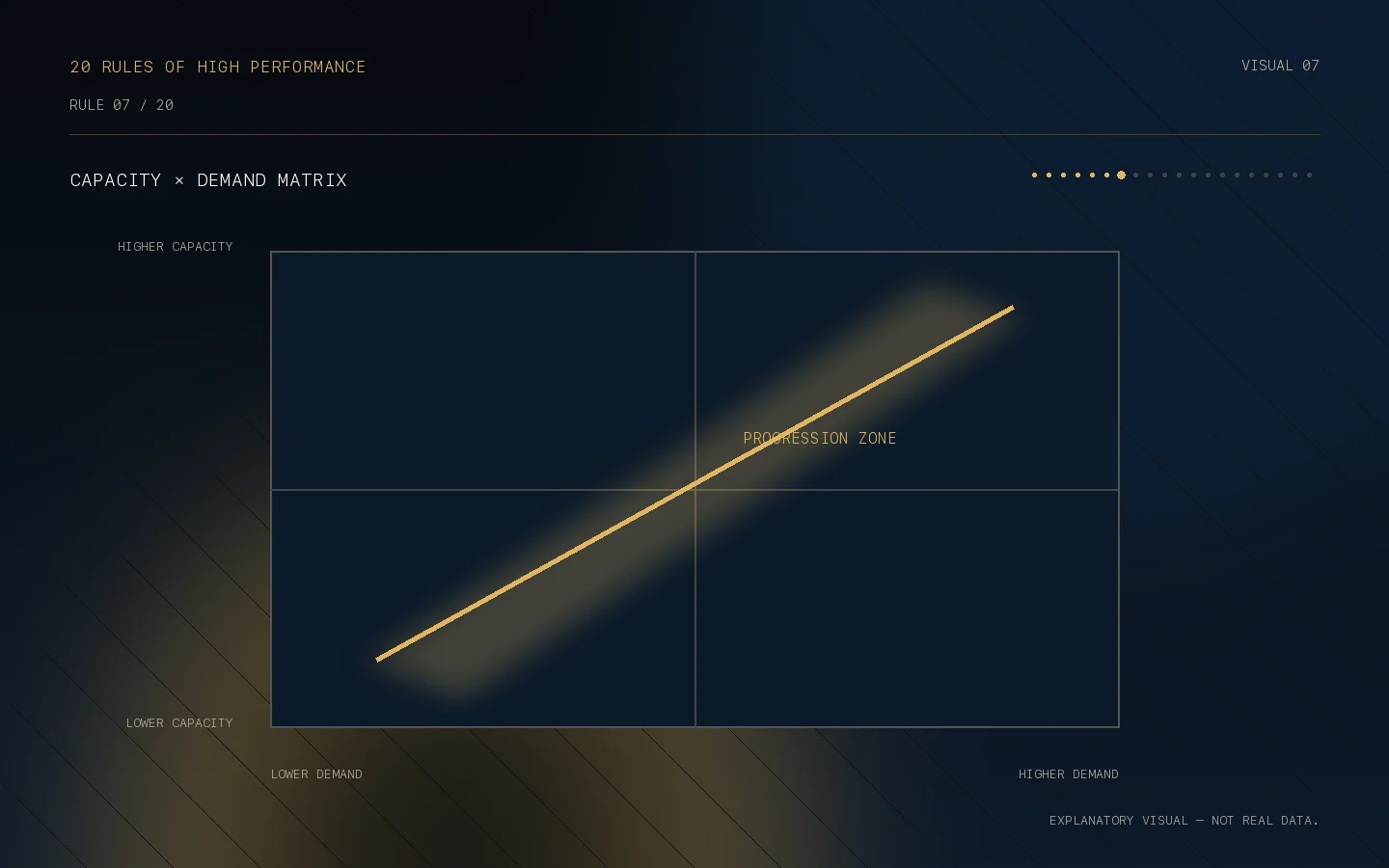
The clinic assesses health and function; the game demands that these capabilities survive speed, uncertainty, and consequence.
Testing reports capability under defined conditions. Specific training informs how this capacity is organized in the face of the real restrictions of the sport.
From capacity to the game
- Map out the role's critical actions and what makes them demanding: speed, contact, uncertainty, or repetition.
- Add constraints one at a time when it makes the response better to read.
- Look at compensatory strategies and decision quality, not just volume completed.
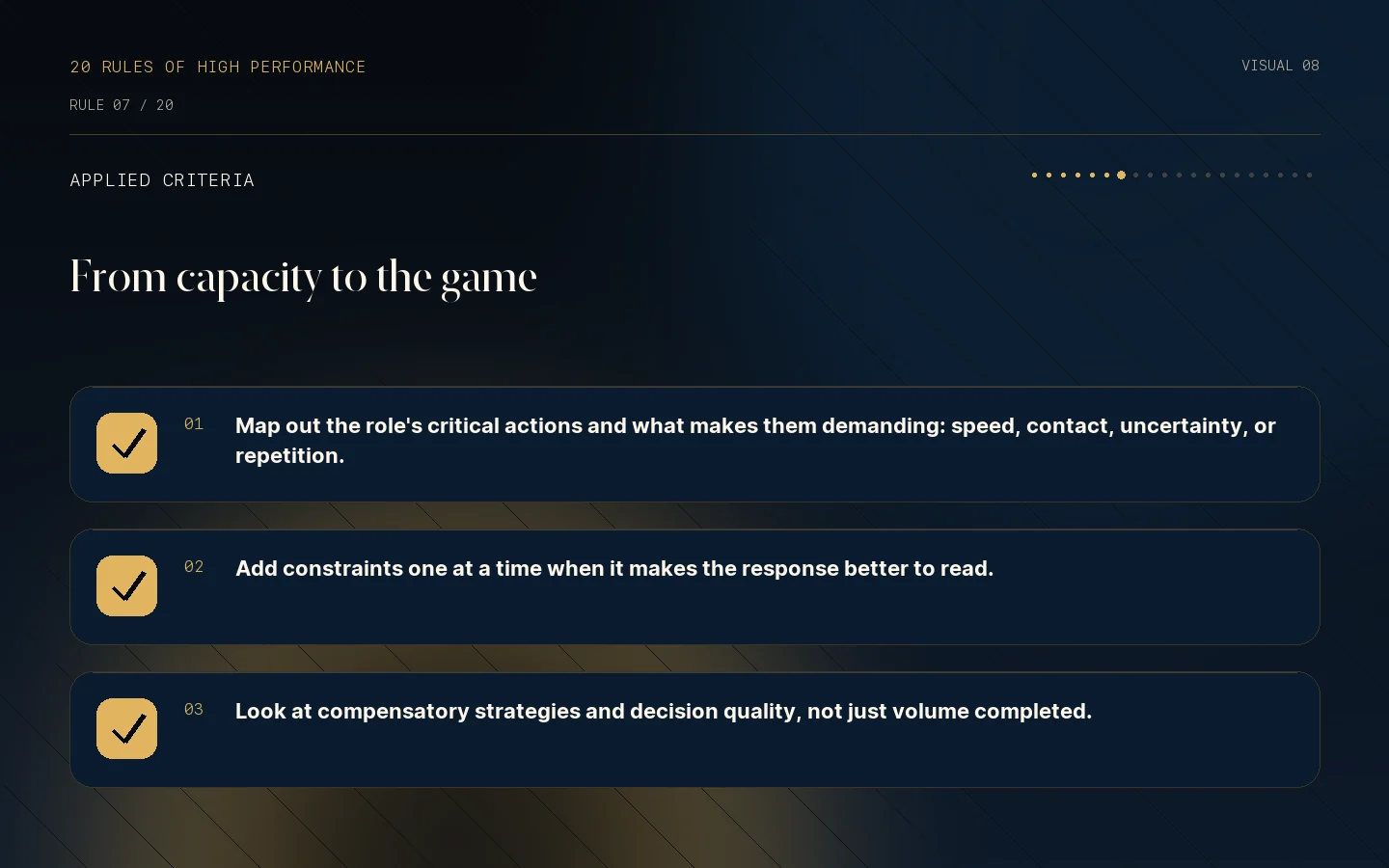
From capacity to the game
Medical clearance protects an essential transition. Specific training turns that possibility into competitive competence.
Respecting the difference between environments is respecting the science of both — and the athlete who needs to cross them.
The game does not ask if the test was passed. It asks whether capacity appears in chaos.